
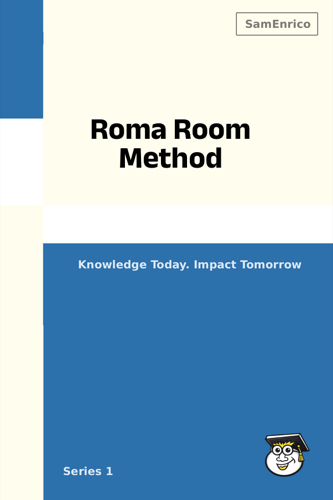
Non-FictionSelf-Help / Spatial
Roma Room Method Audiobook
undefined
by Neil Lucius
undefined
Formats
Free sample
Chapter 1: The Broken Compass--–- When was the last time you memorized something simply because you wanted to, not because you had to? Not a password, not a PIN, not a grocery list scribbled on your phone, but something meaningful—a poem, a speech, the layout of a neighborhood, the names of everyone at a dinner party? If you are like most people in the twenty-first century, the honest answer is: you cannot remember. And that, more than any other fact, reveals the quiet crisis at the heart of modern life.This is not a book about improving your test scores, though it will do that. It is not a book about remembering where you left your keys, though it will do that too.
This is a book about reclaiming a fundamental human ability that technology has stolen from you without your permission. The ability to hold the world inside your head, to navigate information with the same effortless grace that your ancestors used to navigate forests and coastlines, to carry the people and ideas you love with you wherever you go, no battery required.The ancient Greeks had a word for this kind of knowledge: topos, meaning place, from which we derive our word "topography." They understood something that modern neuroscience has only recently confirmed: that human memory is not a filing cabinet or a hard drive. It is a map. And like any map, its power depends entirely on the richness of the territory it describes.This chapter is the foundation upon which everything else in this book will be built. Before you learn how to build a Roma Room, you must understand why your memory has become unreliable, how your brain was designed to remember, and why a technique invented over two thousand years ago is more relevant today than ever before.
By the end of this chapter, you will have not only the motivation but the scientific and historical context to commit to the practice ahead. You will understand that your memory is not broken—it is merely untrained.The Myth of the Bad Memory Let us begin with a confession. I have heard the following sentence thousands of times, from students, executives, retirees, and even professional educators: "I just have a bad memory." It is always said with a tone of resignation, as though memory were a fixed trait like eye color or height. Some people win…
This is the end of the free sample. Get the Audiobook to keep going. Buy now
About this book
Details
- Author
- Neil Lucius
- Publisher
- SamEnrico
- Language
- English
- Genre
- Non-Fiction, Self-Help / Spatial
- Released
- 2026-06-07
- Pages (approx.)
- 124
- Available as
- eBook, Audiobook

Listen in the VoxFlicks app
Audiobooks and audio dramas wherever you go. Sign in with your SamEnrico account and press play.
More by Neil Lucius
 Caregiver Stress Partner GuideNeil Lucius$11.99
 Breathwork for Deep SleepNeil Lucius$11.99
 Meditation for Nighttime RuminationNeil Lucius$11.99
 Grade Pressure Release PlanNeil Lucius$11.99
 Peg System for Mental MathNeil Lucius$11.99
 Rocky Mountain Elk MeadowNeil Lucius$11.99
 Loving Kindness For Direct ReportsNeil Lucius$11.99
 The Last Lap: The Untold Story of Cathy Freeman's 2000 Sydney GoldNeil Lucius$11.99
 The Vanishing of the D.B. Cooper Heist: A Sky High MysteryNeil Lucius$11.99
 The Last Dance: Jordan’s Mind PalaceNeil Lucius$11.99
 The Mineral Guide to CobaltiteNeil Lucius$11.99
 Growing DuvaliaNeil Lucius$11.99
You may also like
 Hong Kong Handover 1997Dunn Johnnie$11.99
 Zumba For Postnatal Recovery CourseNeal Christian$11.99
 Zumba for BeginnersLadner Nikia$11.99
 YouTube Comment Mining GuideHumes Pandora$12.99
 Worry Box MeditationCarlin Rudy$11.99
 Workplace Stress MeditationNguyen Lynn$11.99
 Workplace Stress and Sleep RepairHawley Ivory$11.99
 Workplace Perfectionism CureDelaney Jeffry$11.99
 Workplace Injustice Anger GuideWallen Isabelle$11.99
 Work Addiction and Burnout LinkGreenwood Ester$11.99
 Women in Yoga and WellnessBeattie Galina$11.99
 Women in Stand Up ComedyChun Evangeline$11.99