

Growing Duvalia
This publication, published by SamEnrico, covers G
by Neil Lucius
This publication, published by SamEnrico, covers Growing Duvalia
Formats
About this book
Free sample
Chapter 1: The Alien Among Us...--–- The first time I saw a Duvalia in bloom, I thought someone had glued a starfish to a cactus and sprayed it with cheap perfume—if cheap perfume smelled like a carcass left on a summer sidewalk. It was repulsive, mesmerizing, and absolutely unforgettable. I was standing in a cramped greenhouse in Tucson, Arizona, surrounded by thousands of succulents that all seemed to follow predictable rules: round, spiky, green, patient. Then I turned a corner and found a cluster of low, sprawling stems that looked like they had been carved from weathered jade. And from their center rose a flower that defied everything I thought I knew about plants.
Dark purple, almost black, covered in fine hairs that shimmered as if alive, and radiating an odor that made me step back two feet before leaning in again for another look. That was my introduction to Duvalia elegans, the "Black Star" of the Stapeliad family. It was love at first stench.What Exactly Is a Duvalia?Before we go any further, let me save you from the confusion I experienced during my first year of growing these plants. Duvalia is not a cactus. It is not a typical succulent.
And it is certainly not a houseplant that will forgive you for treating it like a fern. Duvalia is a genus of flowering succulents belonging to the family Apocynaceae, specifically the subfamily Asclepiadoideae—the milkweed group. That means Duvalia is a distant cousin of the common milkweed you might find in a North American meadow, but evolution took this lineage on a wild detour through the driest deserts of Africa and Arabia.The genus was first described in 1812 by the French botanist Henri-Auguste Duval, who probably had no idea that his name would become synonymous with one of the strangest plant groups on Earth. Today, depending on which taxonomist you ask, there are between 20 and 25 recognized species of Duvalia. They range from the mat-forming D.
caespitosa of South Africa to the heat-loving D. sulcata of the Arabian Peninsula. What unites them all is a set…
This is the end of the free sample. Get the eBook to keep going. Buy now
Contents
- Chapter 1
- Chapter 2
- Chapter 3
- Chapter 4
- Chapter 5
- Chapter 6
- Chapter 7
- Chapter 8
- Chapter 9
- Chapter 10
- Chapter 11
- Chapter 12
Details
- Author
- Neil Lucius
- Publisher
- SamEnrico
- Language
- English
- Genre
- Non-Fiction, Informative, Educational
- Released
- 2026-06-02
- Pages (approx.)
- 138
- Available as
- eBook, Audiobook

Read better in the ZLOADR app
Your eBooks on your phone or tablet. Sign in with your SamEnrico account and start reading.
More by Neil Lucius
 Caregiver Stress Partner GuideNeil Lucius$11.99
 Breathwork for Deep SleepNeil Lucius$11.99
 Meditation for Nighttime RuminationNeil Lucius$11.99
 Grade Pressure Release PlanNeil Lucius$11.99
 Peg System for Mental MathNeil Lucius$11.99
 Roma Room MethodNeil Lucius$11.99
 Rocky Mountain Elk MeadowNeil Lucius$11.99
 Loving Kindness For Direct ReportsNeil Lucius$11.99
 The Last Lap: The Untold Story of Cathy Freeman's 2000 Sydney GoldNeil Lucius$11.99
 The Vanishing of the D.B. Cooper Heist: A Sky High MysteryNeil Lucius$11.99
 The Last Dance: Jordan’s Mind PalaceNeil Lucius$11.99
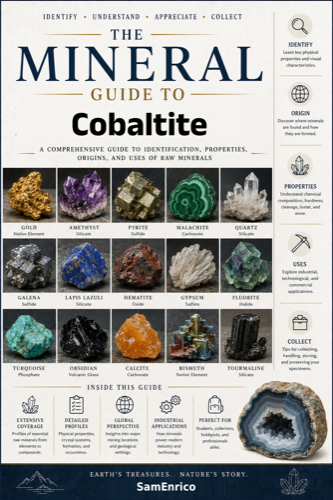 The Mineral Guide to CobaltiteNeil Lucius$11.99