
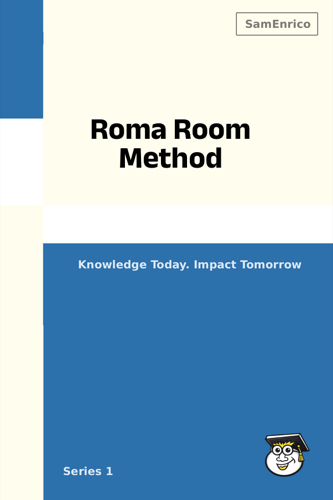
Free sample
Chapter 1: The Broken Compass--–- When was the last time you memorized something simply because you wanted to, not because you had to? Not a password, not a PIN, not a grocery list scribbled on your phone, but something meaningful—a poem, a speech, the layout of a neighborhood, the names of everyone at a dinner party? If you are like most people in the twenty-first century, the honest answer is: you cannot remember. And that, more than any other fact, reveals the quiet crisis at the heart of modern life.This is not a book about improving your test scores, though it will do that. It is not a book about remembering where you left your keys, though it will do that too.
This is a book about reclaiming a fundamental human ability that technology has stolen from you without your permission. The ability to hold the world inside your head, to navigate information with the same effortless grace that your ancestors used to navigate forests and coastlines, to carry the people and ideas you love with you wherever you go, no battery required.The ancient Greeks had a word for this kind of knowledge: topos, meaning place, from which we derive our word "topography." They understood something that modern neuroscience has only recently confirmed: that human memory is not a filing cabinet or a hard drive. It is a map. And like any map, its power depends entirely on the richness of the territory it describes.This chapter is the foundation upon which everything else in this book will be built. Before you learn how to build a Roma Room, you must understand why your memory has become unreliable, how your brain was designed to remember, and why a technique invented over two thousand years ago is more relevant today than ever before.
By the end of this chapter, you will have not only the motivation but the scientific and historical context to commit to the practice ahead. You will understand that your memory is not broken—it is merely untrained.The Myth of the Bad Memory Let us begin with a confession. I have heard the following sentence thousands of times, from students, executives, retirees, and even professional educators: "I just have a bad memory." It is always said with a tone of resignation, as though memory were a fixed trait like eye color or height. Some people win the genetic lottery and remember everything; the rest of us must struggle with leaky, unreliable minds.This is a lie. And it is a dangerous lie because it becomes a self-fulfilling prophecy.The scientific consensus, based on decades of research in cognitive psychology and neuroscience, is unambiguous: there is no such thing as a "bad memory" in a healthy human brain.
There are only untrained memories, underused memories, and memories that have been outsourced to external devices until they have atrophied from neglect. The difference between someone who can memorize a deck of cards in sixty seconds and someone who cannot remember a five-item shopping list is not biology. It is technique.Consider the case of Solomon Shereshevsky, a Russian journalist in the 1920s who could recall long strings of numbers, nonsense syllables, and entire speeches years after hearing them just once. His editor noticed that Shereshevsky never took notes at editorial meetings, yet he could reproduce every word spoken. When psychologists tested him, they discovered that he had not been born with a "superior" memory.
Rather, he had unconsciously developed a technique: he visualized everything he heard as images placed along a mental pathway, a street he had walked many times as a child. Shereshevsky was not a genetic anomaly. He was an untutored genius of a method that anyone can learn.More recently, the neuroscientist Eleanor Maguire at University College London studied memory champions—people who compete in events like the World Memory Championships, memorizing the order of ten shuffled decks of cards or hundreds of random digits. Her findings shocked the scientific community. When she scanned the brains of these champions, she found no difference in overall brain structure compared to average people.
There was no "memory lobe" that was larger or more active. The only difference was in which regions the champions used during memorization: they consistently activated the same neural circuits that are responsible for spatial navigation and visual imagery. In other words, memory champions had not been born with better brains. They had learned to use their brains differently.The implication is profound. Your memory is not a fixed capacity.
It is a skill. And like any skill—playing the piano, speaking a foreign language, hitting a golf ball—it improves dramatically with the right instruction and consistent practice. The only reason you believe you have a "bad memory" is because no one ever taught you how to use it.The Digital Atrophy Epidemic If memory is a skill that can be trained, then it is also a skill that can be lost. And we are losing it faster than at any point in human history.Let me ask you a question. Before smartphones, how did you remember a friend's phone number?
You repeated it to yourself. You wrote it on your hand. You stored it in the dedicated "phone numbers" section of your brain, which, like any muscle, grew stronger with use. Today, how many phone numbers do you know by heart? For most people under forty, the answer is three or fewer: their own, a parent's, maybe a partner's.
Everything else lives in the device.This is not a moral failing. It is an economic one. Your brain operates on a simple principle: use it or lose it. Neural pathways that are frequently activated become stronger, faster, and more efficient. Pathways that are neglected are pruned away—a process called synaptic pruning, which is as natural and necessary as weeding a garden.
When you outsource a memory to your phone, you are telling your brain: this information is not important enough to keep. And your brain obliges.But the damage goes deeper than forgotten phone numbers. Research from the University of California, Los Angeles, has shown that heavy reliance on digital memory tools changes not just what we remember but how we remember. Subjects who were told that a piece of information would be saved on a computer showed significantly worse recall of that information than subjects who believed it would be deleted. More troubling, they also showed worse recall of related, unsaved information.
The mere presence of an external memory device creates what psychologists call "cognitive offloading"—a subconscious decision to stop trying.The philosopher Andy Clark has called this the "extended mind" hypothesis: that our tools become part of our cognitive system. A smartphone is not just a device that stores information; it is a prosthetic memory. And like any prosthetic, it is both a blessing and a curse. For someone who has lost a leg, a prosthetic restores mobility. For someone with two healthy legs, using a prosthetic would cause their real legs to atrophy.
We are walking around with perfectly good biological memories, using prosthetics anyway, and wondering why we cannot walk on our own.The irony…
This is the end of the free sample. Get the eBook to keep going. Buy now
About this book
Details
- Author
- Neil Lucius
- Publisher
- SamEnrico
- Language
- English
- Genre
- Non-Fiction, Self-Help / Spatial
- Released
- 2026-06-07
- Pages (approx.)
- 124
- Available as
- eBook, Audiobook

Read better in the ZLOADR app
Your eBooks on your phone or tablet. Sign in with your SamEnrico account and start reading.
More by Neil Lucius
 Caregiver Stress Partner GuideNeil Lucius$11.99
 Breathwork for Deep SleepNeil Lucius$11.99
 Meditation for Nighttime RuminationNeil Lucius$11.99
 Grade Pressure Release PlanNeil Lucius$11.99
 Peg System for Mental MathNeil Lucius$11.99
 Rocky Mountain Elk MeadowNeil Lucius$11.99
 Loving Kindness For Direct ReportsNeil Lucius$11.99
 The Last Lap: The Untold Story of Cathy Freeman's 2000 Sydney GoldNeil Lucius$11.99
 The Vanishing of the D.B. Cooper Heist: A Sky High MysteryNeil Lucius$11.99
 The Last Dance: Jordan’s Mind PalaceNeil Lucius$11.99
 The Mineral Guide to CobaltiteNeil Lucius$11.99
 Growing DuvaliaNeil Lucius$11.99