
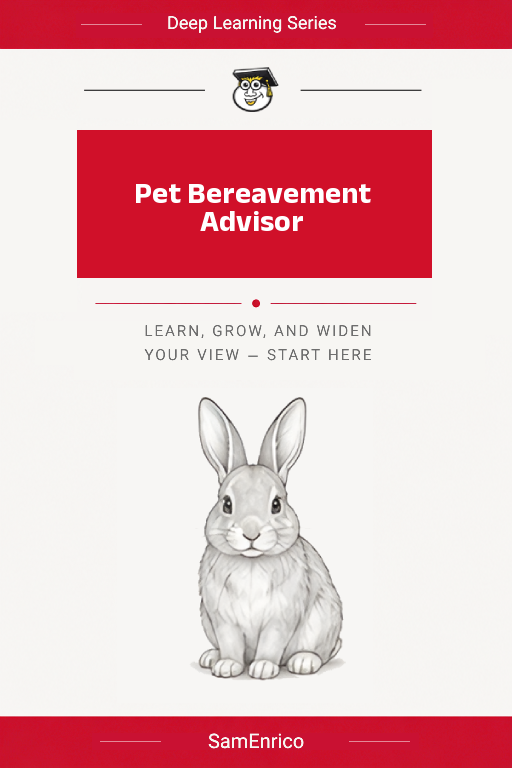
Pet Bereavement Advisor Audiobook
Include a veterinary grief counselor temporarily a
by Sam Reyna
Include a veterinary grief counselor temporarily after losing an emotional support animal, recognizing pet loss as significant mental health trauma.
Formats
Free sample
Chapter 1: The Medical Fact...--–- The first time Sarah called me, she couldn't stop crying long enough to say her dog's name. Ten minutes into the call, she finally choked out: "Bailey was my medication. Not like a metaphor. My actual medication. I have panic disorder.
Bailey would put his head on my chest during an attack and my heart rate would drop twenty points. Now he's gone, and I can't breathe, and my psychiatrist said 'get another dog' like I'm returning a defective prescription." Sarah was not being dramatic. She was being accurate. And her psychiatrist, despite good intentions, had fundamentally misunderstood the difference between a pet and an Emotional Support Animal.This book is written for veterinary grief counselors, mental health professionals, and social workers who will sit across from hundreds of Sarahs in their careers. Before we can treat the trauma of ESA loss, we must first understand what was actually lost.
This chapter provides the biological and clinical foundation for everything that follows. If you skip this chapter, the interventions in later chapters (attachment theory, somatic experiencing, cognitive restructuring for guilt) will lack their necessary grounding. The bond between an ESA and their owner is not sentimental. It is not metaphorical. It is a medical fact, measurable in blood chemistry, neural pathways, and physiological regulation.The Physiology of the Bond: What the Blood Reveals When a client tells you that their ESA "calms them down," they are describing a real biological cascade that has been measured in dozens of peer-reviewed studies.
The human-animal bond operates through at least four distinct physiological mechanisms, all of which are disrupted at the moment of loss.Oxytocin: The Bonding Hormone Oxytocin is a neuropeptide produced in the hypothalamus and released by the posterior pituitary gland. It is often called the "love hormone," but that nickname undersells its clinical significance. Oxytocin reduces anxiety, lowers cortisol, decreases blood pressure, and increases pain tolerance. It also promotes social bonding and trust. When a person interacts with a dog or cat they are attached to—petting, gazing, speaking softly—oxytocin levels rise in both the human and the animal.
This is not a small effect. Studies have shown that a fifteen-minute interaction with a familiar dog can increase plasma oxytocin by nearly 50 percent. For an ESA owner with social anxiety or PTSD, that oxytocin surge is the difference between being able to…
This is the end of the free sample. Get the Audiobook to keep going. Buy now
About this book
Details
- Author
- Sam Reyna
- Publisher
- SamEnrico
- Language
- English
- Genre
- Non-Fiction, Mental Wealth
- Released
- 2026-06-01
- Pages (approx.)
- 158
- Available as
- eBook, Audiobook

Listen in the VoxFlicks app
Audiobooks and audio dramas wherever you go. Sign in with your SamEnrico account and press play.
More by Sam Reyna
 The Anger and Jealousy GuideSam Reyna$11.99
 Self Talk for Money MindsetSam Reyna$11.99
 Conversation Starters for Voting LinesSam Reyna$11.99
 Postpartum Body Image GuideSam Reyna$11.99
 The Loss Acceptance WorkbookSam Reyna$11.99
 Leaving A Religious CommunitySam Reyna$11.99
 Titanic Rivet Failure AnalysisSam Reyna$11.99
 Shy Bladder SyndromeSam Reyna$11.99
 The Boardroom of the Gods: When Myths Made DealsSam Reyna$11.99
 Excalibur's Whisper: The Forgotten Knight of the Round TableSam Reyna$11.99
 How to Produce Hockey Stick ShaftsSam Reyna$11.99
 Mastering The Art of World War II CombativesSam Reyna$11.99
You may also like
 Hong Kong Handover 1997Dunn Johnnie$11.99
 Zumba For Postnatal Recovery CourseNeal Christian$11.99
 Zumba for BeginnersLadner Nikia$11.99
 YouTube Comment Mining GuideHumes Pandora$12.99
 Worry Box MeditationCarlin Rudy$11.99
 Workplace Stress MeditationNguyen Lynn$11.99
 Workplace Stress and Sleep RepairHawley Ivory$11.99
 Workplace Perfectionism CureDelaney Jeffry$11.99
 Workplace Injustice Anger GuideWallen Isabelle$11.99
 Work Addiction and Burnout LinkGreenwood Ester$11.99
 Women in Yoga and WellnessBeattie Galina$11.99
 Women in Stand Up ComedyChun Evangeline$11.99