
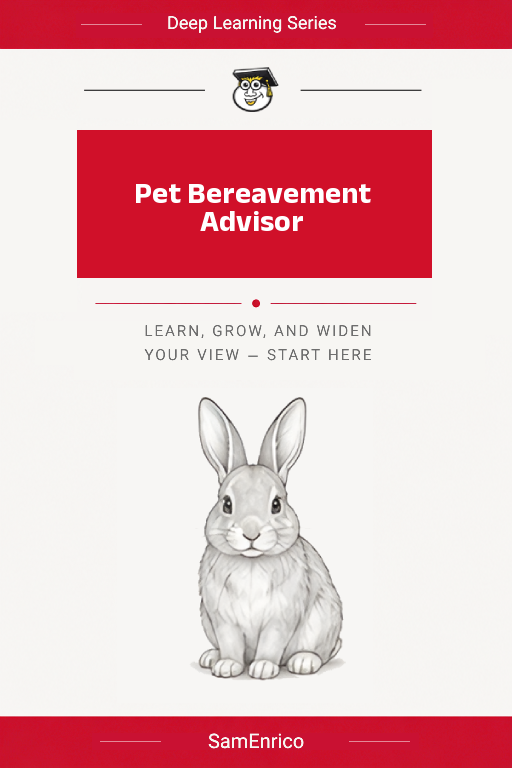
Pet Bereavement Advisor
Include a veterinary grief counselor temporarily a
by Sam Reyna
Include a veterinary grief counselor temporarily after losing an emotional support animal, recognizing pet loss as significant mental health trauma.
Formats
About this book
Free sample
Chapter 1: The Medical Fact...--–- The first time Sarah called me, she couldn't stop crying long enough to say her dog's name. Ten minutes into the call, she finally choked out: "Bailey was my medication. Not like a metaphor. My actual medication. I have panic disorder.
Bailey would put his head on my chest during an attack and my heart rate would drop twenty points. Now he's gone, and I can't breathe, and my psychiatrist said 'get another dog' like I'm returning a defective prescription." Sarah was not being dramatic. She was being accurate. And her psychiatrist, despite good intentions, had fundamentally misunderstood the difference between a pet and an Emotional Support Animal.This book is written for veterinary grief counselors, mental health professionals, and social workers who will sit across from hundreds of Sarahs in their careers. Before we can treat the trauma of ESA loss, we must first understand what was actually lost.
This chapter provides the biological and clinical foundation for everything that follows. If you skip this chapter, the interventions in later chapters (attachment theory, somatic experiencing, cognitive restructuring for guilt) will lack their necessary grounding. The bond between an ESA and their owner is not sentimental. It is not metaphorical. It is a medical fact, measurable in blood chemistry, neural pathways, and physiological regulation.The Physiology of the Bond: What the Blood Reveals When a client tells you that their ESA "calms them down," they are describing a real biological cascade that has been measured in dozens of peer-reviewed studies.
The human-animal bond operates through at least four distinct physiological mechanisms, all of which are disrupted at the moment of loss.Oxytocin: The Bonding Hormone Oxytocin is a neuropeptide produced in the hypothalamus and released by the posterior pituitary gland. It is often called the "love hormone," but that nickname undersells its clinical significance. Oxytocin reduces anxiety, lowers cortisol, decreases blood pressure, and increases pain tolerance. It also promotes social bonding and trust. When a person interacts with a dog or cat they are attached to—petting, gazing, speaking softly—oxytocin levels rise in both the human…
This is the end of the free sample. Get the eBook to keep going. Buy now
Contents
- Chapter 1
- Chapter 2
- Chapter 3
- Chapter 4
- Chapter 5
- Chapter 6
- Chapter 7
- Chapter 8
- Chapter 9
- Chapter 10
- Chapter 11
- Chapter 12
Details
- Author
- Sam Reyna
- Publisher
- SamEnrico
- Language
- English
- Genre
- Non-Fiction, Mental Wealth
- Released
- 2026-06-01
- Pages (approx.)
- 158
- Available as
- eBook, Audiobook

Read better in the ZLOADR app
Your eBooks on your phone or tablet. Sign in with your SamEnrico account and start reading.
More by Sam Reyna
 The Anger and Jealousy GuideSam Reyna$11.99
 Self Talk for Money MindsetSam Reyna$11.99
 Conversation Starters for Voting LinesSam Reyna$11.99
 Postpartum Body Image GuideSam Reyna$11.99
 The Loss Acceptance WorkbookSam Reyna$11.99
 Leaving A Religious CommunitySam Reyna$11.99
 Titanic Rivet Failure AnalysisSam Reyna$11.99
 Shy Bladder SyndromeSam Reyna$11.99
 The Boardroom of the Gods: When Myths Made DealsSam Reyna$11.99
 Excalibur's Whisper: The Forgotten Knight of the Round TableSam Reyna$11.99
 How to Produce Hockey Stick ShaftsSam Reyna$11.99
 Mastering The Art of World War II CombativesSam Reyna$11.99
You may also like
 Student Mental Health Board GuideBerg Meghann$12.99
 High Achiever Mental Health BoardRosas Synthia$12.99
 Technology Addiction AdvisorRoby Shakita$12.99
 Peer Support Group IntegrationDuffy Renay$12.99
 Exercise Mental Health AdvisorBurnett Dewayne$12.99
 Disclosing Depression To InvestorsBadger Kazuko$12.99
 Yawn Stretch RegulationRomano Berna$12.99
 Wrist Flexion ReleaseBusch Kandace$12.99
 Workplace Mental Health AllyValentine Meta$12.99
 Workplace Mental Health AdvisorAshcraft Johnie$12.99
 Wealthy Upbringing Guilt GuideXiong Deeanna$12.99
 Vacation Planning For Burnt FoundersGonzales Hope$12.99