
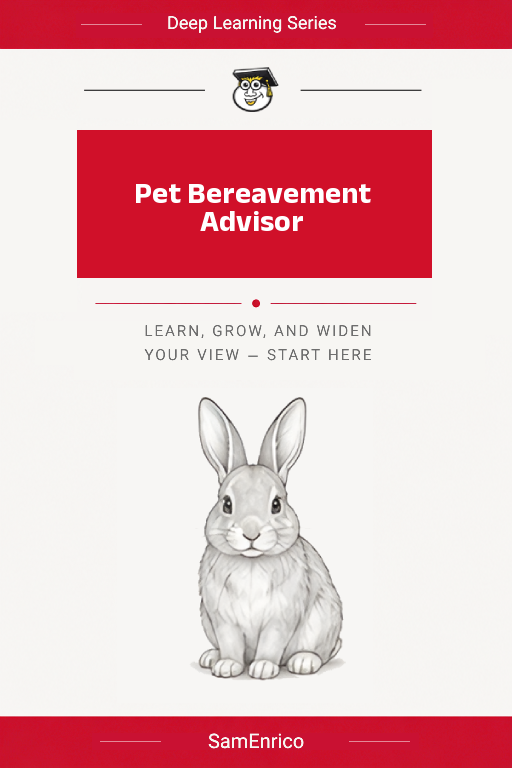
Pet Bereavement Advisor eBook
Include a veterinary grief counselor temporarily a
by Sam Reyna
Include a veterinary grief counselor temporarily after losing an emotional support animal, recognizing pet loss as significant mental health trauma.
Formats
Free sample
Chapter 1: The Medical Fact...--–- The first time Sarah called me, she couldn't stop crying long enough to say her dog's name. Ten minutes into the call, she finally choked out: "Bailey was my medication. Not like a metaphor. My actual medication. I have panic disorder.
Bailey would put his head on my chest during an attack and my heart rate would drop twenty points. Now he's gone, and I can't breathe, and my psychiatrist said 'get another dog' like I'm returning a defective prescription." Sarah was not being dramatic. She was being accurate. And her psychiatrist, despite good intentions, had fundamentally misunderstood the difference between a pet and an Emotional Support Animal.This book is written for veterinary grief counselors, mental health professionals, and social workers who will sit across from hundreds of Sarahs in their careers. Before we can treat the trauma of ESA loss, we must first understand what was actually lost.
This chapter provides the biological and clinical foundation for everything that follows. If you skip this chapter, the interventions in later chapters (attachment theory, somatic experiencing, cognitive restructuring for guilt) will lack their necessary grounding. The bond between an ESA and their owner is not sentimental. It is not metaphorical. It is a medical fact, measurable in blood chemistry, neural pathways, and physiological regulation.The Physiology of the Bond: What the Blood Reveals When a client tells you that their ESA "calms them down," they are describing a real biological cascade that has been measured in dozens of peer-reviewed studies.
The human-animal bond operates through at least four distinct physiological mechanisms, all of which are disrupted at the moment of loss.Oxytocin: The Bonding Hormone Oxytocin is a neuropeptide produced in the hypothalamus and released by the posterior pituitary gland. It is often called the "love hormone," but that nickname undersells its clinical significance. Oxytocin reduces anxiety, lowers cortisol, decreases blood pressure, and increases pain tolerance. It also promotes social bonding and trust. When a person interacts with a dog or cat they are attached to—petting, gazing, speaking softly—oxytocin levels rise in both the human and the animal.
This is not a small effect. Studies have shown that a fifteen-minute interaction with a familiar dog can increase plasma oxytocin by nearly 50 percent. For an ESA owner with social anxiety or PTSD, that oxytocin surge is the difference between being able to enter a grocery store and being trapped in the car.Cortisol Reduction: The Stress Hormone Cortisol is the body's primary stress hormone. It is essential for survival—it mobilizes energy, increases alertness, and suppresses non-essential functions during threat. But chronic elevation of cortisol, which is common in anxiety disorders, major depression, and PTSD, damages the hippocampus (memory center), suppresses the immune system, and contributes to cardiovascular disease.
Petting a familiar animal reduces cortisol. One study found that after just five minutes of interacting with a therapy dog, salivary cortisol decreased by an average of 28 percent. For an ESA owner with generalized anxiety disorder, their ESA functions as a continuous, on-demand cortisol regulator. When the ESA dies, the client does not just lose a companion; they lose their most effective anxiolytic.Blood Pressure and Heart Rate: The Cardiovascular Effect The cardiovascular effects of pet ownership have been studied for decades. In one landmark study, stockbrokers with hypertension who adopted a dog or cat had lower resting blood pressure and smaller increases in blood pressure during mental stress tasks than those who did not adopt.
The effect was not small—systolic blood pressure was on average 10 to 15 points lower in the pet-owning group. For an ESA owner with panic disorder, the presence of their animal can abort a panic attack before it reaches full intensity. The mechanism is likely a combination of oxytocin-mediated parasympathetic activation (the "rest and digest" system) and simple behavioral distraction (the animal redirects attention away from internal bodily sensations that fuel panic).Dopamine and Serotonin: The Reward and Mood Pathways Dopamine is involved in reward, motivation, and pleasure. Serotonin is involved in mood regulation, appetite, and sleep. Both are dysregulated in major depressive disorder.
Interacting with a pet increases dopaminergic activity in the nucleus accumbens (the brain's reward center) and serotonergic activity in the prefrontal cortex. For a client with depression, their ESA provides a reliable, predictable source of positive reinforcement. The dog is always happy to see them. The cat purrs when they enter the room. These small dopamine hits are not trivial; they are the scaffolding that supports the client's ability to get out of bed.
When the ESA dies, that scaffolding collapses.Why ESAs Are Prescribed: A Clinical Review Not every pet is an Emotional Support Animal. The distinction is not about the owner's love for the animal; it is about the animal's documented role in mitigating a diagnosed mental health condition. An ESA is prescribed by a licensed mental health professional through an ESA letter, which certifies that the animal is a necessary part of the client's treatment plan. This letter grants the client two specific legal protections under the Fair Housing Act: the right to keep the ESA in housing that otherwise prohibits pets, and exemption from pet fees and deposits. (ESAs do not have public access rights under the Americans with Disabilities Act; that distinction belongs to service animals.)The clinical justification for an ESA letter requires that the mental health professional document how the animal specifically mitigates the client's symptoms.
The following are the most common clinical presentations for which ESAs are prescribed.Major Depressive Disorder (MDD)MDD is characterized by depressed mood, anhedonia (loss of interest or pleasure), changes in appetite or weight, sleep disturbances, psychomotor changes, fatigue, feelings of worthlessness, difficulty concentrating, and recurrent thoughts of death. An ESA can mitigate multiple symptoms of MDD simultaneously. The animal provides a reason to wake up (someone needs to be fed, walked, let out). The animal provides non-judgmental companionship that counters feelings of worthlessness. The animal interrupts rumination (the repetitive focus on negative thoughts) by demanding attention.
And the animal provides sensory stimulation—warmth, soft fur, rhythmic breathing—that can be deeply calming. For a client with MDD, the loss of their ESA is not just the loss of a relationship; it is the loss of their primary behavioral activation tool. Without the dog, they may stop getting out of bed entirely.Generalized Anxiety Disorder (GAD)GAD is characterized by excessive, uncontrollable worry about multiple domains (work, health, finances, relationships) accompanied by physical symptoms such as muscle tension, fatigue, irritability, sleep disturbance, and difficulty concentrating. An ESA mitigates GAD in several ways. The animal provides a grounding presence during worry spirals—petting the dog gives the client something external to focus on.
The animal provides a predictable, safe relationship in a world that feels unpredictable and threatening. And the animal can serve as a "social bridge," reducing social anxiety by giving the client something to talk about (the dog) and a reason to be in public spaces (walking the dog). For a client with GAD, the death of their ESA removes their most reliable grounding tool. Without the dog's weight on their lap or the cat's purr in their ear, their anxiety…
This is the end of the free sample. Get the eBook to keep going. Buy now
About this book
Details
- Author
- Sam Reyna
- Publisher
- SamEnrico
- Language
- English
- Genre
- Non-Fiction, Mental Wealth
- Released
- 2026-06-01
- Pages (approx.)
- 158
- Available as
- eBook, Audiobook

Read better in the ZLOADR app
Your eBooks on your phone or tablet. Sign in with your SamEnrico account and start reading.
More by Sam Reyna
 The Anger and Jealousy GuideSam Reyna$11.99
 Self Talk for Money MindsetSam Reyna$11.99
 Conversation Starters for Voting LinesSam Reyna$11.99
 Postpartum Body Image GuideSam Reyna$11.99
 The Loss Acceptance WorkbookSam Reyna$11.99
 Leaving A Religious CommunitySam Reyna$11.99
 Titanic Rivet Failure AnalysisSam Reyna$11.99
 Shy Bladder SyndromeSam Reyna$11.99
 The Boardroom of the Gods: When Myths Made DealsSam Reyna$11.99
 Excalibur's Whisper: The Forgotten Knight of the Round TableSam Reyna$11.99
 How to Produce Hockey Stick ShaftsSam Reyna$11.99
 Mastering The Art of World War II CombativesSam Reyna$11.99
You may also like
 Hong Kong Handover 1997Dunn Johnnie$11.99
 Zumba For Postnatal Recovery CourseNeal Christian$11.99
 Zumba for BeginnersLadner Nikia$11.99
 YouTube Comment Mining GuideHumes Pandora$12.99
 Worry Box MeditationCarlin Rudy$11.99
 Workplace Stress MeditationNguyen Lynn$11.99
 Workplace Stress and Sleep RepairHawley Ivory$11.99
 Workplace Perfectionism CureDelaney Jeffry$11.99
 Workplace Injustice Anger GuideWallen Isabelle$11.99
 Work Addiction and Burnout LinkGreenwood Ester$11.99
 Women in Yoga and WellnessBeattie Galina$11.99
 Women in Stand Up ComedyChun Evangeline$11.99