
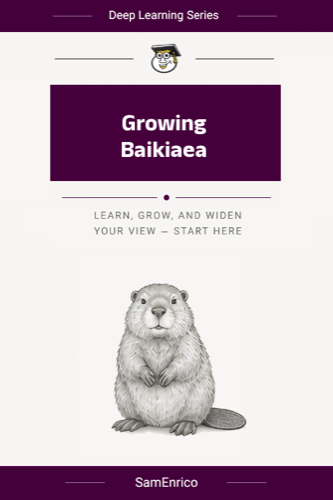
Growing Baikiaea
This publication, published by SamEnrico, covers G
This publication, published by SamEnrico, covers Growing Baikiaea
Formats
About this book
Free sample
Chapter 1: The Tree That Shouldn’t Exist...--–- Deep in the Kalahari Basin, where annual rainfall barely exceeds the width of a man’s hand and the soil is little more than fossilized sand dunes, grows a tree that has no right to thrive. Yet Baikiaea plurijuga—known to timber merchants as Rhodesian Teak and to locals as Mukusi—does more than survive. It produces wood harder than oak, more durable than mahogany, and so resistant to termites that railway sleepers laid a century ago still hold their shape beneath freight trains. This is the story of that impossible tree and how to grow it.The Paradox of the Kalahari Most trees demand rich loam, reliable rainfall, and protection from fire. Baikiaea demands the opposite.
It evolved on the Kalahari sand sheet, a geological formation spanning 2.5 million square kilometres across southern Africa. These sands are not soil in the agricultural sense. They are wind-blown quartz grains, rounded by eons of abrasion, containing almost no clay, negligible organic matter, and less than 0.1% available phosphorus. Water poured onto Kalahari sand vanishes downward within minutes, leaving the surface bone-dry again by midday. Any agronomist called to assess such land would declare it useless for commercial forestry.And yet the Kalahari woodlands—an open forest of Baikiaea, Pterocarpus angolensis, and Guibourtia coleosperma—represent one of Africa’s most valuable timber ecosystems.
The contradiction is not a mystery to be solved but a lesson to be learned. Baikiaea did not succeed despite the Kalahari sands; it succeeded because of them. The tree’s deep taproot follows percolating rainwater down through the sand column, reaching moisture stored at depths of 10 to 15 metres. Its fine feeder roots spread horizontally, forming associations with mycorrhizal fungi that extract phosphorus from otherwise unavailable mineral sources. And its heartwood accumulates toxic extractives that repel termites—a necessity in a landscape where underground termite colonies can number in the millions per hectare.Understanding this paradox is the first step toward successful cultivation.
Growers who attempt to force Baikiaea into rich soils, irrigated plantations, or high-rainfall zones inevitably fail. The tree rebels against…
This is the end of the free sample. Get the eBook to keep going. Buy now
Contents
- Chapter 1
- Chapter 2
- Chapter 3
- Chapter 4
- Chapter 5
- Chapter 6
- Chapter 7
- Chapter 8
- Chapter 9
- Chapter 10
- Chapter 11
- Chapter 12
Details
- Author
- Brunner Alysa
- Publisher
- SamEnrico
- Language
- English
- Genre
- Non-Fiction, Informative, Educational
- Released
- 2026-05-11
- Pages (approx.)
- 152
- Available as
- eBook, Audiobook

Read better in the ZLOADR app
Your eBooks on your phone or tablet. Sign in with your SamEnrico account and start reading.
More by Brunner Alysa
 Interruption AffirmationsBrunner Alysa$11.99
 Union Collective Bargaining GuideBrunner Alysa$11.99
 Child Loss and Step ParentingBrunner Alysa$11.99
 Asana Rules Engine WorkflowsBrunner Alysa$11.99
 Dual N Back Training ManualBrunner Alysa$11.99
 Living Legacy Interview GuideBrunner Alysa$11.99
 Gambling Addiction and Fantasy SportsBrunner Alysa$11.99
 Divorce and Social LifeBrunner Alysa$11.99
 The Silk Road Whisperers: Spies, Merchants, and the Unseen Diplomacy of Ancient TradeBrunner Alysa$11.99
 Hippocrates: The Father of Western MedicineBrunner Alysa$11.99
 How to Produce Home Product Making Machinery PartsBrunner Alysa$11.99
 Remote Co Founder CommunicationBrunner Alysa$12.99