
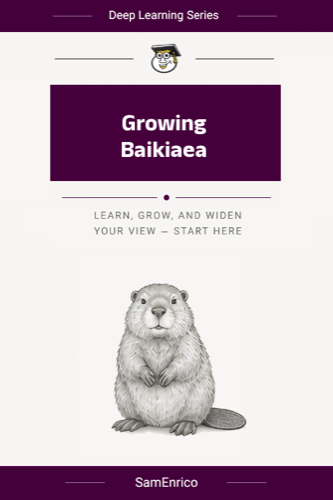
Non-FictionInformativeEducational
Growing Baikiaea eBook
This publication, published by SamEnrico, covers G
This publication, published by SamEnrico, covers Growing Baikiaea
Formats
Free sample
Chapter 1: The Tree That Shouldn’t Exist...--–- Deep in the Kalahari Basin, where annual rainfall barely exceeds the width of a man’s hand and the soil is little more than fossilized sand dunes, grows a tree that has no right to thrive. Yet Baikiaea plurijuga—known to timber merchants as Rhodesian Teak and to locals as Mukusi—does more than survive. It produces wood harder than oak, more durable than mahogany, and so resistant to termites that railway sleepers laid a century ago still hold their shape beneath freight trains. This is the story of that impossible tree and how to grow it.The Paradox of the Kalahari Most trees demand rich loam, reliable rainfall, and protection from fire. Baikiaea demands the opposite.
It evolved on the Kalahari sand sheet, a geological formation spanning 2.5 million square kilometres across southern Africa. These sands are not soil in the agricultural sense. They are wind-blown quartz grains, rounded by eons of abrasion, containing almost no clay, negligible organic matter, and less than 0.1% available phosphorus. Water poured onto Kalahari sand vanishes downward within minutes, leaving the surface bone-dry again by midday. Any agronomist called to assess such land would declare it useless for commercial forestry.And yet the Kalahari woodlands—an open forest of Baikiaea, Pterocarpus angolensis, and Guibourtia coleosperma—represent one of Africa’s most valuable timber ecosystems.
The contradiction is not a mystery to be solved but a lesson to be learned. Baikiaea did not succeed despite the Kalahari sands; it succeeded because of them. The tree’s deep taproot follows percolating rainwater down through the sand column, reaching moisture stored at depths of 10 to 15 metres. Its fine feeder roots spread horizontally, forming associations with mycorrhizal fungi that extract phosphorus from otherwise unavailable mineral sources. And its heartwood accumulates toxic extractives that repel termites—a necessity in a landscape where underground termite colonies can number in the millions per hectare.Understanding this paradox is the first step toward successful cultivation.
Growers who attempt to force Baikiaea into rich soils, irrigated plantations, or high-rainfall zones inevitably fail. The tree rebels against conditions it did not evolve to endure. But those who accept its ecological identity—who plant on poor sand, tolerate slow growth, and manage fire rather than eliminating it—find themselves in possession of a timber asset that appreciates in value with every passing decade.A Botanical Identity Often Misunderstood Before proceeding further, a clarification of names is essential. Baikiaea plurijuga belongs to the Fabaceae family—the legumes—making it a distant relative of peas, beans, and acacias. It is not a true teak.
True teak (Tectona grandis) comes from Southeast Asia, belongs to the Lamiaceae family (mint and basil), and grows in humid tropical forests receiving 1,500 to 2,500 mm of annual rainfall. The two species share no botanical relationship whatsoever. The common name “Rhodesian Teak” arose during the colonial era when European foresters noticed that Baikiaea wood resembled true teak in colour, hardness, and durability. The resemblance is coincidental, a product of convergent evolution rather than shared ancestry.The genus name honours William Balfour Baikie, a Scottish explorer and naval surgeon who led the Niger Expedition of 1854. Baikie was an unusual figure among Victorian adventurers: he learned local languages, treated African patients without regard to race, and negotiated treaties that benefited indigenous traders as much as British commerce.
He never saw a Baikiaea tree in person—the species was collected and named after his death by the German botanist Hermann Harms in 1911. But the naming was apt. Like Baikie himself, the tree thrives on unexpected ground and refuses to conform to European expectations.Within the genus Baikiaea, several species exist. Baikiaea plurijuga is the commercially important one, native to the Kalahari sand belt of Zimbabwe, Zambia, Botswana, Namibia, and Angola. A second species, Baikiaea insignis, grows in West African forests from Nigeria to Gabon, where it produces similar but slightly less durable timber.
A third, Baikiaea ghesquiereana, is confined to the Congo Basin. This book focuses exclusively on Baikiaea plurijuga, the species with a proven track record in plantation forestry and the greatest economic potential.The Timber That Outlasts Empires What makes Baikiaea wood so valuable? The answer lies in three interconnected properties: density, chemistry, and cell structure.Density and Hardness. The air-dry density of Baikiaea heartwood ranges from 800 to 1,000 kg per cubic metre, making it heavier than water. On the Janka hardness test—which measures the force required to embed a steel ball halfway into a wood sample—Baikiaea scores between 2,200 and 2,500 lbf (pounds-force).
To put this in perspective, white oak scores 1,360 lbf, teak 1,070 lbf, and eastern white pine a mere 380 lbf. This extreme hardness makes Baikiaea resistant to indentation, abrasion, and wear. Floors made from this wood can withstand decades of foot traffic without visible damage.Chemistry and Decay Resistance. Baikiaea heartwood contains approximately 12 to 15 per cent extractives by weight—chemical compounds that are not part of the cell wall structure but are deposited in the cell lumens as the tree ages. The most important of these are quinones and flavonoids, which are toxic to termites and decay fungi.
Laboratory tests have shown that Baikiaea heartwood can resist termite attack for more than 25 years in ground contact, a performance matched by few other commercial timbers. The same extractives give the wood its characteristic reddish-brown colour, which darkens to a rich mahogany hue with exposure to light.Cell Structure and Workability. Despite its extreme hardness, Baikiaea wood is reasonably workable when proper techniques are used. The grain is typically straight or only slightly interlocked, allowing clean planing and machining. The wood glues well, finishes smoothly, and takes a high natural polish without the need for synthetic sealers.
The main challenge, as discussed in Chapter 11, is the wood’s high silica content, which rapidly dulls cutting tools. This is not a defect but a feature: the same silica that blunts sawblades also creates a surface that resists wear.These properties translate directly into market value. At current international prices, high-grade Baikiaea lumber sells for 2,500to2,500 to 2,500to4,000 per cubic metre, depending on dimensions and quality certification. This places it in the same price tier as premium teak, African mahogany, and black walnut. Unlike fast-growing plantation species such as eucalyptus or pine, which are sold by weight or volume as commodities, Baikiaea is sold on specifications—each log is graded individually, and defects reduce value dramatically.
This is both a risk and an opportunity. A well-managed plantation produces timber that commands artisanal prices; a poorly managed plantation yields firewood.Historical Range and Current Distribution Understanding where Baikiaea grows naturally provides indispensable clues for cultivation. The species’ range follows the Kalahari sand belt, a crescent-shaped geological feature stretching from northern Namibia across Botswana and into southwestern Zambia and western Zimbabwe. A separate population exists in eastern Angola and southwestern Democratic Republic of Congo. The total area of natural Baikiaea woodland is estimated at approximately 130,000 square kilometres, of which the largest remaining blocks are in the Kalahari Desert region of Botswana (70,000 square kilometres) and the Kavango-Zambezi Transfrontier Conservation Area (50,000 square kilometres).Within this range, Baikiaea is never the sole tree species.
It typically co-occurs with Pterocarpus angolensis (African bloodwood), Guibourtia coleosperma (African rosewood), Burkea africana (wild syringa), and Terminalia sericea (silver…
This is the end of the free sample. Get the eBook to keep going. Buy now
About this book
Details
- Author
- Brunner Alysa
- Publisher
- SamEnrico
- Language
- English
- Genre
- Non-Fiction, Informative, Educational
- Released
- 2026-05-11
- Pages (approx.)
- 152
- Available as
- eBook, Audiobook

Read better in the ZLOADR app
Your eBooks on your phone or tablet. Sign in with your SamEnrico account and start reading.
More by Brunner Alysa
 Interruption AffirmationsBrunner Alysa$11.99
 Union Collective Bargaining GuideBrunner Alysa$11.99
 Child Loss and Step ParentingBrunner Alysa$11.99
 Asana Rules Engine WorkflowsBrunner Alysa$11.99
 Dual N Back Training ManualBrunner Alysa$11.99
 Living Legacy Interview GuideBrunner Alysa$11.99
 Gambling Addiction and Fantasy SportsBrunner Alysa$11.99
 Divorce and Social LifeBrunner Alysa$11.99
 The Silk Road Whisperers: Spies, Merchants, and the Unseen Diplomacy of Ancient TradeBrunner Alysa$11.99
 Hippocrates: The Father of Western MedicineBrunner Alysa$11.99
 How to Produce Home Product Making Machinery PartsBrunner Alysa$11.99
 Remote Co Founder CommunicationBrunner Alysa$12.99
You may also like
 Hong Kong Handover 1997Dunn Johnnie$11.99
 Zumba For Postnatal Recovery CourseNeal Christian$11.99
 Zumba for BeginnersLadner Nikia$11.99
 YouTube Comment Mining GuideHumes Pandora$12.99
 Worry Box MeditationCarlin Rudy$11.99
 Workplace Stress MeditationNguyen Lynn$11.99
 Workplace Stress and Sleep RepairHawley Ivory$11.99
 Workplace Perfectionism CureDelaney Jeffry$11.99
 Workplace Injustice Anger GuideWallen Isabelle$11.99
 Work Addiction and Burnout LinkGreenwood Ester$11.99
 Women in Yoga and WellnessBeattie Galina$11.99
 Women in Stand Up ComedyChun Evangeline$11.99