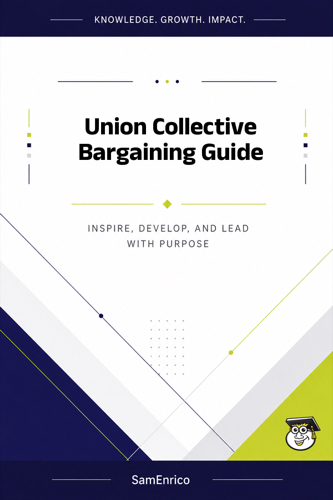
Union Collective Bargaining Guide
Uses interests and objective criteria in labor man
Uses interests and objective criteria in labor management talks.
Formats
About this book
Free sample
Chapter 1: The Forty-Million-Dollar Mistake--–- The strike had lasted 147 days. Picketers had been arrested. A forklift had been vandalized. Two marriages had ended because of the financial strain. And when the union members finally voted to accept management's offer, the vote was 47-47, broken only by the tie-breaking vote of a shop steward who had been awake for thirty-one hours.The wage increase was 2.8 percent.Management's final offer on Day 147 was almost identical to the offer they had put on the table on Day 1.
The union's final acceptance was almost identical to the offer they had rejected on Day 1. The only difference was the forty million dollars in lost wages, lost production, legal fees, and security costs that both sides had burned through during the five months of warfare.A mid-level human resources manager, reflecting on the strike years later, said something that haunted the author of this book: "We won. But winning cost us more than losing would have. And I still don't know why we couldn't see that at the time."This book is the answer to that manager's question.The Most Expensive Word in Labor Relations Every union negotiator and every management representative walks into the bargaining room carrying a heavy psychological burden. On the union side, it is the memory of past betrayals—the plant that closed, the concession that was never reciprocated, the promise that was broken.
On the management side, it is the pressure from shareholders, the fear of setting a precedent, and the conviction that any dollar given to labor is a dollar stolen from profits.These burdens are real. They are not imagined. But they have a destructive consequence: they convince both sides that negotiation is war.When negotiation becomes war, the language changes. Union negotiators stop saying "We need" and start saying "We demand." Management representatives stop saying "We can't afford" and start saying "We will never." Proposals become positions. Positions become ultimatums.
Ultimatums become strikes or lockouts. And strikes or lockouts become the forty-million-dollar mistake.The most expensive word in labor relations is not "strike." It is not "lockout." It is…
This is the end of the free sample. Get the eBook to keep going. Buy now
Contents
- Chapter 1
- Chapter 2
- Chapter 3
- Chapter 4
- Chapter 5
- Chapter 6
- Chapter 7
- Chapter 8
- Chapter 9
- Chapter 10
- Chapter 11
- Chapter 12
Details
- Author
- Brunner Alysa
- Publisher
- SamEnrico
- Language
- English
- Genre
- Non-Fiction, Business Brief, Labor
- Released
- 2026-06-09
- Pages (approx.)
- 131
- Available as
- eBook, Audiobook

Read better in the ZLOADR app
Your eBooks on your phone or tablet. Sign in with your SamEnrico account and start reading.
More by Brunner Alysa
 Interruption AffirmationsBrunner Alysa$11.99
 Child Loss and Step ParentingBrunner Alysa$11.99
 Asana Rules Engine WorkflowsBrunner Alysa$11.99
 Dual N Back Training ManualBrunner Alysa$11.99
 Living Legacy Interview GuideBrunner Alysa$11.99
 Gambling Addiction and Fantasy SportsBrunner Alysa$11.99
 Divorce and Social LifeBrunner Alysa$11.99
 The Silk Road Whisperers: Spies, Merchants, and the Unseen Diplomacy of Ancient TradeBrunner Alysa$11.99
 Hippocrates: The Father of Western MedicineBrunner Alysa$11.99
 How to Produce Home Product Making Machinery PartsBrunner Alysa$11.99
 Remote Co Founder CommunicationBrunner Alysa$12.99
 AI Content Production HandbookBrunner Alysa$12.99