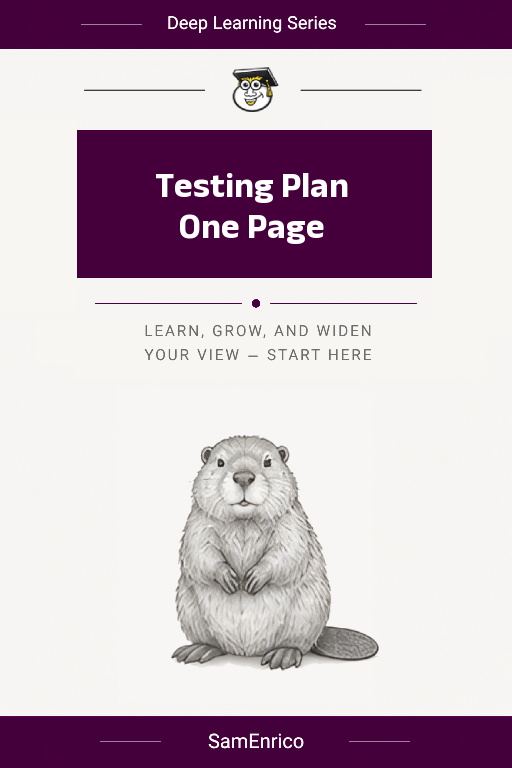
Testing Plan One Page eBook
Outline A/B test hypotheses, variants, success met
by Swenson Miss
Outline A/B test hypotheses, variants, success metrics, and schedule.
Formats
Free sample
Chapter 1: The Hypothesis Trap--Most teams believe they know how to ask a business question. They don’t.I have sat in over two hundred test planning meetings across forty companies, from two-person startups to Fortune 500 enterprises with experimentation budgets larger than most countries’ GDP. In nearly every single one, the first question asked was some variation of: “What should we test?” The answers that followed were confident, well-intentioned, and almost always wrong.“Let’s test the button color.”“We should test moving the CTA above the fold.”“What if we try a three-step checkout instead of one page?”“I heard that adding social proof increases conversions. Let’s test that.”Each of these sounds reasonable. Each is plausible.
And each is a trap that will waste your team’s time, erode trust in experimentation, and produce results that are statistically valid but strategically useless.The problem is not that these are bad ideas. The problem is that they are not proper business questions at all. They are guesses dressed in the clothing of hypotheses. And until you learn to distinguish between a guess and a genuine business question, every test you run will be an expensive flip of a coin.This chapter introduces the single most important discipline in experimentation: the art of asking a question so precise that the answer, whether yes or no, forces a decision. We will borrow a framework from emergency medicine—a field where vague questions kill people—and adapt it to A/B testing.
We will then transform that framework into the first half of a complete hypothesis statement that lives in Section 1 of your one-page template. By the end of this chapter, you will never again walk into a test planning meeting without a question that cuts through opinion, politics, and guesswork.The Cost of a Vague Question Let me tell you about a company I’ll call Fin Core. Fin Core was a mid-sized fintech startup with a respectable experimentation program. They had feature flags, a sample size calculator, and a data scientist who knew her p-values from her confidence intervals. By all external measures, they were doing A/B testing correctly.One quarter, the product manager for the onboarding flow proposed a test: “Let’s try adding a progress bar to the multi-step registration form.” The rationale was straightforward.
Users were dropping off at step three of five. A progress bar might reduce anxiety and increase completion. The team nodded. The data scientist calculated the sample size. The engineer implemented the variant.
The test ran for two weeks.The result was a 1.2% lift in completion rate, statistically significant at p < 0.05. The team celebrated. They rolled out the progress bar to 100% of traffic. The product manager got a bonus. Everyone moved on.Six months later, a new data scientist joined Fin Core and asked a question that no one had asked before: “What was the original problem we were trying to solve?” She pulled up the test documentation.
The problem was drop-off at step three. The progress bar addressed that. But she noticed something strange. When she segmented the data by user type—something the original analysis had not done—she found that the progress bar had actually decreased completion for mobile users by 3% while increasing it for desktop users by 4%. The overall lift of 1.2% was a statistical artifact of the traffic mix.
The company had made its mobile experience worse for six months without knowing it.This is the cost of a vague question. The team had asked “Will a progress bar increase completion?” That is a question, yes. But it is not a good one. A good question would have forced them to specify: for which users? Compared to what?
Over what time horizon? With what guardrails? And most critically, why do we believe this will work?The progress bar test was not a failure of statistics. It was a failure of framing. And it is repeated thousands of times every day across the companies that believe they have mastered A/B testing.The PICOT Framework: Borrowing from Emergency Medicine In 1995, a physician named Dr.
W.S. Richardson published a paper that would quietly revolutionize clinical practice. He was frustrated. Medical residents were asking questions like “Does this drug work?” or “Should we order this test?” These questions were too vague to answer with the growing body of medical research. Richardson adapted a framework from public health called PICOT, which stood for Population, Intervention, Comparison, Outcome, and Time.
He required every clinical question to specify all five elements before anyone touched a patient.The results were transformative. A question like “Does this drug work?” became “In adults with hypertension (Population), does lisinopril (Intervention) compared to placebo (Comparison) reduce systolic blood pressure by at least 10 mm Hg (Outcome) within 12 weeks (Time)?” That question is answerable. That question forces a decision. That question cannot hide ambiguity behind friendly phrasing.A/B testing suffers from exactly the same problem as 1990s clinical medicine. We ask “Will a progress bar increase completion?” and then wonder why our results are inconclusive.
The PICOT framework is not a metaphor. It is a direct, transferable tool. Let me translate each element into the language of experimentation.Population: Who Exactly Are You Testing?Most tests target “all users” or “everyone who visits the page.” This is almost always a mistake. Different populations behave differently. New users are not the same as returning users.
Mobile users are not the same as desktop users. Users who have already converted are not the same as those who have not. When you define your population too broadly, you wash out the signals that matter.A precise population statement looks like this: “First-time visitors from mobile devices who have added at least one item to their cart but have not yet started checkout.” That is not a casual description. That is a SQL query. It is specific enough that an engineer could write a targeting rule without asking a single clarifying question.The art of population definition is finding the Goldilocks zone.
Too narrow, and you will not have enough traffic to reach statistical significance within a reasonable time frame. Too broad, and your results will be uninterpretable because different sub-populations will respond in opposite directions. The right population is the one where you believe the causal mechanism—the “because” that we will add in Chapter 2—operates most cleanly.Here is a rule of thumb that has saved me more times than I can count: if you cannot write a one-sentence description of your population that includes three specific attributes (behavioral, demographic, or contextual), your population is too broad. “All users” has zero attributes. “Logged-in users” has one.
“Logged-in users who have made a purchase in the last 30 days and are viewing on a tablet” has three. Aim for three.Intervention: What Exactly Are You Changing?The intervention is the thing you are testing. This seems obvious, but in practice, it is where most test plans become dangerously vague. “Change the button color” is not an intervention specification. Which button?
On which page? From which color to which color? Under what conditions does the button appear?A proper intervention specification is unambiguous and repeatable.…
This is the end of the free sample. Get the eBook to keep going. Buy now
About this book
Details
- Author
- Swenson Miss
- Publisher
- SamEnrico
- Language
- English
- Genre
- Non-Fiction, Business Brief, Experimentation
- Released
- 2026-05-29
- Pages (approx.)
- 137
- Available as
- eBook, Audiobook

Read better in the ZLOADR app
Your eBooks on your phone or tablet. Sign in with your SamEnrico account and start reading.
More by Swenson Miss
 Parental Anger Time Out GuideSwenson Miss$11.99
 Student Study PrioritizationSwenson Miss$11.99
 Carb Cycling Tracking GuideSwenson Miss$11.99
 Addiction and Attachment PrimerSwenson Miss$11.99
 Franchising Your Local Brand Across Borders Joint VenturesSwenson Miss$11.99
 Summit of Shadows: The Untold Story of Arlene Blum and the First All-Women's Ascent of AnnapurnaSwenson Miss$11.99
 Empress of the Purple: Theodora’s Rise from the ShadowsSwenson Miss$11.99
 Understanding D Ercole SyndromeSwenson Miss$17.99
 How to Start a Hobby in Making PaperSwenson Miss$11.99
 Green Tariff Energy GuideSwenson Miss$12.99
 Cyber Security ConsultantSwenson Miss$11.99