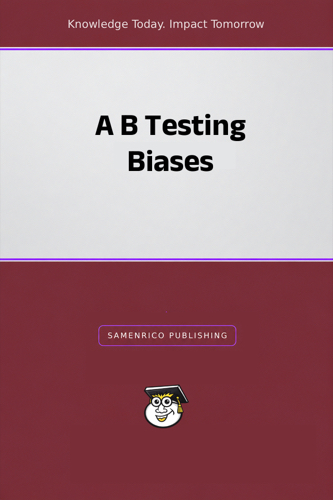
A B Testing Biases
Designs experiments correctly.
Designs experiments correctly.
Formats
About this book
Free sample
Chapter 1: The Illusion of Certainty--–- On a Tuesday morning in March 2018, a senior product manager named Elena walked into a conference room at a mid-sized Saa S company and announced that she had proof. Her team had spent four months rebuilding the onboarding flow, reducing it from seven screens to three. The A/B test had run for two weeks on ten percent of new users. The results were unambiguous: completion rates had increased by eighteen percent. The p-value was 0.001.
The confidence interval was tight. She had slides, charts, and a recommendation to launch immediately. The room applauded. The CEO gave a thumbs up. The feature went live the following Monday.
Within thirty days, the company’s trial-to-paid conversion rate had dropped by twelve percent—the worst quarterly performance in three years. New users were completing the onboarding flow in record numbers and then never coming back. The shorter flow had removed a crucial education step that helped users understand the product’s value. Elena had measured what was easy to measure—completion—rather than what mattered: long-term conversion. Her test was statistically significant and directionally wrong.This story is not a cautionary tale about a statistical mistake.
It is a story about the illusion of certainty—the seductive belief that because you have numbers, p-values, and confidence intervals, you must be seeing the truth. The illusion of certainty is the most dangerous bias in A/B testing because it disguises itself as rigor. It tells you that you are being data-driven when you are actually being misled. It replaces the humility of genuine inquiry with the arrogance of false precision. And it begins long before any data is collected, in the quiet assumptions you make about what to measure, how to measure it, and when to stop.This chapter is about the psychological roots of the illusion of certainty.
Before we can understand sample ratio mismatch, sequential testing, or algorithmic confounding—topics we will explore in later chapters—we must understand ourselves. The experimenter is the first and most important variable in any A/B test. Your hopes, your fears, your…
This is the end of the free sample. Get the eBook to keep going. Buy now
Contents
- Chapter 1
- Chapter 2
- Chapter 3
- Chapter 4
- Chapter 5
- Chapter 6
- Chapter 7
- Chapter 8
- Chapter 9
- Chapter 10
- Chapter 11
- Chapter 12
Details
- Author
- Steward Dwana
- Publisher
- SamEnrico
- Language
- English
- Genre
- Non-Fiction, Business Brief, Experimentation
- Released
- 2026-06-05
- Pages (approx.)
- 141
- Available as
- eBook, Audiobook

Read better in the ZLOADR app
Your eBooks on your phone or tablet. Sign in with your SamEnrico account and start reading.
More by Steward Dwana
 Mindful Healthcare Professional GuideSteward Dwana$11.99
 Calf Strain Recovery ProtocolSteward Dwana$11.99
 UK CMA Merger BlocksSteward Dwana$11.99
 Metta For Evening Wind DownSteward Dwana$11.99
 Mentoring New ManagersSteward Dwana$11.99
 Trace Evidence Collection GuideSteward Dwana$11.99
 Good Father, Bad AngerSteward Dwana$11.99
 Assertiveness For FreelancersSteward Dwana$11.99
 The Clockwork Dreamer: How a 19th-Century Engineer Built the First Practical Steam-Powered CarSteward Dwana$11.99
 The Codebreaker of Southeast Asia: Hoang Tuan's Mathematical RevolutionSteward Dwana$11.99
 The Last Charge of the Qing: The Fall of the Boxer Rebellion (1900)Steward Dwana$11.99
 How to Start a Marine Insurance Survey Business (Beginners Guide)Steward Dwana$11.99