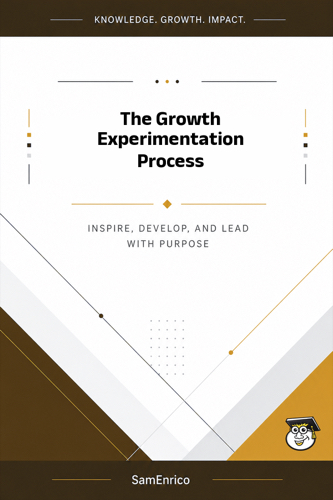
The Growth Experimentation Process
Designs, runs, and analyzes A/B tests for growth.
Designs, runs, and analyzes A/B tests for growth.
Formats
About this book
Free sample
Chapter 1: The Metric That Lies--–- The email arrived at 9:47 AM on a Tuesday. The subject line read: "Big win! +12% conversion rate!" The product manager had cc’d the entire company. Within minutes, the CEO replied with fireworks emojis. The VP of Marketing asked for a press release draft.
By noon, the engineering team was tasked with rolling out the change to 100% of traffic.–- Thirty days later, revenue was flat. Actually, it was down slightly. The CFO wanted to know why a "winning" test had produced nothing. The product manager ran the numbers again. The conversion rate was still up 12%—but average order value had dropped 18%.
The test had attracted discount-seekers who bought cheap items and never returned. The team had optimized for a metric that lied.–- This scene plays out every day in growth teams across the world. Not because the teams are incompetent, but because they lack a trustworthy framework for measuring what actually matters. They look at conversion rate because it is easy. They celebrate statistical significance because it feels scientific.
And they ship changes that make their primary metric go up while their business quietly goes down.–- This chapter is not about how to run A/B tests. It is about how to know if your A/B test results are telling you the truth. Before you write a single line of code, before you split a single user, you need to build the foundation that separates trustworthy experimentation from self-deceptive guesswork.The Conversion Rate Trap–- Conversion rate is the most dangerous metric in growth experimentation. It feels objective. It is easy to calculate.
Every A/B testing tool puts it front and center. But conversion rate is also incredibly easy to game, and it hides more than it reveals.–- Consider two variants of a checkout page. Variant A converts at 5% with an average order value of $100. Variant B converts at 5.5% with an average order value of $90. Which is better?
Conversion rate alone says Variant B wins by 10%. But revenue per visitor tells a different story: Variant A generates $5.00…
This is the end of the free sample. Get the eBook to keep going. Buy now
Contents
- Chapter 1
- Chapter 2
- Chapter 3
- Chapter 4
- Chapter 5
- Chapter 6
- Chapter 7
- Chapter 8
- Chapter 9
- Chapter 10
- Chapter 11
- Chapter 12
Details
- Author
- Ritter Therese
- Publisher
- SamEnrico
- Language
- English
- Genre
- Non-Fiction, Business Brief, Experimentation
- Released
- 2026-06-07
- Pages (approx.)
- 125
- Available as
- eBook, Audiobook

Read better in the ZLOADR app
Your eBooks on your phone or tablet. Sign in with your SamEnrico account and start reading.
More by Ritter Therese
 Deception Detection WorkbookRitter Therese$11.99
 No Shipping Cost TrapRitter Therese$11.99
 Listening Bad Habits To BreakRitter Therese$11.99
 The Jade Phoenix's Last Flight: A Celestial OmenRitter Therese$11.99
 Learn to Play the Alto SaxophoneRitter Therese$11.99
 AI for Sales Battle CardsRitter Therese$12.99
 Distribution SupervisorRitter Therese$11.99
 How to Start a Clocks (retail) Business (Beginners Guide)Ritter Therese$11.99