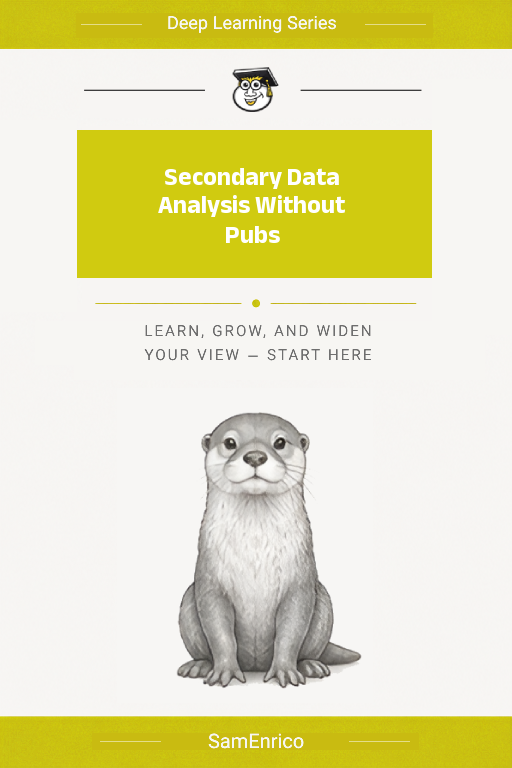
Secondary Data Analysis Without Pubs
Use publicly available datasets to conduct indepen
Use publicly available datasets to conduct independent analyses and include results in applications as research evidence.
Formats
About this book
Free sample
Chapter 1: The Permission Trap---- Every day, thousands of aspiring analysts sit at their computers with a problem they don't even know they have. They believe, with the certainty of religious conviction, that they cannot produce credible research evidence without someone else's permission. They wait for a professor to invite them into a lab. They wait for a grant to fund a survey. They wait for a company to share internal data.
They wait, and they wait, and while they wait, their careers remain exactly where they started.This chapter dismantles that belief. It is not a gentle suggestion or a polite alternative. It is a demolition of the single most destructive myth in the data analysis profession: the myth that original data collection is the only path to credible evidence.The truth, which the best employers already know, is that secondary analysis of public datasets produces evidence that is often more valuable than primary research. Not equal. Not acceptable as a substitute.
Better. More actionable. More reproducible. More representative of real-world phenomena than any carefully controlled lab study could ever be.This chapter introduces the concept that will transform your portfolio from empty to impressive: No Academic Permission. You do not need a university affiliation.
You do not need an Institutional Review Board. You do not need a funded project. You need a laptop, an internet connection, and the frameworks in this book. Everything else is an excuse, and this chapter will show you why those excuses have kept you stuck.The Hidden Cost of Waiting for Permission Let us begin with a simple calculation. The average master's degree in data science or public policy takes two years and costs between 30,000and30,000 and 30,000and120,000.
During those two years, students complete between six and twelve projects, most of which use provided datasets in structured assignments. Upon graduation, they discover something devastating: their portfolio contains nothing they can claim as their own independent work.The professor provided the data. The assignment provided the question. The grading rubric provided the success criteria. The student provided the keystrokes.Meanwhile, a self-directed analyst who spent those same…
This is the end of the free sample. Get the eBook to keep going. Buy now
Contents
- Chapter 1
- Chapter 2
- Chapter 3
- Chapter 4
- Chapter 5
- Chapter 6
- Chapter 7
- Chapter 8
- Chapter 9
- Chapter 10
- Chapter 11
- Chapter 12
Details
- Author
- Meador Britteny
- Publisher
- SamEnrico
- Language
- English
- Genre
- Non-Fiction, Student's Shortcut, Secondary Analysis
- Released
- 2026-05-29
- Pages (approx.)
- 146
- Available as
- eBook, Audiobook

Read better in the ZLOADR app
Your eBooks on your phone or tablet. Sign in with your SamEnrico account and start reading.
More by Meador Britteny
 HIIT for Men Over 50Meador Britteny$11.99
 MBSR for Hypertension GuideMeador Britteny$11.99
 Constraint Based CreativityMeador Britteny$11.99
 Survey Data Retention Policies AIMeador Britteny$11.99
 OCD And Executive FunctioningMeador Britteny$11.99
 The War Room: How a Tech Titan Outmaneuvered Wall StreetMeador Britteny$11.99
 The Silent Takeover: How a Tech Mogul Bought the WorldMeador Britteny$11.99
 Human Factors ConsultantMeador Britteny$11.99
 Computer Science Master EuropeMeador Britteny$12.99
 How to Become a Destaticizer FeederMeador Britteny$11.99
 Understanding Caplan's SyndromeMeador Britteny$17.99