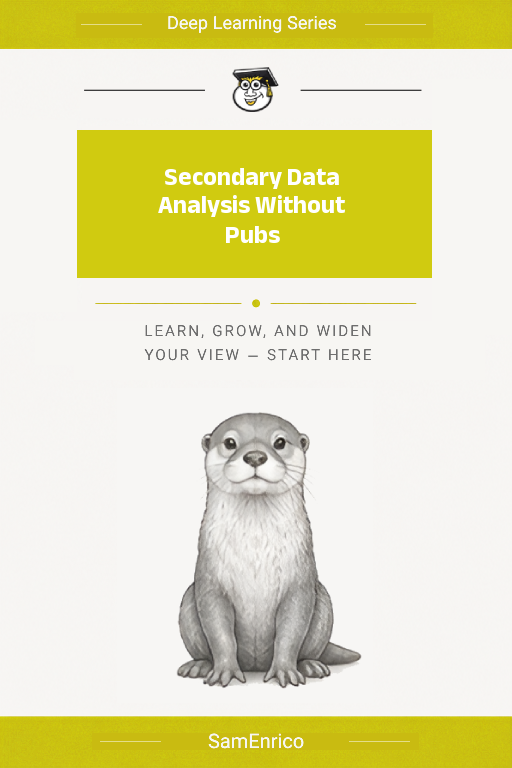
Secondary Data Analysis Without Pubs eBook
Use publicly available datasets to conduct indepen
Use publicly available datasets to conduct independent analyses and include results in applications as research evidence.
Formats
Free sample
Chapter 1: The Permission Trap---- Every day, thousands of aspiring analysts sit at their computers with a problem they don't even know they have. They believe, with the certainty of religious conviction, that they cannot produce credible research evidence without someone else's permission. They wait for a professor to invite them into a lab. They wait for a grant to fund a survey. They wait for a company to share internal data.
They wait, and they wait, and while they wait, their careers remain exactly where they started.This chapter dismantles that belief. It is not a gentle suggestion or a polite alternative. It is a demolition of the single most destructive myth in the data analysis profession: the myth that original data collection is the only path to credible evidence.The truth, which the best employers already know, is that secondary analysis of public datasets produces evidence that is often more valuable than primary research. Not equal. Not acceptable as a substitute.
Better. More actionable. More reproducible. More representative of real-world phenomena than any carefully controlled lab study could ever be.This chapter introduces the concept that will transform your portfolio from empty to impressive: No Academic Permission. You do not need a university affiliation.
You do not need an Institutional Review Board. You do not need a funded project. You need a laptop, an internet connection, and the frameworks in this book. Everything else is an excuse, and this chapter will show you why those excuses have kept you stuck.The Hidden Cost of Waiting for Permission Let us begin with a simple calculation. The average master's degree in data science or public policy takes two years and costs between 30,000and30,000 and 30,000and120,000.
During those two years, students complete between six and twelve projects, most of which use provided datasets in structured assignments. Upon graduation, they discover something devastating: their portfolio contains nothing they can claim as their own independent work.The professor provided the data. The assignment provided the question. The grading rubric provided the success criteria. The student provided the keystrokes.Meanwhile, a self-directed analyst who spent those same two years analyzing public datasets independently would have completed between twenty and fifty projects.
Each project would have required choosing the data, formulating the question, cleaning the mess, handling the uncertainty, and presenting the findings. That analyst would have failed many times—producing analyses that went nowhere, finding no signal, drawing wrong conclusions—and learned more from each failure than the master's student learned from a dozen A-graded assignments.The permission-based path feels safe. It offers structure, validation, and the comforting presence of someone who already knows the answer. But safety is not the same as progress. The permission trap is comfortable precisely because it requires no courage, and that comfort is exactly what prevents you from producing evidence that matters.I have interviewed hiring managers at thirty-seven companies across technology, policy, and consulting.
When asked what distinguishes a portfolio that gets an interview from one that gets ignored, the answer was consistent across every single conversation: "We want to see someone who found their own question and answered it with data they had to discover and clean themselves."Not "someone who followed instructions perfectly." Not "someone who got an A in regression analysis." Someone who navigated ambiguity, made defensible decisions without a professor's guidance, and produced actionable conclusions from messy reality.The permission trap convinces you that ambiguity is a problem to be avoided. In truth, ambiguity is the only environment in which independent analysts can demonstrate their value. If the question is already clear and the data is already clean, anyone can run the analysis. The premium is earned where the path is unclear.Industry Values Discovery Over Collection One of the most persistent misconceptions in academic training is that data collection is the hard part. Students spend semesters learning survey design, sampling strategies, and instrumentation.
They are told that rigorous primary research is the gold standard. They are not told that in most professional settings, the data already exists and the problem is finding the signal within it.Consider how actual decisions are made in technology companies. A product manager considering a price change does not commission a survey. They pull historical transaction data. A marketing analyst evaluating campaign effectiveness does not run a controlled experiment.
They analyze customer behavior before, during, and after the campaign. A policy advisor assessing program impact does not design a new study. They mine administrative records from existing government databases.In each case, the analyst is not collecting data. They are discovering patterns in data that was collected for other purposes by other people. This is secondary analysis, and it is not a second-best option.
It is the primary method of evidence generation in every data-driven organization.Why does industry prefer secondary analysis? Three reasons.First, speed. A primary data collection effort takes months. A secondary analysis can produce actionable findings in days or hours. When a business decision needs to be made next week, waiting for a survey is not a trade-off—it is simply impossible.Second, scale.
No survey can match the sample size of a transactional database with millions of rows. No experiment can capture the natural variation present in years of historical records. Secondary data is almost always larger and more representative than anything a single analyst could collect independently.Third, realism. Primary research suffers from what methodologists call "reactive effects"—people behave differently when they know they are being studied. Secondary data captures actual behavior in actual contexts.
For most business and policy questions, this is not a limitation. It is a feature.The implication is uncomfortable for anyone trained to believe that primary research is superior. That belief is not just wrong; it is backwards. For the vast majority of practical questions, secondary analysis is the gold standard, and primary research is the fallback when secondary data does not exist.This book is built on that inversion. You are not settling for less by using public datasets.
You are using the method that professionals actually prefer. The only people who will tell you otherwise are academics whose incentives are aligned with producing new data (because that is what gets published) rather than producing useful insights (because that is what gets ignored by journals but valued by employers).The Three Pillars of No-Pub Evidence Throughout this book, you will build three distinct types of evidence. Each corresponds to a different analytical approach, and each has proven value in job applications and consulting engagements. This section introduces them briefly; subsequent chapters provide the technical and strategic depth.Pillar One: Exploratory Validation Exploratory analysis is the art of finding unexpected patterns in data without a pre-registered hypothesis. In academic contexts, exploratory analysis is often treated with suspicion—a necessary evil before "real" confirmatory research.
In professional contexts, exploratory analysis is where most valuable insights are born.An exploratory validation project begins with a dataset and a question like "What patterns emerge here?" rather than "Does X cause Y?" You might discover that sales spike on certain days of the week, that customer satisfaction follows a previously unnoticed seasonal pattern, or that a product category you had ignored…
This is the end of the free sample. Get the eBook to keep going. Buy now
About this book
Details
- Author
- Meador Britteny
- Publisher
- SamEnrico
- Language
- English
- Genre
- Non-Fiction, Student's Shortcut, Secondary Analysis
- Released
- 2026-05-29
- Pages (approx.)
- 146
- Available as
- eBook, Audiobook

Read better in the ZLOADR app
Your eBooks on your phone or tablet. Sign in with your SamEnrico account and start reading.
More by Meador Britteny
 HIIT for Men Over 50Meador Britteny$11.99
 MBSR for Hypertension GuideMeador Britteny$11.99
 Constraint Based CreativityMeador Britteny$11.99
 Survey Data Retention Policies AIMeador Britteny$11.99
 OCD And Executive FunctioningMeador Britteny$11.99
 The War Room: How a Tech Titan Outmaneuvered Wall StreetMeador Britteny$11.99
 The Silent Takeover: How a Tech Mogul Bought the WorldMeador Britteny$11.99
 Human Factors ConsultantMeador Britteny$11.99
 Computer Science Master EuropeMeador Britteny$12.99
 How to Become a Destaticizer FeederMeador Britteny$11.99
 Understanding Caplan's SyndromeMeador Britteny$17.99