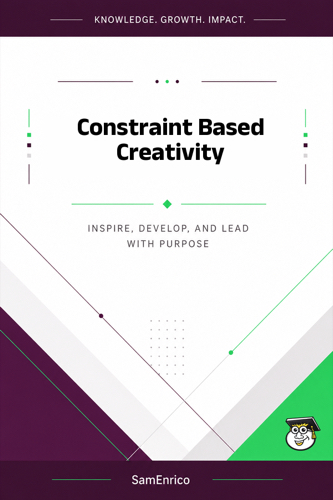
Constraint Based Creativity
Use limitations to spark innovative business solut
Use limitations to spark innovative business solutions.
Formats
About this book
Free sample
Chapter 1: The Scarcity Paradox--–- In the summer of 1970, three astronauts found themselves 205,000 miles from Earth with a dying spaceship, a square carbon dioxide filter, and a pile of irregularly shaped canisters, plastic bags, duct tape, and flight manuals. They had exactly seventy-two hours of oxygen left, a lunar module designed for two people now carrying three, and no working primary propulsion. By every logical measure, Jim Lovell, Fred Haise, and Jack Swigert should have died in space.Instead, they became the most celebrated case study in constraint-based creativity ever recorded.What happened aboard Apollo 13 was not a miracle. It was not luck. It was a master class in what happens when the human brain is forced to solve a problem with exactly what it has, exactly where it is, exactly when it matters most.
Mission Control engineers on the ground dumped a box of “available parts” onto a table—items that were already onboard the spacecraft—and told the astronauts to build a CO₂ scrubber adapter using nothing else. No new materials. No resupply. No second chances. The square filter had to fit into a round hole, and the only tools available were those designed for entirely different tasks.Within hours, the astronauts had rigged a working adapter using a suit hose, a sock, a flight manual cover, and copious amounts of duct tape.
They lived. The world watched. And virtually every business book since has cited Apollo 13 as the definitive proof that constraints work.But here is what those books miss: the Apollo 13 crew succeeded not because they faced a constraint, but because they faced exactly one binding constraint at a time. The CO₂ problem was singular. Everything else—navigation, power, water, temperature—was temporarily bracketed.
The engineers did not try to solve five crises simultaneously. They solved the square-peg-round-hole problem first, then moved to the next constraint, then the next. One tight limit, one creative breakthrough, one sequence.That distinction—between one productive constraint and five paralyzing ones—is the entire foundation of this chapter.The Scarcity Paradox: Why Less Becomes More Every business leader has felt the sting of scarcity.…
This is the end of the free sample. Get the eBook to keep going. Buy now
Contents
- Chapter 1
- Chapter 2
- Chapter 3
- Chapter 4
- Chapter 5
- Chapter 6
- Chapter 7
- Chapter 8
- Chapter 9
- Chapter 10
- Chapter 11
- Chapter 12
Details
- Author
- Meador Britteny
- Publisher
- SamEnrico
- Language
- English
- Genre
- Non-Fiction, Self-Help, Constraints
- Released
- 2026-06-09
- Pages (approx.)
- 131
- Available as
- eBook, Audiobook

Read better in the ZLOADR app
Your eBooks on your phone or tablet. Sign in with your SamEnrico account and start reading.
More by Meador Britteny
 HIIT for Men Over 50Meador Britteny$11.99
 MBSR for Hypertension GuideMeador Britteny$11.99
 Survey Data Retention Policies AIMeador Britteny$11.99
 OCD And Executive FunctioningMeador Britteny$11.99
 The War Room: How a Tech Titan Outmaneuvered Wall StreetMeador Britteny$11.99
 The Silent Takeover: How a Tech Mogul Bought the WorldMeador Britteny$11.99
 Human Factors ConsultantMeador Britteny$11.99
 Computer Science Master EuropeMeador Britteny$12.99
 Secondary Data Analysis Without PubsMeador Britteny$12.99
 How to Become a Destaticizer FeederMeador Britteny$11.99
 Understanding Caplan's SyndromeMeador Britteny$17.99