
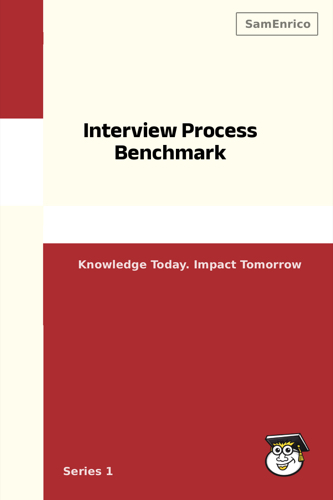
Interview Process Benchmark eBook
Analyze how fast growing firms reduce time to hire
by Beaty Hien
Analyze how fast growing firms reduce time to hire while improving quality.
Formats
Free sample
Chapter 1: The Speed Paradox--Most business leaders believe that slowing down the interview process leads to more thorough vetting. They operate under a simple, intuitive logic: more time equals more scrutiny, and more scrutiny equals better decisions. This belief is so deeply embedded in corporate culture that it is rarely questioned. Hiring managers delay decisions to "think it over." Recruiters schedule interviews across three weeks to "accommodate everyone." Panels wait for the "perfect alignment" of calendars. And in every case, they tell themselves the same thing: "We are being thorough."They are wrong.Not partially wrong.
Not wrong in some nuanced, context-dependent way. Fundamentally, systematically, and expensively wrong.The belief that slow hiring produces high-quality hires is not just a myth—it is a dangerous misconception that costs companies billions of dollars annually in lost productivity, burnout, and missed opportunities. More critically, it creates a self-defeating cycle: the slower your process, the worse your candidates become. You are not screening for excellence. You are filtering for desperation.This chapter dismantles the false trade-off between speed and quality.
It presents the data, the psychology, and the case studies that prove the opposite: that fast, disciplined hiring produces better outcomes than slow, meandering processes. By the end of this chapter, you will understand why the 10-Day Window is the single most important constraint in modern talent acquisition, and why every subsequent chapter in this book exists to help you operate within it.The Billion-Dollar Cost of an Empty Chair Before we can understand why speed matters, we must first understand what is at stake. An open role is not a neutral event. It is not simply a vacancy waiting to be filled. It is a drain on revenue, morale, and organizational momentum.Consider the direct costs first.
When a role sits open, the work does not disappear. It is redistributed to existing employees. Those employees, already operating at capacity, now work longer hours, carry heavier cognitive loads, and face increased pressure to deliver the same results with fewer resources. The predictable outcome? Burnout.
According to a 2023 study by the Society for Human Resource Management, teams operating with a single open role for more than 60 days experience a 28% increase in voluntary turnover among remaining team members. The vacancy creates more vacancies.The revenue impact is even more stark. For a sales role with a $1 million quota, every week the role remains empty represents approximately $20,000 in forgone revenue. For a product manager role overseeing a feature that would drive $500,000 in annual recurring revenue, a 90-day vacancy costs $125,000 in delayed value. For a software engineer at a pre-revenue startup, a six-month vacancy can delay product launch by six months—potentially costing the company its first-mover advantage, its funding round, or its existence.Then there is the cost of the hire itself.
Studies cited by the U.S. Department of Labor and multiple meta-analyses published in the Journal of Applied Psychology estimate that a single bad hire can cost between 5 and 15 times the employee's annual salary when accounting for recruitment expenses, training time, lost productivity, and the cultural damage inflicted on the team. A $120,000 senior manager who fails can cost the organization $600,000 to $1.8 million. This is not a rounding error. This is a business-ending event for many small and medium-sized companies.But here is the crucial insight that most executives miss: the cost of a bad hire and the cost of a vacancy are not independent risks.
They are directly connected by speed. When you stretch your interview process across 30, 45, or 60 days, you do not reduce your risk of a bad hire. You increase it. Because the candidates who remain in your pipeline after weeks of delays are not the best candidates. They are the most patient candidates.
And patience is not a job skill.The 10-Day Window: The Constraint You Cannot Ignore Let us look at the data. Multiple sources—including Linked In's Global Talent Trends report, Greenhouse's Hiring Benchmark data, and independent research from the Harvard Business Review—converge on a single, undeniable finding: top-tier candidates are off the market within 10 days of beginning their search.This is the 10-Day Window. It applies to both active candidates (those explicitly looking for a new role) and passive candidates (those who are open to conversation but not actively applying). For active candidates, the window is even narrower: 7 to 10 days from first outreach to offer acceptance. For passive candidates, the window begins the moment they signal openness—by updating a Linked In profile, responding to a recruiter, or clicking "I'm interested" on a job posting.Why 10 days?
The answer lies in candidate psychology and market dynamics.First, top performers are rarely on the market for long because they are, by definition, desirable. They receive multiple inquiries. They have multiple options. Their time is valuable, and they are acutely aware that every day spent in an interview process is a day not spent doing their current job, pursuing their current projects, or living their current life. They have a low tolerance for friction, delay, and uncertainty.Second, the market has become dramatically more efficient over the past decade.
Job boards, social media, and recruiting platforms have collapsed information asymmetry. Candidates know their market value. They know which companies are hiring. They can apply to 20 roles in an afternoon and receive screening requests within 48 hours. The company that moves fastest—not the company that pays the most—wins the best talent.Third, there is a well-documented psychological phenomenon called the "commitment momentum" effect.
When a candidate moves through a process quickly, they perceive the opportunity as more valuable. Fast processes signal organizational competence, decisiveness, and respect for the candidate's time. Slow processes signal chaos, indecision, and indifference. Candidates interpret the speed of your process as a proxy for the speed of your organization. If you take three weeks to schedule an interview, they assume you will take three weeks to approve a purchase order, respond to a customer, or launch a product.Here is the brutal math problem that every hiring manager must confront: the median industry interview process takes 30 days from pipeline entry to offer (as we will detail in Chapter 2).
If top candidates are gone in 10 days, then for 20 of those 30 days, you are not screening the best candidates. You are screening the candidates who did not receive other offers, who are less confident in their market value, or who are underperforming in their current roles and therefore have no better options.You are not screening for excellence. You are filtering for desperation.Let that sink in. Every day beyond the 10-Day Window, your pipeline becomes systematically weaker. The candidates who withdraw are the ones with options.
The candidates who remain are the ones without. By the time you extend an offer at day 30, you are not celebrating a successful hire. You are celebrating the fact that someone—anyone—stayed on the line long enough for you to fumble through your process.The Halo Effect of Speed Speed, when paired with respect and transparency, creates a powerful psychological advantage that high-growth firms have learned to weaponize.There is a concept in social psychology called the "halo effect": the tendency for one positive attribute of a person or organization to influence overall…
This is the end of the free sample. Get the eBook to keep going. Buy now
About this book
Details
- Author
- Beaty Hien
- Publisher
- SamEnrico
- Language
- English
- Genre
- Non-Fiction, Strategic Atlas, Interviewing
- Released
- 2026-06-08
- Pages (approx.)
- 135
- Available as
- eBook, Audiobook

Read better in the ZLOADR app
Your eBooks on your phone or tablet. Sign in with your SamEnrico account and start reading.
More by Beaty Hien
 The Complicated Grief and SecularBeaty Hien$11.99
 Dwight L Moody EvangelistBeaty Hien$11.99
 Beginner Mindfulness for Test AnxietyBeaty Hien$11.99
 The Email Clarity for Remote TeamsBeaty Hien$11.99
 The Forgotten Pioneers: How Australian Rules Football Conquered the British IslesBeaty Hien$11.99
 Understanding Stuve–wiedemann DysplasiaBeaty Hien$17.99
 How to Become a Sheep ShearerBeaty Hien$11.99
 RSPO Certification ExportBeaty Hien$12.99
 Future of Coding EducationBeaty Hien$12.99
 Data Center EngineerBeaty Hien$11.99