
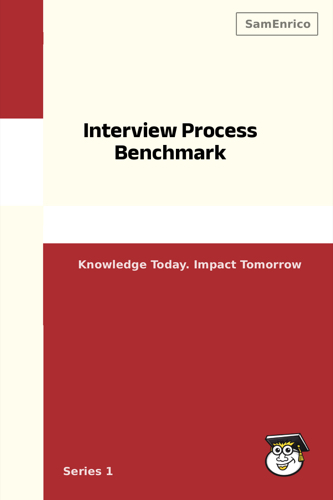
Interview Process Benchmark
Analyze how fast growing firms reduce time to hire
by Beaty Hien
Analyze how fast growing firms reduce time to hire while improving quality.
Formats
About this book
Free sample
Chapter 1: The Speed Paradox--Most business leaders believe that slowing down the interview process leads to more thorough vetting. They operate under a simple, intuitive logic: more time equals more scrutiny, and more scrutiny equals better decisions. This belief is so deeply embedded in corporate culture that it is rarely questioned. Hiring managers delay decisions to "think it over." Recruiters schedule interviews across three weeks to "accommodate everyone." Panels wait for the "perfect alignment" of calendars. And in every case, they tell themselves the same thing: "We are being thorough."They are wrong.Not partially wrong.
Not wrong in some nuanced, context-dependent way. Fundamentally, systematically, and expensively wrong.The belief that slow hiring produces high-quality hires is not just a myth—it is a dangerous misconception that costs companies billions of dollars annually in lost productivity, burnout, and missed opportunities. More critically, it creates a self-defeating cycle: the slower your process, the worse your candidates become. You are not screening for excellence. You are filtering for desperation.This chapter dismantles the false trade-off between speed and quality.
It presents the data, the psychology, and the case studies that prove the opposite: that fast, disciplined hiring produces better outcomes than slow, meandering processes. By the end of this chapter, you will understand why the 10-Day Window is the single most important constraint in modern talent acquisition, and why every subsequent chapter in this book exists to help you operate within it.The Billion-Dollar Cost of an Empty Chair Before we can understand why speed matters, we must first understand what is at stake. An open role is not a neutral event. It is not simply a vacancy waiting to be filled. It is a drain on revenue, morale, and organizational momentum.Consider the direct costs first.
When a role sits open, the work does not disappear. It is redistributed to existing employees. Those employees, already operating at capacity, now work longer hours, carry heavier cognitive loads, and face increased pressure to deliver the same results with fewer resources. The predictable outcome? Burnout.
According to a 2023 study by the Society for Human Resource Management, teams operating with a single open role for…
This is the end of the free sample. Get the eBook to keep going. Buy now
Contents
- Chapter 1
- Chapter 2
- Chapter 3
- Chapter 4
- Chapter 5
- Chapter 6
- Chapter 7
- Chapter 8
- Chapter 9
- Chapter 10
- Chapter 11
- Chapter 12
Details
- Author
- Beaty Hien
- Publisher
- SamEnrico
- Language
- English
- Genre
- Non-Fiction, Strategic Atlas, Interviewing
- Released
- 2026-06-08
- Pages (approx.)
- 135
- Available as
- eBook, Audiobook

Read better in the ZLOADR app
Your eBooks on your phone or tablet. Sign in with your SamEnrico account and start reading.
More by Beaty Hien
 The Complicated Grief and SecularBeaty Hien$11.99
 Dwight L Moody EvangelistBeaty Hien$11.99
 Beginner Mindfulness for Test AnxietyBeaty Hien$11.99
 The Email Clarity for Remote TeamsBeaty Hien$11.99
 The Forgotten Pioneers: How Australian Rules Football Conquered the British IslesBeaty Hien$11.99
 Understanding Stuve–wiedemann DysplasiaBeaty Hien$17.99
 How to Become a Sheep ShearerBeaty Hien$11.99
 RSPO Certification ExportBeaty Hien$12.99
 Future of Coding EducationBeaty Hien$12.99
 Data Center EngineerBeaty Hien$11.99