
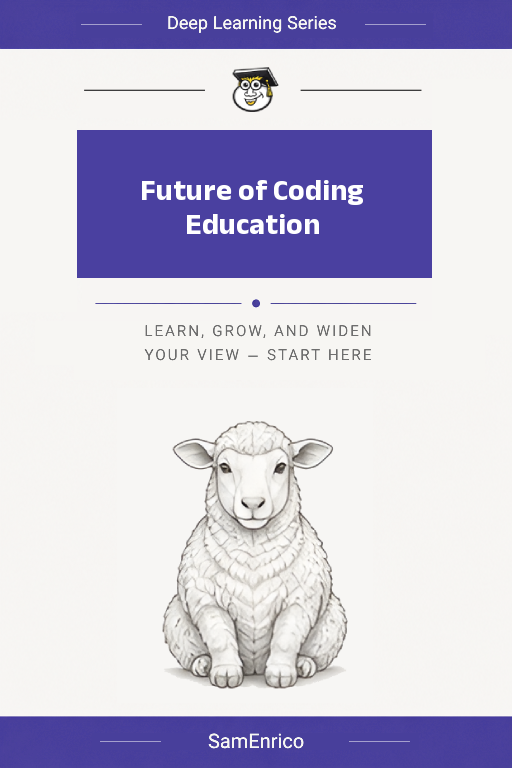
Future of Coding Education
Predicts trends in coding education including micr
by Beaty Hien
Predicts trends in coding education including micro-credentials, employer partnerships, and AI teaching assistants reshaping bootcamp vs degree debate.
Formats
About this book
Free sample
Chapter 1: The Syntax Funeral--–- The obituary arrived on a Tuesday afternoon, buried between a pull request and a Slack notification. “Rote syntax memorization,” it read, “passed away quietly sometime between the release of Git Hub Copilot and the first GPT-4 API calls. It is survived by pattern recognition, algorithmic thinking, and a growing skepticism of anything written in a language younger than the programmer reading it.” No one attended the funeral. Everyone was too busy asking an AI to write their eulogies.This chapter argues that generative AI—Copilot, Cursor, Chat GPT Engineer, and the dozen new tools launched while you read this sentence—has rendered traditional syntax-first coding education obsolete. Not diminished.
Not supplemented. Obsolete. The way we learned to code (memorize syntax, write loops from scratch, debug pointer arithmetic at 2 AM) is no longer the most efficient path to competence. It is not even the second-most efficient path. And yet, most coding bootcamps and university CS programs continue to teach as if the last three years never happened.
They are preparing students for a job that no longer exists, using methods that no longer work, while the actual job has transformed into something unrecognizable.This chapter does something that will feel uncomfortable to many educators and learners: it redefines the goal of coding education entirely. We are moving from “fluency in Python” (or Java, or Rust, or whatever language is trendy this month) to something broader, more durable, and fundamentally human. That something is Software Literacy—the ability to read, critique, orchestrate, debug, and secure AI-generated code. Software Literacy does not require you to write a balanced binary search tree from memory. It requires you to know what a balanced binary search tree is, when to use one, how to ask an AI to generate it correctly, and how to verify that the AI’s output won’t collapse under load or expose user data.This is not a small shift.
It is a pedagogical earthquake. And the ground is already moving beneath our feet.The Great Misalignment: What We Teach vs. What We Actually Do Let us…
This is the end of the free sample. Get the eBook to keep going. Buy now
Contents
- Chapter 1
- Chapter 2
- Chapter 3
- Chapter 4
- Chapter 5
- Chapter 6
- Chapter 7
- Chapter 8
- Chapter 9
- Chapter 10
- Chapter 11
- Chapter 12
Details
- Author
- Beaty Hien
- Publisher
- SamEnrico
- Language
- English
- Genre
- Non-Fiction, Student's Shortcut, Future Trends
- Released
- 2026-06-01
- Pages (approx.)
- 141
- Available as
- eBook, Audiobook

Read better in the ZLOADR app
Your eBooks on your phone or tablet. Sign in with your SamEnrico account and start reading.
More by Beaty Hien
 The Complicated Grief and SecularBeaty Hien$11.99
 Dwight L Moody EvangelistBeaty Hien$11.99
 Beginner Mindfulness for Test AnxietyBeaty Hien$11.99
 Interview Process BenchmarkBeaty Hien$11.99
 The Email Clarity for Remote TeamsBeaty Hien$11.99
 The Forgotten Pioneers: How Australian Rules Football Conquered the British IslesBeaty Hien$11.99
 Understanding Stuve–wiedemann DysplasiaBeaty Hien$17.99
 How to Become a Sheep ShearerBeaty Hien$11.99
 RSPO Certification ExportBeaty Hien$12.99
 Data Center EngineerBeaty Hien$11.99