
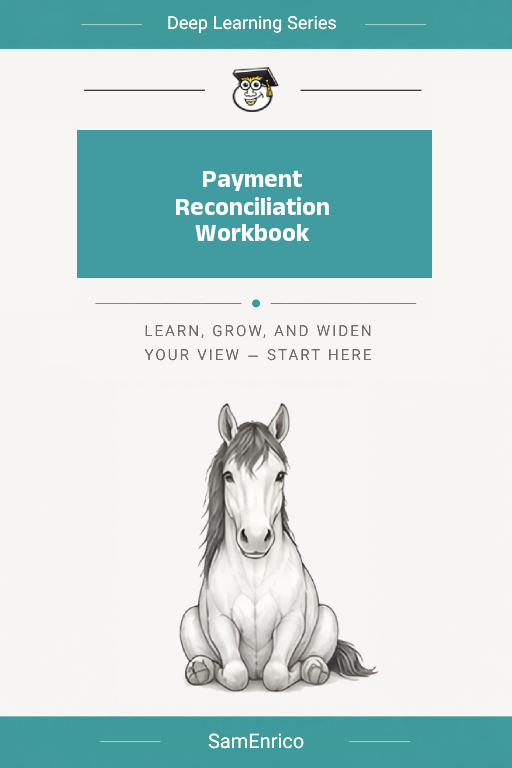
Payment Reconciliation Workbook
Match incoming cross-border payments to invoices a
Match incoming cross-border payments to invoices across multiple currencies and platforms. Automate reconciliation with ERP integrations and reduce manual errors.
Formats
About this book
Free sample
Chapter 1: The $47,000 Mistake--The first time Maria, a controller for a mid-sized e-commerce brand, discovered a 47,000problem,shewasnotlookingforit.Shewastryingtoclosethebooksfor August,aprocessthatusuallytookherteamfivedays.Ondaythree,shenoticedthata47,000 problem, she was not looking for it. She was trying to close the books for August, a process that usually took her team five days. On day three, she noticed that a 47,000problem,shewasnotlookingforit.Shewastryingtoclosethebooksfor August,aprocessthatusuallytookherteamfivedays.Ondaythree,shenoticedthata12,500 payment from a German distributor had been sitting in her bank statement for eleven days, unmatched. The invoice was in USD. The payment arrived in EUR.
Her spreadsheet had converted it at the wrong rate because someone had typed 1.1345 instead of 1.1435. That single fat-finger error triggered a cascade of mismatches across eight related transactions. By the time Maria untangled the mess, she had worked two weekends, her team had processed three duplicate payment inquiries, and the external auditors had flagged a material weakness in her reconciliation controls.The 47,000wasnotasingleloss.Itwasthesumoffifteenhoursofovertime,a47,000 was not a single loss. It was the sum of fifteen hours of overtime, a 47,000wasnotasingleloss.Itwasthesumoffifteenhoursofovertime,a12,000 duplicate payment that was never recovered, a $4,500 chargeback that went unrecognized for sixty days, and the soft cost of delayed financial reporting that caused her CEO to make a pricing decision based on stale cash data. Maria's story is not unusual.
It is the baseline reality for thousands of finance teams who believe that spreadsheets give them control.This chapter dismantles that belief. It exposes the hidden costs of manual reconciliation, introduces the concept of Reconciliation Debt, and establishes the foundational standard that will guide every subsequent chapter of this workbook: the Three-Way Match. By the end of this chapter, you will have calculated your own Reconciliation Debt, mapped your current sources of truth, and committed to retiring the spreadsheet as your primary reconciliation tool—or at least acknowledging the conditions under which it is acceptable to keep it.The Illusion of Safety Spreadsheets are seductive. They are familiar, flexible, and free (or nearly so, bundled into your Microsoft 365 subscription). Every accountant learned pivot tables before they learned ERP modules.
Every finance manager has a "master reconciliation file" named something like Reconciliation_Final_v7.xlsx. The illusion of safety comes from visibility: you…
This is the end of the free sample. Get the eBook to keep going. Buy now
Contents
- Chapter 1
- Chapter 2
- Chapter 3
- Chapter 4
- Chapter 5
- Chapter 6
- Chapter 7
- Chapter 8
- Chapter 9
- Chapter 10
- Chapter 11
- Chapter 12
Details
- Author
- Ricketts Louie
- Publisher
- SamEnrico
- Language
- English
- Genre
- Non-Fiction, Business Brief, Accounting Operations
- Released
- 2026-06-01
- Pages (approx.)
- 148
- Available as
- eBook, Audiobook

Read better in the ZLOADR app
Your eBooks on your phone or tablet. Sign in with your SamEnrico account and start reading.
More by Ricketts Louie
 The Interruption Resilience PrimerRicketts Louie$11.99
 Senior Role Models GuideRicketts Louie$11.99
 Self Hypnosis for HockeyRicketts Louie$11.99
 Signal Status AddictionRicketts Louie$11.99
 The Architect of the Achaemenid: The Black Genius Behind PersepolisRicketts Louie$11.99
 Sekaninaite MiningRicketts Louie$11.99
 How to Produce Air and Water RocketsRicketts Louie$11.99
 How to Become a Pallet AssemblerRicketts Louie$11.99