
Non-FictionInformativeEducational
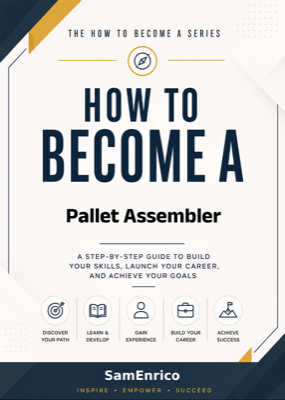
How to Become a Pallet Assembler
How to Become a Pallet Assembler
How to Become a Pallet Assembler
Formats
About this book
Free sample
Chapter 1: The Wood Detective--–- Before you ever pull a trigger on a nail gun, before you clamp a single joint, before you even step onto a shop floor, you have to learn to see what others ignore. Walk into any warehouse, any lumber yard, any recycling center, and you will find pallets stacked in careless columns—treated as identical, interchangeable, worthless. That blindness is your opportunity. Because pallets are not all the same. They carry secrets in their grain, their stamps, their scars.
And the difference between a pallet that survives a 2,500-pound forklift drop and one that explodes on impact begins with what you notice before you touch it.This chapter is not about assembly. It is about identification. It is about becoming what veteran assemblers call a "wood detective"—someone who can look at a stack of lumber and instantly know its species, its moisture content, its legal status for export, its structural limits, and its potential for repair or reuse. The standard grocery pallet measures 48 inches by 40 inches. That much is common knowledge.
But everything beyond that dimension is a mystery to the untrained eye. By the end of this chapter, you will decode ISPM 15 stamps like a customs officer, identify oak versus poplar from ten feet away, and reject wet lumber that will rot before it reaches a customer. You will move from seeing pallets as identical wooden rectangles to understanding them as engineered products with distinct architectures, each designed for a specific job.Let us begin with the skeleton.The Two Great Architectures: Stringer vs. Block Every pallet belongs to one of two families. Learn to distinguish them instantly, because your assembly method, your fastener choice, and your client’s shipping requirements all depend on this single distinction.The first family is the stringer pallet.
Look at it from the side. You will see three parallel runners running the full length of the pallet—these are the stringers. Between them, open spaces allow a forklift to enter from two directions only: the front and the back. The stringers themselves often have notches cut into their…
This is the end of the free sample. Get the eBook to keep going. Buy now
Contents
- Chapter 1
- Chapter 2
- Chapter 3
- Chapter 4
- Chapter 5
- Chapter 6
- Chapter 7
- Chapter 8
- Chapter 9
- Chapter 10
- Chapter 11
- Chapter 12
Details
- Author
- Ricketts Louie
- Publisher
- SamEnrico
- Language
- English
- ISBN
- 9781505767155
- Genre
- Non-Fiction, Informative, Educational
- Released
- 2026-05-25
- Pages (approx.)
- 129
- Available as
- eBook, Paperback, Audiobook

Read better in the ZLOADR app
Your eBooks on your phone or tablet. Sign in with your SamEnrico account and start reading.
More by Ricketts Louie
 The Interruption Resilience PrimerRicketts Louie$11.99
 Senior Role Models GuideRicketts Louie$11.99
 Self Hypnosis for HockeyRicketts Louie$11.99
 Signal Status AddictionRicketts Louie$11.99
 The Architect of the Achaemenid: The Black Genius Behind PersepolisRicketts Louie$11.99
 Sekaninaite MiningRicketts Louie$11.99
 How to Produce Air and Water RocketsRicketts Louie$11.99
 Payment Reconciliation WorkbookRicketts Louie$12.99
You may also like
 Hong Kong Handover 1997Dunn Johnnie$11.99
 Zumba For Postnatal Recovery CourseNeal Christian$11.99
 Zumba for BeginnersLadner Nikia$11.99
 YouTube Comment Mining GuideHumes Pandora$12.99
 Worry Box MeditationCarlin Rudy$11.99
 Workplace Stress MeditationNguyen Lynn$11.99
 Workplace Stress and Sleep RepairHawley Ivory$11.99
 Workplace Perfectionism CureDelaney Jeffry$11.99
 Workplace Injustice Anger GuideWallen Isabelle$11.99
 Work Addiction and Burnout LinkGreenwood Ester$11.99
 Women in Yoga and WellnessBeattie Galina$11.99
 Women in Stand Up ComedyChun Evangeline$11.99