
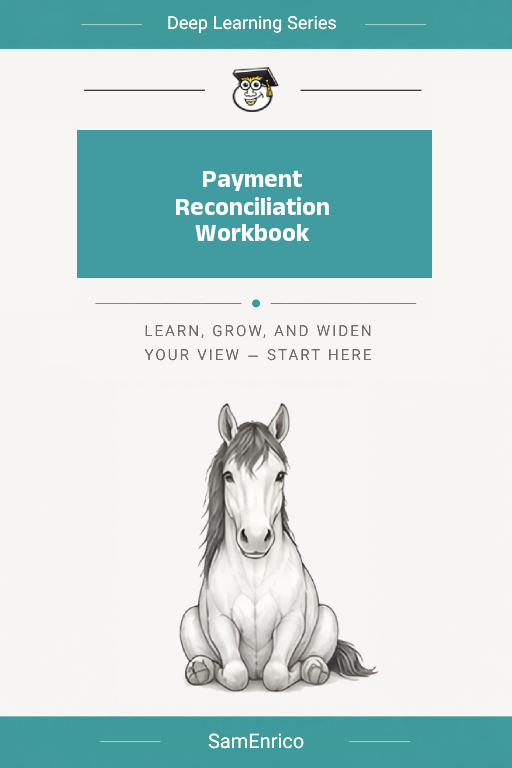
Non-FictionBusiness BriefAccounting Operations
Payment Reconciliation Workbook eBook
Match incoming cross-border payments to invoices a
Match incoming cross-border payments to invoices across multiple currencies and platforms. Automate reconciliation with ERP integrations and reduce manual errors.
Formats
Free sample
Chapter 1: The $47,000 Mistake--The first time Maria, a controller for a mid-sized e-commerce brand, discovered a 47,000problem,shewasnotlookingforit.Shewastryingtoclosethebooksfor August,aprocessthatusuallytookherteamfivedays.Ondaythree,shenoticedthata47,000 problem, she was not looking for it. She was trying to close the books for August, a process that usually took her team five days. On day three, she noticed that a 47,000problem,shewasnotlookingforit.Shewastryingtoclosethebooksfor August,aprocessthatusuallytookherteamfivedays.Ondaythree,shenoticedthata12,500 payment from a German distributor had been sitting in her bank statement for eleven days, unmatched. The invoice was in USD. The payment arrived in EUR.
Her spreadsheet had converted it at the wrong rate because someone had typed 1.1345 instead of 1.1435. That single fat-finger error triggered a cascade of mismatches across eight related transactions. By the time Maria untangled the mess, she had worked two weekends, her team had processed three duplicate payment inquiries, and the external auditors had flagged a material weakness in her reconciliation controls.The 47,000wasnotasingleloss.Itwasthesumoffifteenhoursofovertime,a47,000 was not a single loss. It was the sum of fifteen hours of overtime, a 47,000wasnotasingleloss.Itwasthesumoffifteenhoursofovertime,a12,000 duplicate payment that was never recovered, a $4,500 chargeback that went unrecognized for sixty days, and the soft cost of delayed financial reporting that caused her CEO to make a pricing decision based on stale cash data. Maria's story is not unusual.
It is the baseline reality for thousands of finance teams who believe that spreadsheets give them control.This chapter dismantles that belief. It exposes the hidden costs of manual reconciliation, introduces the concept of Reconciliation Debt, and establishes the foundational standard that will guide every subsequent chapter of this workbook: the Three-Way Match. By the end of this chapter, you will have calculated your own Reconciliation Debt, mapped your current sources of truth, and committed to retiring the spreadsheet as your primary reconciliation tool—or at least acknowledging the conditions under which it is acceptable to keep it.The Illusion of Safety Spreadsheets are seductive. They are familiar, flexible, and free (or nearly so, bundled into your Microsoft 365 subscription). Every accountant learned pivot tables before they learned ERP modules.
Every finance manager has a "master reconciliation file" named something like Reconciliation_Final_v7.xlsx. The illusion of safety comes from visibility: you can see the cells, trace the formulas, and manually override anything that looks wrong. That visibility feels like control.But control requires more than visibility. It requires accuracy, auditability, and resistance to human error. Spreadsheets fail on all three counts when operating at scale.Consider the anatomy of a fat-finger error.
A finance analyst copying a set of transaction IDs from a bank export to a reconciliation template accidentally skips one row. The remaining IDs shift. By the time the matching process runs, Transaction ID #1045 is matched to Invoice #1046. The error propagates silently because spreadsheets do not have referential integrity. In a database, a foreign key constraint would prevent this mismatch.
In Excel, nothing stops you from mismatching thousands of rows before anyone notices.The same problem appears in FX conversions. Manual entry of exchange rates introduces transcription errors. Copy-pasting rates from a website introduces stale data if the rate changed between the time you copied it and the time you applied it. Even the humble VLOOKUP—a function that most finance professionals consider reliable—fails silently when the lookup value is not found, returning an error or, worse, the last valid value from a previous row.These are not theoretical risks. A 2023 study of financial close processes found that companies relying on spreadsheets for reconciliation experienced an average error rate of 2.3 percent per transaction.
At 10,000 monthly transactions, that is 230 errors. Each error requires an average of twelve minutes to investigate and resolve. That is forty-six hours of wasted labor every month, before counting the cost of duplicate payments or missed chargebacks.The Wagamama Case Study: When Manual Reconciliation Fails at Scale Wagamama, the international restaurant chain, learned this lesson painfully. In 2019, the company was processing payments from dozens of delivery partners (Uber Eats, Deliveroo, Just Eat) across multiple currencies and countries. Each partner had its own settlement schedule, fee structure, and data format.
The finance team reconciled each partner's payout report against bank statements using a collection of spreadsheets.The process worked, sort of, when transaction volumes were low. But as Wagamama expanded its delivery footprint, the spreadsheets buckled. The team discovered that they had been overpaying one delivery partner by approximately £300,000 over eighteen months because a spreadsheet formula had been summing the wrong column. The error was discovered only when a new finance hire—someone who had not been trained to trust the spreadsheet—asked why the numbers did not look right.The audit that followed revealed a systemic problem. The manual reconciliation process had no built-in checks.
There was no automated comparison between the total of individual transaction records and the lump-sum settlement deposit. There was no flag for unusual fee deductions. Most critically, there was no three-way match connecting the delivery partner's transaction report, the bank deposit, and the underlying customer invoices.Wagamama ultimately migrated to an automated reconciliation platform. The results were dramatic: match rates went from 72 percent to 99.4 percent, month-end close time dropped from eight days to two days, and the finance team stopped working weekends. But the £300,000 loss was permanent.The lesson is not that Wagamama was careless.
The lesson is that spreadsheets are brittle. They work until they do not. And when they fail, they fail catastrophically because errors propagate silently.The Two-Way Match Fallacy Most manual reconciliation processes are built around two-way matching: compare the payment to the invoice. If the amounts match, mark the invoice paid. If not, investigate.This approach misses the most important source of truth: the bank statement.
A payment is not truly reconciled until the funds have settled in your bank account, net of all fees and adjustments. Two-way matching cannot detect:Fees deducted by the payment processor before settlement Chargebacks that reduce the net deposit Currency conversion losses that the customer did not disclose Bank errors (rare but real)Fraudulent payments that were authorized but later reversed The standard defined in this workbook—and used consistently across all chapters—is the Three-Way Match: Invoice (ERP) ↔ Payment Instruction (PSP or remittance) ↔ Settlement (Bank Statement). Each leg of the triangle provides unique information that the others cannot supply.Leg Source Provides Invoice ERPExpected amount, due date, customer, line items Payment Instruction PSP, payment gateway, or customer remittance Gross amount paid, fees deducted, payer reference Settlement Bank statement Net amount deposited, settlement date, bank reference When all three legs agree, you have a complete reconciliation. When they disagree, the discrepancy tells you where to investigate. For example:Invoice = 100,Payment Instruction=100, Payment Instruction = 100,Payment Instruction=97.10, Bank Statement = 97.10→PSPfeeof97.10 → PSP fee of 97.10→PSPfeeof2.90.
No further action needed if you have a rule for fee handling.Invoice = 100,Payment Instruction=100, Payment Instruction = 100,Payment Instruction=100, Bank Statement = $97.10 → The bank deducted a fee that the PSP did not disclose. Investigate with your bank.Invoice = 100,Payment Instruction=100, Payment Instruction = 100,Payment Instruction=100, Bank Statement = $100 → Perfect match. Post automatically.Invoice = 100,Payment Instruction=notfound,Bank Statement=100, Payment Instruction = not found, Bank Statement = 100,Payment Instruction=notfound,Bank Statement=100 → Unknown deposit. Investigate for prepayment or misapplied cash.The three-way match is…
This is the end of the free sample. Get the eBook to keep going. Buy now
About this book
Details
- Author
- Ricketts Louie
- Publisher
- SamEnrico
- Language
- English
- Genre
- Non-Fiction, Business Brief, Accounting Operations
- Released
- 2026-06-01
- Pages (approx.)
- 148
- Available as
- eBook, Audiobook

Read better in the ZLOADR app
Your eBooks on your phone or tablet. Sign in with your SamEnrico account and start reading.
More by Ricketts Louie
 The Interruption Resilience PrimerRicketts Louie$11.99
 Senior Role Models GuideRicketts Louie$11.99
 Self Hypnosis for HockeyRicketts Louie$11.99
 Signal Status AddictionRicketts Louie$11.99
 The Architect of the Achaemenid: The Black Genius Behind PersepolisRicketts Louie$11.99
 Sekaninaite MiningRicketts Louie$11.99
 How to Produce Air and Water RocketsRicketts Louie$11.99
 How to Become a Pallet AssemblerRicketts Louie$11.99
You may also like
 Hong Kong Handover 1997Dunn Johnnie$11.99
 Zumba For Postnatal Recovery CourseNeal Christian$11.99
 Zumba for BeginnersLadner Nikia$11.99
 YouTube Comment Mining GuideHumes Pandora$12.99
 Worry Box MeditationCarlin Rudy$11.99
 Workplace Stress MeditationNguyen Lynn$11.99
 Workplace Stress and Sleep RepairHawley Ivory$11.99
 Workplace Perfectionism CureDelaney Jeffry$11.99
 Workplace Injustice Anger GuideWallen Isabelle$11.99
 Work Addiction and Burnout LinkGreenwood Ester$11.99
 Women in Yoga and WellnessBeattie Galina$11.99
 Women in Stand Up ComedyChun Evangeline$11.99