
Non-FictionInformativeEducational
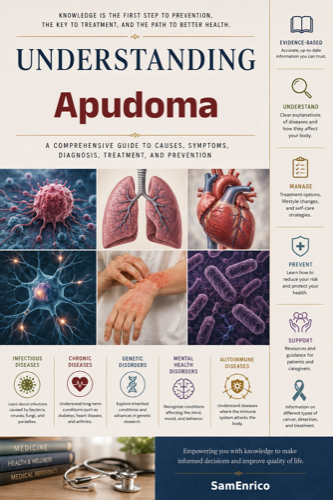
Understanding Apudoma Audiobook
This disease publication, published by SamEnrico,
This disease publication, published by SamEnrico, covers Understanding Apudoma
Formats
Free sample
Chapter 1: The Glowing Cells...--In 1966, a British scientist named Professor A.G.E. Pearse peered through his microscope at a slide of mammalian pituitary tissue. He had done this thousands of times before, but on this particular day, he saw something that would change the course of cancer research forever. The cells before him were behaving unlike any others he had ever studied. They had selectively absorbed a special dye—a fluorescent stain that should have marked only neurons—and yet these cells resided not in the brain or spinal cord, but deep within a gland responsible for producing hormones.
They glowed. They took up precursor molecules, stripped away a single carbon atom, and transformed those precursors into powerful bioactive amines. Pearse called these remarkable cells "APUD cells," an acronym that would eventually lend its name to one of medicine's most misunderstood and misdiagnosed families of tumors: the Apudomas.To understand Apudoma—what it is, why it behaves so strangely, and why it is so frequently missed by even experienced physicians—one must begin not with the tumor itself, but with the normal cell from which it arises. This chapter tells the story of that discovery: the scientific detective work, the evolution of medical terminology, and the biological principles that make Apudomas unique among all human cancers. By the end of this chapter, you will understand not only the history and naming of these tumors but also why the term "Apudoma" remains clinically relevant fifty years after its invention.The Discovery That Changed Everything Before the 1960s, the cells that give rise to Apudomas were considered medical oddities—scattered, unrelated cells in disparate organs that seemed to share no common thread.
Pathologists had described argentaffin cells (cells that take up silver stains) in the gut. Others had identified chromaffin cells in the adrenal medulla. Still others had characterized pancreatic islet cells. No one had connected them.Professor Pearse, working at the Royal Postgraduate Medical School in London, made the connection through a series of elegant experiments. He observed that certain cells shared three critical properties: they could take up amine precursors (chemical building blocks), they could decarboxylate those precursors (remove a carbon atom), and they produced biogenic amines (bioactive compounds like serotonin and dopamine).
From these three properties, he coined the acronym APUD: Amine Precursor Uptake and Decarboxylation.The biochemical pathway Pearse described is deceptively simple. Imagine a cell that can…
This is the end of the free sample. Get the Audiobook to keep going. Buy now
About this book
Details
- Author
- Bagwell Noreen
- Publisher
- SamEnrico
- Language
- English
- Genre
- Non-Fiction, Informative, Educational
- Released
- 2026-05-09
- Pages (approx.)
- 158
- Available as
- eBook, Audiobook

Listen in the VoxFlicks app
Audiobooks and audio dramas wherever you go. Sign in with your SamEnrico account and press play.
More by Bagwell Noreen
 Postpartum Depression GuideBagwell Noreen$11.99
 Career Transition for Retail WorkersBagwell Noreen$11.99
 Thunderbirds Pilot MemoirBagwell Noreen$11.99
 Psychological Relapse Prevention GuideBagwell Noreen$11.99
 Practical Exam Skills GuideBagwell Noreen$11.99
 Career Transition Without BurnoutBagwell Noreen$11.99
 Disappointment After SuccessBagwell Noreen$11.99
 Bombing Accuracy: Norden vs. British SightsBagwell Noreen$11.99
 Citation Rules Quick Reference Card ManualBagwell Noreen$11.99
 The Lost Giants of the Indian Ocean: Uncovering Ancient Fossils Beneath the WavesBagwell Noreen$11.99
 The Vanishing of the Honey Island Swamp MonsterBagwell Noreen$11.99
 The Frozen Hour: The 1972 Andes Flight Disaster RevisitedBagwell Noreen$11.99
You may also like
 Hong Kong Handover 1997Dunn Johnnie$11.99
 Zumba For Postnatal Recovery CourseNeal Christian$11.99
 Zumba for BeginnersLadner Nikia$11.99
 YouTube Comment Mining GuideHumes Pandora$12.99
 Worry Box MeditationCarlin Rudy$11.99
 Workplace Stress MeditationNguyen Lynn$11.99
 Workplace Stress and Sleep RepairHawley Ivory$11.99
 Workplace Perfectionism CureDelaney Jeffry$11.99
 Workplace Injustice Anger GuideWallen Isabelle$11.99
 Work Addiction and Burnout LinkGreenwood Ester$11.99
 Women in Yoga and WellnessBeattie Galina$11.99
 Women in Stand Up ComedyChun Evangeline$11.99