
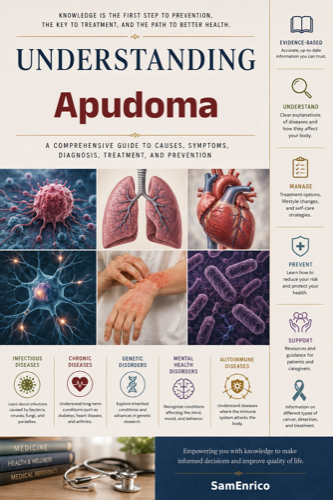
Understanding Apudoma eBook
This disease publication, published by SamEnrico,
This disease publication, published by SamEnrico, covers Understanding Apudoma
Formats
Free sample
Chapter 1: The Glowing Cells...--In 1966, a British scientist named Professor A.G.E. Pearse peered through his microscope at a slide of mammalian pituitary tissue. He had done this thousands of times before, but on this particular day, he saw something that would change the course of cancer research forever. The cells before him were behaving unlike any others he had ever studied. They had selectively absorbed a special dye—a fluorescent stain that should have marked only neurons—and yet these cells resided not in the brain or spinal cord, but deep within a gland responsible for producing hormones.
They glowed. They took up precursor molecules, stripped away a single carbon atom, and transformed those precursors into powerful bioactive amines. Pearse called these remarkable cells "APUD cells," an acronym that would eventually lend its name to one of medicine's most misunderstood and misdiagnosed families of tumors: the Apudomas.To understand Apudoma—what it is, why it behaves so strangely, and why it is so frequently missed by even experienced physicians—one must begin not with the tumor itself, but with the normal cell from which it arises. This chapter tells the story of that discovery: the scientific detective work, the evolution of medical terminology, and the biological principles that make Apudomas unique among all human cancers. By the end of this chapter, you will understand not only the history and naming of these tumors but also why the term "Apudoma" remains clinically relevant fifty years after its invention.The Discovery That Changed Everything Before the 1960s, the cells that give rise to Apudomas were considered medical oddities—scattered, unrelated cells in disparate organs that seemed to share no common thread.
Pathologists had described argentaffin cells (cells that take up silver stains) in the gut. Others had identified chromaffin cells in the adrenal medulla. Still others had characterized pancreatic islet cells. No one had connected them.Professor Pearse, working at the Royal Postgraduate Medical School in London, made the connection through a series of elegant experiments. He observed that certain cells shared three critical properties: they could take up amine precursors (chemical building blocks), they could decarboxylate those precursors (remove a carbon atom), and they produced biogenic amines (bioactive compounds like serotonin and dopamine).
From these three properties, he coined the acronym APUD: Amine Precursor Uptake and Decarboxylation.The biochemical pathway Pearse described is deceptively simple. Imagine a cell that can capture raw materials from the bloodstream—specifically, amino acids like L-dopa (a precursor to dopamine) and 5-hydroxytryptophan (a precursor to serotonin). Inside the cell, an enzyme called an aromatic L-amino acid decarboxylase (or DOPA decarboxylase) removes a carboxyl group (COOH) from these precursors. In doing so, the enzyme transforms an inactive building block into a potent, biologically active molecule. That molecule can then be stored in secretory granules, waiting to be released into the bloodstream to affect distant organs—or into nearby tissues to affect neighboring cells.What made Pearse's discovery revolutionary was not the biochemistry itself, but his realization that this ability was not limited to a single organ.
He went on to identify APUD cells in the pituitary gland, the thyroid (C cells, which produce calcitonin), the parathyroids, the adrenal medulla (chromaffin cells, which produce catecholamines), the pancreatic islets (which produce insulin and glucagon), and the entire gastrointestinal tract (enterochromaffin cells, which produce serotonin and other peptides). These cells, Pearse proposed, formed a Diffuse Neuroendocrine System (DNES)—a network of neuroendocrine cells scattered throughout the body but united by a common embryonic origin and a shared biochemical toolkit.From APUD Cells to Apudomas As with any cell in the body, APUD cells can undergo neoplastic transformation—they can become cancerous. When they do, the resulting tumor retains many of the properties of the original cell. It can take up amine precursors. It can decarboxylate them.
And, crucially for patients, it can secrete bioactive amines and peptides into the bloodstream, causing a bewildering array of symptoms.Pearse proposed the term "Apudoma" to describe tumors arising from these APUD cells. The term caught on quickly in the pathology and endocrinology communities of the 1970s and 1980s. For the first time, physicians had a unifying concept that explained why a tumor in the pancreas (an insulinoma) and a tumor in the small intestine (a carcinoid) could behave similarly: both arose from APUD cells. Both could secrete hormones. Both tended to grow slowly.
Both required similar diagnostic approaches.Yet the term "Apudoma" also generated controversy. Some argued that it was too narrow, focusing on a single biochemical property (amine uptake and decarboxylation) that not all neuroendocrine tumors exhibit to the same degree. Others pointed out that the term lumped together tumors that had important clinical differences—a pancreatic gastrinoma, for example, has a different prognosis and treatment than an ileal carcinoid. By the 1990s, the World Health Organization (WHO) had begun to phase out the term "Apudoma" in favor of Neuroendocrine Tumor (NET) , a broader, more descriptive term that emphasized the cell of origin (neuroendocrine) rather than a specific biochemical pathway.The Modern Terminology: Apudoma vs. Neuroendocrine Tumor Today, a patient diagnosed with an Apudoma is almost certainly diagnosed with what physicians call a Neuroendocrine Tumor (NET).
The two terms are, for all practical purposes, synonymous. However, understanding the history of the term "Apudoma" provides insight into the biology of these tumors that the more generic term "NET" does not.Why "Apudoma" still matters: The APUD concept emphasizes three critical features of these tumors that remain clinically relevant:Hormone production: Because Apudomas arise from cells designed to secrete hormones, they frequently produce excess hormones themselves. This is why functioning Apudomas cause dramatic syndromes like carcinoid syndrome (serotonin excess), Zollinger-Ellison syndrome (gastrin excess), and insulinoma (insulin excess). The term "Apudoma" reminds the clinician to look for hormone-mediated symptoms.Amine precursor uptake: The ability of Apudomas to take up amine precursors is not just a historical curiosity—it is the basis of modern functional imaging. The 68Gallium-DOTATATE PET/CT scan, the gold standard for detecting neuroendocrine tumors, works precisely because Apudoma cells express somatostatin receptors, which are part of the broader APUD machinery.
The same biological property that Pearse identified in the 1960s allows radiologists to make these tumors light up like beacons on a scan.Slow growth: Many Apudomas are indolent, growing over years or decades. This is a direct reflection of their origin from slowly dividing neuroendocrine cells. The APUD concept explains why a patient can live with metastatic Apudoma for ten or twenty years—a reality that distinguishes these tumors from almost all other metastatic cancers.Why "Neuroendocrine Tumor" is now preferred: The modern term NET emphasizes the cell lineage (neuroendocrine) rather than a specific biochemical pathway. It is more inclusive—encompassing both high-grade and low-grade tumors, functioning and non-functioning, well-differentiated and poorly differentiated. It also aligns with current WHO classification systems, which grade NETs by mitotic count and Ki-67 index rather than by APUD biochemistry alone.In this book, the terms "Apudoma" and "Neuroendocrine Tumor (NET)" are used interchangeably.
The historical term is preserved in the title to honor the scientific legacy of Pearse's discovery and to provide a conceptual framework that many patients and physicians still find useful.…
This is the end of the free sample. Get the eBook to keep going. Buy now
About this book
Details
- Author
- Bagwell Noreen
- Publisher
- SamEnrico
- Language
- English
- Genre
- Non-Fiction, Informative, Educational
- Released
- 2026-05-09
- Pages (approx.)
- 158
- Available as
- eBook, Audiobook

Read better in the ZLOADR app
Your eBooks on your phone or tablet. Sign in with your SamEnrico account and start reading.
More by Bagwell Noreen
 Postpartum Depression GuideBagwell Noreen$11.99
 Career Transition for Retail WorkersBagwell Noreen$11.99
 Thunderbirds Pilot MemoirBagwell Noreen$11.99
 Psychological Relapse Prevention GuideBagwell Noreen$11.99
 Practical Exam Skills GuideBagwell Noreen$11.99
 Career Transition Without BurnoutBagwell Noreen$11.99
 Disappointment After SuccessBagwell Noreen$11.99
 Bombing Accuracy: Norden vs. British SightsBagwell Noreen$11.99
 Citation Rules Quick Reference Card ManualBagwell Noreen$11.99
 The Lost Giants of the Indian Ocean: Uncovering Ancient Fossils Beneath the WavesBagwell Noreen$11.99
 The Vanishing of the Honey Island Swamp MonsterBagwell Noreen$11.99
 The Frozen Hour: The 1972 Andes Flight Disaster RevisitedBagwell Noreen$11.99