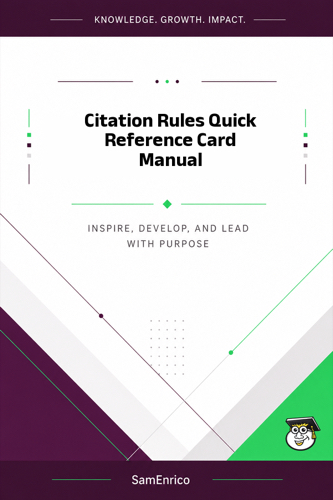
Citation Rules Quick Reference Card Manual
undefined
undefined
Formats
About this book
Free sample
Chapter 1: The Four Pillars--–- Every citation in human history, from Plato’s footnotes to your professor’s syllabus, asks the same four questions. You have never been told this directly. Most style guides bury this truth under thousands of style-specific rules, leaving you to believe that APA, MLA, Chicago, and Bluebook are separate languages rather than dialects of a single, logical system. This chapter dismantles that confusion. Before you learn how to italicize a journal title or abbreviate a legal reporter, you must understand the universal grammar that makes all citations work.
Master this chapter, and every subsequent page of this manual becomes intuitive. Ignore it, and you will spend years memorizing rules instead of understanding principles.The Secret That Style Guides Won’t Tell You Open any citation manual. You will see endless entries: how to cite a You Tube video, how to cite a government document, how to cite a tweet, how to cite a lecture, how to cite a painting. These are not separate rules. They are variations on a single template.
Every source ever cited contains exactly four categories of information, no more and no less. Call them the Four Pillars.The first pillar is Who – the author, creator, editor, or institution responsible for the work. The second pillar is When – the date of publication, creation, or last update. The third pillar is What – the title of the specific work you consulted. The fourth pillar is Where – the location where a reader can find that work, whether a publisher’s name, a page range, a URL, a DOI, or a physical archive.That is it.
Every citation in APA, MLA, Chicago, Bluebook, Harvard, Vancouver, Turabian, or any other system is simply a rearrangement of these four pillars with different punctuation and typography. A citation is not magic. It is a standardized address. The Four Pillars tell your reader: This person (Who) created this thing (What) at this time (When), and you can find it here (Where).Why has no one told you this before? Because style guides profit from complexity.
The American Psychological Association sells its 400-page manual. The Modern Language Association sells its 400-page handbook. The Chicago Manual of…
This is the end of the free sample. Get the eBook to keep going. Buy now
Contents
- Chapter 1
- Chapter 2
- Chapter 3
- Chapter 4
- Chapter 5
- Chapter 6
- Chapter 7
- Chapter 8
- Chapter 9
- Chapter 10
- Chapter 11
- Chapter 12
Details
- Author
- Bagwell Noreen
- Publisher
- SamEnrico
- Language
- English
- Genre
- Non-Fiction, Student's Shortcut, Quick Reference
- Released
- 2026-06-06
- Pages (approx.)
- 146
- Available as
- eBook, Audiobook

Read better in the ZLOADR app
Your eBooks on your phone or tablet. Sign in with your SamEnrico account and start reading.
More by Bagwell Noreen
 Postpartum Depression GuideBagwell Noreen$11.99
 Career Transition for Retail WorkersBagwell Noreen$11.99
 Thunderbirds Pilot MemoirBagwell Noreen$11.99
 Psychological Relapse Prevention GuideBagwell Noreen$11.99
 Practical Exam Skills GuideBagwell Noreen$11.99
 Career Transition Without BurnoutBagwell Noreen$11.99
 Disappointment After SuccessBagwell Noreen$11.99
 Bombing Accuracy: Norden vs. British SightsBagwell Noreen$11.99
 The Lost Giants of the Indian Ocean: Uncovering Ancient Fossils Beneath the WavesBagwell Noreen$11.99
 The Vanishing of the Honey Island Swamp MonsterBagwell Noreen$11.99
 The Frozen Hour: The 1972 Andes Flight Disaster RevisitedBagwell Noreen$11.99
 How to Become a Quality-control InspectorBagwell Noreen$11.99