
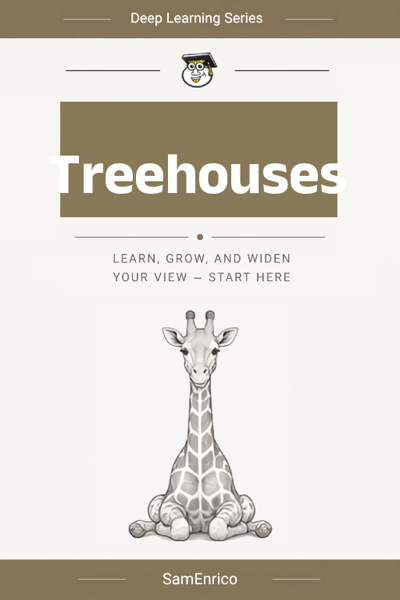
Treehouses
A Coursebook on Treehouses
A Coursebook on Treehouses
Formats
About this book
Free sample
Chapter 1: The Question Before the Hammer--–- Before a single board is cut, before a single nail is driven, before you even climb the tree to size it up, there is one question you must answer with absolute honesty: Why are you building this? The answer shapes everything that follows—the height, the budget, the materials, the safety features, the tree you select, and even whether you should build at all. A treehouse built for a five-year-old who will outgrow it in three summers is a fundamentally different structure than a writer’s studio meant to last twenty years, which is different still from a weekend guest suite or a meditation retreat. Most failed treehouse projects—and there are many—fail not because of bad carpentry but because of a mismatch between purpose and design. Someone builds a playhouse forty feet in the air.
Someone else builds a lavish guest suite without insulation. Someone builds a retreat but forgets to account for the weight of the furniture. This chapter forces you to get clear on your “why” before you spend a dollar or drive a single screw.The Four Archetypes of Treehouse Purpose Over decades of studying the best-selling treehouse literature—from the practical plans of David Stiles to the architectural wonders of Pete Nelson—four primary purposes emerge again and again. Every successful treehouse falls into one of these categories or a hybrid of two. Understanding which archetype you are building for will determine nearly every subsequent decision in this coursebook.Playhouse.
This is the treehouse of childhood imagination: a secret fort, a pirate ship, a castle in the air. Playhouses are typically built low to the ground—no more than six to eight feet at the platform—because falls from greater heights carry life-altering consequences. They prioritize safety over aesthetics, durability over finishes, and simplicity over complexity. Furnishings are minimal: perhaps a bench, a shelf for treasures, a rope ladder that can be pulled up. The expected lifespan is three to seven years, until the children grow older or lose interest.
Because playhouses are lightweight and temporary, they can often be built with smaller trees (though never below the 12-inch diameter…
This is the end of the free sample. Get the eBook to keep going. Buy now
Contents
- Chapter 1
- Chapter 2
- Chapter 3
- Chapter 4
- Chapter 5
- Chapter 6
- Chapter 7
- Chapter 8
- Chapter 9
- Chapter 10
- Chapter 11
- Chapter 12
Details
- Author
- Jennings Dana
- Publisher
- SamEnrico
- Language
- English
- Genre
- Non-Fiction, Informative, Educational
- Released
- 2026-05-04
- Pages (approx.)
- 144
- Available as
- eBook, Audiobook

Read better in the ZLOADR app
Your eBooks on your phone or tablet. Sign in with your SamEnrico account and start reading.
More by Jennings Dana
 Collaborative Art For Business Creativity ManualJennings Dana$11.99
 Slovak Labor MobilityJennings Dana$11.99Slovak Labor MobilityJennings Dana$11.99
 Restaurant Weight Loss GuideJennings Dana$11.99
 Waiting and Delay Anger PatternsJennings Dana$11.99
 The Lead Generation Funnel HandbookJennings Dana$11.99
 Frozen Secrets of the White Continent: Uncovering Antarctica's Hidden PastJennings Dana$11.99
 The Day the Beatles Never Broke Up: A Musical Timeline DividedJennings Dana$11.99
 Understanding Chromosome 8, Trisomy 8qJennings Dana$17.99
 How to Start a Consulting Service BusinessJennings Dana$11.99
 Supabase Firebase AlternativeJennings Dana$12.99
 ESOP Buyer Profile GuideJennings Dana$12.99