
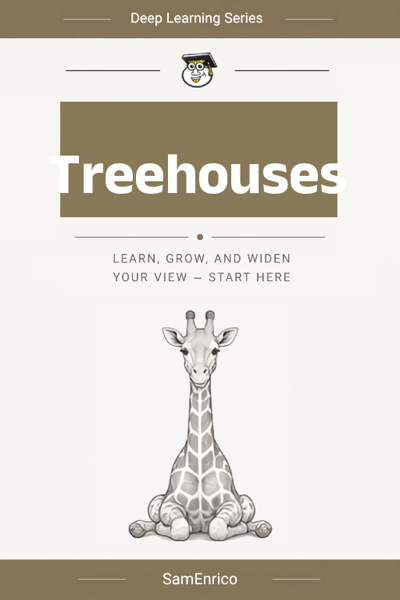
Treehouses eBook
A Coursebook on Treehouses
A Coursebook on Treehouses
Formats
Free sample
Chapter 1: The Question Before the Hammer--–- Before a single board is cut, before a single nail is driven, before you even climb the tree to size it up, there is one question you must answer with absolute honesty: Why are you building this? The answer shapes everything that follows—the height, the budget, the materials, the safety features, the tree you select, and even whether you should build at all. A treehouse built for a five-year-old who will outgrow it in three summers is a fundamentally different structure than a writer’s studio meant to last twenty years, which is different still from a weekend guest suite or a meditation retreat. Most failed treehouse projects—and there are many—fail not because of bad carpentry but because of a mismatch between purpose and design. Someone builds a playhouse forty feet in the air.
Someone else builds a lavish guest suite without insulation. Someone builds a retreat but forgets to account for the weight of the furniture. This chapter forces you to get clear on your “why” before you spend a dollar or drive a single screw.The Four Archetypes of Treehouse Purpose Over decades of studying the best-selling treehouse literature—from the practical plans of David Stiles to the architectural wonders of Pete Nelson—four primary purposes emerge again and again. Every successful treehouse falls into one of these categories or a hybrid of two. Understanding which archetype you are building for will determine nearly every subsequent decision in this coursebook.Playhouse.
This is the treehouse of childhood imagination: a secret fort, a pirate ship, a castle in the air. Playhouses are typically built low to the ground—no more than six to eight feet at the platform—because falls from greater heights carry life-altering consequences. They prioritize safety over aesthetics, durability over finishes, and simplicity over complexity. Furnishings are minimal: perhaps a bench, a shelf for treasures, a rope ladder that can be pulled up. The expected lifespan is three to seven years, until the children grow older or lose interest.
Because playhouses are lightweight and temporary, they can often be built with smaller trees (though never below the 12-inch diameter rule in Chapter 2) and simpler attachment systems. However, do not mistake “temporary” for “flimsy.” A playhouse must still support the weight of multiple children jumping in unison—a live load that can exceed that of adults sitting quietly.Studio. This is the treehouse as workspace: an artist’s studio, a writer’s retreat, a musician’s practice room, or a remote office. Studios require natural light (large windows or skylights), weatherproofing (rain and wind protection), and often electricity for laptops, lamps, or tools. The platform height is typically eight to fifteen feet—high enough for privacy and a sense of separation but low enough for easy access without complex stairs or bridges.
Studios demand insulation if used in cold climates and ventilation if used in summer. Furnishings include a desk, chair, storage, and sometimes a small wood stove or space heater. Unlike playhouses, studios are built for long-term use, often a decade or more, which means tree selection, attachment systems, and material quality must be correspondingly higher. The expected user is one to two adults, so live load calculations (Chapter 5) can be more precise than the over-engineered safety margins required for unpredictable children.Guest Suite. The most demanding of the four archetypes.
A guest suite is a habitable space where someone might sleep, eat, and spend extended time. This means insulation for all four seasons, privacy (solid walls, window coverings), a means of egress that meets safety codes, and often a composting toilet (see Chapter 10 for options). Guest suites require the largest platforms—typically 10×12 feet or more—and the strongest trees. They are built at heights ranging from eight to twenty feet, often with proper stairs rather than ladders. Because guests are not treehouse experts, safety features must be intuitive and foolproof: sturdy railings, non-slip treads, clear pathways.
The expected lifespan is ten to thirty years, which demands the highest-quality hardware, the healthiest trees, and a serious commitment to maintenance (Chapter 12). A guest suite is essentially a small cabin that happens to be in a tree. Do not undertake this archetype as your first treehouse.Retreat. The retreat is the philosophical cousin of the studio but with a different intention. While a studio is for doing (writing, painting, practicing), a retreat is for being (meditating, resting, disconnecting).
Retreats are often minimalist or even open-air—a simple platform with a roof and a comfortable chair, surrounded by leaves and sky. They may have no walls at all, or only screens to keep out insects. Furnishings are sparse: a hammock, a cushion, a small table for tea. Retreats can be built quite low (six to eight feet) or quite high (fifteen to twenty feet) depending on the desired feeling of elevation and seclusion. Because they are simple structures, retreats are suitable for beginners, provided the builder does not overcomplicate them.
The danger with retreats is scope creep: what starts as a meditation platform becomes a screened porch becomes a partially walled room becomes a de facto guest suite. Stay true to the minimalist vision, or reclassify your project as a studio or guest suite and adjust your plans accordingly.The Triad Balance: Aesthetics, Safety, Ecology Every treehouse exists at the intersection of three competing priorities. Pete Nelson calls this the “treehouse triangle” in his masterwork Treehouses of the World. David Stiles frames it as “beauty, brawn, and bark.” Regardless of terminology, the concept is the same: you cannot maximize all three simultaneously. Every choice is a trade-off.Aesthetics is the visual and emotional appeal of the treehouse.
A beautiful treehouse feels like it belongs in the tree, not imposed upon it. It respects the natural lines of branches, uses materials that weather gracefully (cedar, copper, stone), and creates a sense of wonder. Aesthetics often conflicts with ecology: the most beautiful design might require cutting a branch that keeps the tree healthy, or placing a window exactly where a major limb grows. It also conflicts with safety: the most beautiful railing might have gaps that are too wide, or the most beautiful roof might be too heavy for the supporting beams. The solution is not to abandon aesthetics but to integrate it early, not as an afterthought.
A beautiful treehouse that falls down or kills a tree is not beautiful at all.Safety is the non-negotiable floor. No treehouse should ever be built without guardrails, without load calculations, without emergency egress, without proper attachment hardware. Safety is not a matter of opinion or style; it is a matter of physics and human anatomy. A fall from ten feet onto packed earth can fracture a skull. A platform that collapses under snow load can crush a child.
A ladder that rotates can break an adult’s back. Safety often conflicts with aesthetics (utilitarian railings are not as pretty as minimalist cables) and with ecology (the safest attachments are often the most invasive to the tree). But safety always wins. If a design choice compromises safety, the design must change. No exception.Ecology is the tree’s right to survive and thrive.
Too many treehouse builders treat the tree as an inert telephone pole—an anchor to be drilled into without concern for…
This is the end of the free sample. Get the eBook to keep going. Buy now
About this book
Details
- Author
- Jennings Dana
- Publisher
- SamEnrico
- Language
- English
- Genre
- Non-Fiction, Informative, Educational
- Released
- 2026-05-04
- Pages (approx.)
- 144
- Available as
- eBook, Audiobook

Read better in the ZLOADR app
Your eBooks on your phone or tablet. Sign in with your SamEnrico account and start reading.
More by Jennings Dana
 Collaborative Art For Business Creativity ManualJennings Dana$11.99
 Slovak Labor MobilityJennings Dana$11.99Slovak Labor MobilityJennings Dana$11.99
 Restaurant Weight Loss GuideJennings Dana$11.99
 Waiting and Delay Anger PatternsJennings Dana$11.99
 The Lead Generation Funnel HandbookJennings Dana$11.99
 Frozen Secrets of the White Continent: Uncovering Antarctica's Hidden PastJennings Dana$11.99
 The Day the Beatles Never Broke Up: A Musical Timeline DividedJennings Dana$11.99
 Understanding Chromosome 8, Trisomy 8qJennings Dana$17.99
 How to Start a Consulting Service BusinessJennings Dana$11.99
 Supabase Firebase AlternativeJennings Dana$12.99
 ESOP Buyer Profile GuideJennings Dana$12.99