
Non-FictionBusiness BriefPreference Programs
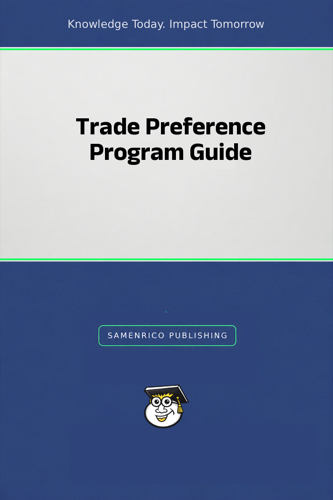
Trade Preference Program Guide eBook
Claim duty free benefits under GSP, AGOA, and othe
Claim duty free benefits under GSP, AGOA, and other preference programs using this handbook.
Formats
Free sample
Chapter 1: The Million-Dollar Mistake--–- In a cramped warehouse outside Newark, New Jersey, a mid-sized importer of Ethiopian leather handbags had just finished a routine customs audit. The result was not routine. Over five years, the company had paid $1.7 million in duties on products that should have entered the United States completely tax-free under the African Growth and Opportunity Act (AGOA). Their competitor, a similar importer based in Los Angeles, had paid zero. The difference was not quality, speed, or relationships.
The difference was knowledge. The Newark importer simply did not know that a trade preference program existed for African-made goods. Their customs broker had never mentioned it. Their suppliers in Addis Ababa had never heard of it. And so, for sixty consecutive months, they wrote checks to U.S.
Customs and Border Protection (CBP) for money they never owed. This book exists to ensure you are never that importer.The $100 Billion Blind Spot Trade preference programs are among the best-kept secrets in international commerce. Collectively, the United States operates over a dozen unilateral preference programs—including the Generalized System of Preferences (GSP), the African Growth and Opportunity Act (AGOA), the Caribbean Basin Trade Partnership Act (CBTPA), the Haiti HOPE/HELP legislation, and the Andean Trade Preference Act (ATPA)—that together cover tens of thousands of products from more than 130 countries. These programs allow eligible products to enter the U.S. market duty-free or at significantly reduced tariff rates, provided the importer follows specific origin, documentation, and shipping rules.Yet despite the enormous savings available, preference programs remain dramatically underutilized.
According to the United Nations Conference on Trade and Development (UNCTAD), global utilization rates for GSP-style programs average less than 60 percent across developing countries. For smaller exporters and first-time users, the rate drops below 30 percent. In plain language: billions of dollars in legally avoidable tariffs are paid every year simply because importers and exporters do not know the rules or are afraid to navigate them.This chapter introduces you to the fundamental architecture of U.S. trade preference programs: what they are, how they differ from free trade agreements, why Congress creates them, and why they periodically disappear (only to be resurrected). By the end of this chapter, you will understand not only the strategic value of these programs but also the political and legal landscape that shapes them.
You will learn why your competitors may already be using preference programs without you knowing it—and how to close that gap starting tomorrow.Unilateral vs. Reciprocal: The Critical Distinction Before diving into specific programs, you must understand the fundamental legal and economic distinction between two types of trade agreements: unilateral preference programs and reciprocal free trade agreements (FTAs). This distinction shapes everything from documentation requirements to political risk to long-term supply chain strategy.Reciprocal Free Trade Agreements—such as the United States-Mexico-Canada Agreement (USMCA), the U.S.-Korea FTA, or the U.S.-Peru Trade Promotion Agreement—are bilateral or multilateral treaties in which the United States grants tariff concessions in exchange for equivalent concessions from its trading partners. If the U.S. eliminates tariffs on Korean automobiles, Korea must eliminate tariffs on U.S.
beef. These agreements are negotiated over years, ratified by Congress through special fast-track procedures, and are generally permanent (though they may be modernized). They require detailed rules of origin, substantial documentation, and often include investor-state dispute settlement mechanisms.Unilateral Preference Programs—the subject of this book—are fundamentally different. Under GSP, AGOA, CBTPA, and similar programs, the United States unilaterally grants duty-free access to certain products from designated beneficiary countries without requiring those countries to provide reciprocal tariff reductions. The United States gives; it does not demand equal concessions in return.
This asymmetry is not an accident. It reflects a deliberate policy choice: using trade preferences as a tool of economic development, foreign policy, and geopolitical influence.Congress authorizes these programs not as treaties but as domestic legislation. The Trade Act of 1974 created GSP. The African Growth and Opportunity Act of 2000 created AGOA. The Caribbean Basin Economic Recovery Act of 1983 created the CBTPA framework.
Because these are statutes, not treaties, they expire periodically unless Congress affirmatively renews them. This expiration risk—known in trade circles as "program lapse"—is one of the most important and least understood risks facing importers who rely on preferences. A program that exists today may not exist next month. And when it lapses, duties become due on goods that would otherwise enter duty-free.The Legal Architecture: How Congress Creates (and Kills) Preferences Understanding the legislative mechanics of preference programs is essential for any serious supply chain manager. These programs do not exist in perpetuity.
They are subject to congressional calendars, political horse-trading, and periodic expiration that can last months or years.GSP, for example, was originally authorized for ten years under the Trade Act of 1974. Since then, Congress has renewed it more than a dozen times, often retroactively. The most significant lapse occurred in 2018, when GSP expired in December of that year and was not renewed until March 2020—a gap of fifteen months that forced importers to post cash deposits or bonds on millions of dollars' worth of goods. When Congress finally renewed GSP retroactively, importers scrambled to file post-importation claims under 19 U.S.C. § 1520(d) to recover duties paid during the lapse.
Some succeeded. Others, who had not maintained proper documentation or had not paid duties under protest, lost hundreds of thousands of dollars.AGOA has a different legislative rhythm. Originally authorized for fifteen years, it has been extended multiple times, most recently through 2025. But AGOA's country-specific eligibility is reviewed annually by the Office of the United States Trade Representative (USTR). A country that meets the economic and political criteria one year may be suspended the next.
Ethiopia, Mali, Guinea, and Burkina Faso have all been suspended from AGOA following political instability or human rights concerns. The 2019 suspension of India and Turkey from GSP—discussed in detail in Chapter 10—demonstrates how quickly preference benefits can disappear for entire product categories or entire countries.Beneficiary Countries: Who Qualifies and Who Does Not Not every country qualifies for every preference program. Each program has its own list of beneficiary countries, and those lists change over time based on economic indicators, political developments, and legislative amendments.For GSP, beneficiary status is determined primarily by per capita income. The World Bank classifies countries into income tiers, and GSP eligibility generally excludes high-income countries. In 2019, the Trump administration suspended India and Turkey from GSP after determining that both countries had gained sufficient market access to U.S.
markets without providing equivalent access to U.S. exports. India, for example, had become a net exporter of medical devices to the United States while maintaining import barriers on U.S. medical devices. The suspension affected thousands of products, from Indian jewelry to Turkish carpets, forcing U.S.
importers to either absorb full Most Favored Nation (MFN) duties or find alternative sources.For AGOA, the criteria are broader and more subjective. Under the AGOA Implementation Act, a country must demonstrate progress toward:– A market-based economy that respects private property rights and the rule of law– Political pluralism and the rule of law– Elimination of barriers to U.S. trade…
This is the end of the free sample. Get the eBook to keep going. Buy now
About this book
Details
- Author
- Brownlee Cori
- Publisher
- SamEnrico
- Language
- English
- Genre
- Non-Fiction, Business Brief, Preference Programs
- Released
- 2026-06-06
- Pages (approx.)
- 151
- Available as
- eBook, Audiobook

Read better in the ZLOADR app
Your eBooks on your phone or tablet. Sign in with your SamEnrico account and start reading.
More by Brownlee Cori
 The Bedtime Body ScanBrownlee Cori$11.99
 Hypnotic Nerve Pain GuideBrownlee Cori$11.99
 Global Team Async Workflow GuideBrownlee Cori$11.99
 Executive Kidnap Crisis Logistics ManualBrownlee Cori$11.99
 The 21st Century's Silent Revolution: How the Right to Repair Movement Became LawBrownlee Cori$11.99
 Echoes of the Forgotten: The Lost Tapes of the 1969 Apollo 11 Backup CrewBrownlee Cori$11.99
 Part Time Work Dubai StudentsBrownlee Cori$12.99
 Blockchain Supply Chain TrackBrownlee Cori$12.99
 Rv Cleaning (Waste Tank Handling)Brownlee Cori$11.99
 Understanding Congenital Mitral MalformationBrownlee Cori$17.99
You may also like
 Hong Kong Handover 1997Dunn Johnnie$11.99
 Zumba For Postnatal Recovery CourseNeal Christian$11.99
 Zumba for BeginnersLadner Nikia$11.99
 YouTube Comment Mining GuideHumes Pandora$12.99
 Worry Box MeditationCarlin Rudy$11.99
 Workplace Stress MeditationNguyen Lynn$11.99
 Workplace Stress and Sleep RepairHawley Ivory$11.99
 Workplace Perfectionism CureDelaney Jeffry$11.99
 Workplace Injustice Anger GuideWallen Isabelle$11.99
 Work Addiction and Burnout LinkGreenwood Ester$11.99
 Women in Yoga and WellnessBeattie Galina$11.99
 Women in Stand Up ComedyChun Evangeline$11.99