
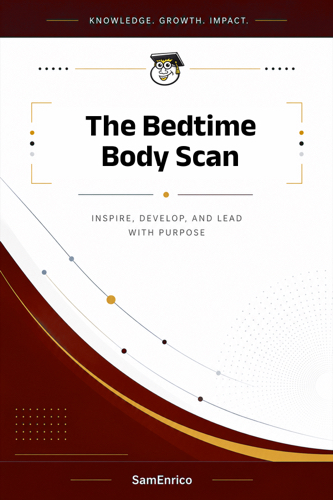
The Bedtime Body Scan
Transition practice from wakefulness to sleep.
Transition practice from wakefulness to sleep.
Formats
About this book
Free sample
Chapter 1: The Paradox of Effort--–- You are reading this book because you have tried to fall asleep. That is precisely the problem.Let that land for a moment. Every night, you perform the same ritual: you climb into bed, arrange the pillows, turn off the light, and then you try. You try to relax. You try to quiet your mind.
You try to breathe slowly. You try not to think about tomorrow's meeting or last week's argument or the fact that you are, at this very moment, not sleeping. And the more you try, the wider awake you become.This is not a personal failing. It is not a sign of weakness, anxiety, or a "broken" brain. It is, instead, a perfectly predictable consequence of how your brain is wired — and how modern life has hijacked that wiring.
The central argument of this book, and the foundation of everything that follows, is this: gross effort — the kind involving forcing, striving, and performance anxiety — is the enemy of sleep. Conversely, gentle effort — the soft, permission-based act of noticing without demanding — is the gateway to the bridge state between waking and dreaming.But before we can teach you how to apply gentle effort, we must first understand why gross effort fails so spectacularly. And to understand that, we need to take a brief journey into the neuroscience of the restless mind.The Anatomy of a Sleepless Night Imagine your brain at 11:15 PM. You have been in bed for fifteen minutes. The room is dark.
Your body is still. And yet, your mind is anything but quiet. You are running through a mental list of what you need to do tomorrow. You are replaying a comment you made in a meeting that you now regret. You are calculating how many hours of sleep you will get if you fall asleep right now.
You are, in short, thinking about yourself — your past, your future, your performance, your failures, your obligations.The region of your brain responsible for this kind of self-referential thinking is called the default mode network, or DMN. Neuroscientists gave it…
This is the end of the free sample. Get the eBook to keep going. Buy now
Contents
- Chapter 1
- Chapter 2
- Chapter 3
- Chapter 4
- Chapter 5
- Chapter 6
- Chapter 7
- Chapter 8
- Chapter 9
- Chapter 10
- Chapter 11
- Chapter 12
Details
- Author
- Brownlee Cori
- Publisher
- SamEnrico
- Language
- English
- Genre
- Non-Fiction, Self-Help, Evening
- Released
- 2026-06-09
- Pages (approx.)
- 150
- Available as
- eBook, Audiobook

Read better in the ZLOADR app
Your eBooks on your phone or tablet. Sign in with your SamEnrico account and start reading.
More by Brownlee Cori
 Hypnotic Nerve Pain GuideBrownlee Cori$11.99
 Global Team Async Workflow GuideBrownlee Cori$11.99
 Executive Kidnap Crisis Logistics ManualBrownlee Cori$11.99
 Trade Preference Program GuideBrownlee Cori$11.99
 The 21st Century's Silent Revolution: How the Right to Repair Movement Became LawBrownlee Cori$11.99
 Echoes of the Forgotten: The Lost Tapes of the 1969 Apollo 11 Backup CrewBrownlee Cori$11.99
 Part Time Work Dubai StudentsBrownlee Cori$12.99
 Blockchain Supply Chain TrackBrownlee Cori$12.99
 Rv Cleaning (Waste Tank Handling)Brownlee Cori$11.99
 Understanding Congenital Mitral MalformationBrownlee Cori$17.99
You may also like
 Hong Kong Handover 1997Dunn Johnnie$11.99
 Zumba For Postnatal Recovery CourseNeal Christian$11.99
 Zumba for BeginnersLadner Nikia$11.99
 YouTube Comment Mining GuideHumes Pandora$12.99
 Worry Box MeditationCarlin Rudy$11.99
 Workplace Stress MeditationNguyen Lynn$11.99
 Workplace Stress and Sleep RepairHawley Ivory$11.99
 Workplace Perfectionism CureDelaney Jeffry$11.99
 Workplace Injustice Anger GuideWallen Isabelle$11.99
 Work Addiction and Burnout LinkGreenwood Ester$11.99
 Women in Yoga and WellnessBeattie Galina$11.99
 Women in Stand Up ComedyChun Evangeline$11.99