
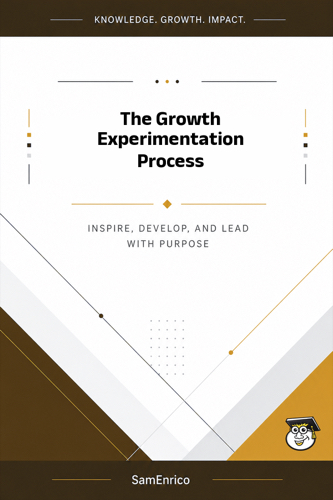
Non-FictionBusiness BriefExperimentation
The Growth Experimentation Process eBook
Designs, runs, and analyzes A/B tests for growth.
Designs, runs, and analyzes A/B tests for growth.
Formats
Free sample
Chapter 1: The Metric That Lies--–- The email arrived at 9:47 AM on a Tuesday. The subject line read: "Big win! +12% conversion rate!" The product manager had cc’d the entire company. Within minutes, the CEO replied with fireworks emojis. The VP of Marketing asked for a press release draft.
By noon, the engineering team was tasked with rolling out the change to 100% of traffic.–- Thirty days later, revenue was flat. Actually, it was down slightly. The CFO wanted to know why a "winning" test had produced nothing. The product manager ran the numbers again. The conversion rate was still up 12%—but average order value had dropped 18%.
The test had attracted discount-seekers who bought cheap items and never returned. The team had optimized for a metric that lied.–- This scene plays out every day in growth teams across the world. Not because the teams are incompetent, but because they lack a trustworthy framework for measuring what actually matters. They look at conversion rate because it is easy. They celebrate statistical significance because it feels scientific.
And they ship changes that make their primary metric go up while their business quietly goes down.–- This chapter is not about how to run A/B tests. It is about how to know if your A/B test results are telling you the truth. Before you write a single line of code, before you split a single user, you need to build the foundation that separates trustworthy experimentation from self-deceptive guesswork.The Conversion Rate Trap–- Conversion rate is the most dangerous metric in growth experimentation. It feels objective. It is easy to calculate.
Every A/B testing tool puts it front and center. But conversion rate is also incredibly easy to game, and it hides more than it reveals.–- Consider two variants of a checkout page. Variant A converts at 5% with an average order value of $100. Variant B converts at 5.5% with an average order value of $90. Which is better?
Conversion rate alone says Variant B wins by 10%. But revenue per visitor tells a different story: Variant A generates $5.00 per visitor ($100 × 5%), while Variant B generates $4.95 per visitor ($90 × 5.5%). The "winning" test actually loses money.–- This is not a hypothetical edge case. It happens constantly. A discount popup increases conversion but attracts low-quality users.
A simplified checkout removes shipping options, causing customers to abandon later. A bold "Buy Now" button works great for impulse purchases but drives away high-research buyers. In every case, conversion rate moves in the wrong direction—up while the business suffers.–- The problem is that conversion rate measures a single moment: did the user complete this specific action? It does not measure the value of that action, the likelihood of repeat behavior, or the downstream consequences of the change. It is a narrow, short-term metric that rewards short-term thinking.The OEC: One Number to Rule Them All–- Ronny Kohavi, the godfather of online experimentation at Amazon and Microsoft, solved this problem decades ago with a simple but powerful concept: the Overall Evaluation Criterion, or OEC.
The OEC is a single, composite metric that balances short-term gains against long-term health. It forces you to define, before you run any test, what "success" actually means.–- At Amazon, the OEC was not conversion rate or even revenue per visitor. It was a complex formula that included immediate purchase value, estimated future value based on product category, and a penalty for returns. A test that increased sales of cheap, high-return items would show a positive conversion rate but a flat or negative OEC. The metric could not be gamed.–- Your OEC does not need to be as sophisticated as Amazon’s.
But it does need to be thoughtfully designed. The best OECs share three characteristics: they are directional (moving up means the business is genuinely healthier), they are sensitive enough to detect meaningful changes within your test duration, and they are resistant to gaming.–- Here is a practical framework for building your OEC:–- Start with the business outcome you actually care about. For an ecommerce company, that is usually profit or customer lifetime value. For a Saa S company, it is subscription revenue or retention. For a content site, it might be engagement time or ad revenue.
Name the real outcome.–- Work backward to a measurable proxy. You cannot measure lifetime value in a 14-day test. But you can measure 7-day value, which correlates strongly with lifetime value. You cannot measure profit directly if you lack cost data, but you can measure revenue minus a standard cost assumption. Find the closest measurable proxy that still points in the right direction.–- Combine multiple signals into one number.
A simple OEC might be (revenue per visitor) × (1 - return rate). A more sophisticated OEC might be (initial purchase value) + (0.3 × estimated 30-day value). The combination prevents any single lever from being over-optimized.–- Here are concrete examples of good, better, and best OECs:–- Bad OEC: Conversion rate. Too easy to game. Ignores value and retention.–- Good OEC: Revenue per visitor.
Captures both conversion and average order value. Does not capture retention or returns.–- Better OEC: Revenue per visitor minus estimated cost of goods sold. Captures profit on the initial purchase.–- Best OEC: 7-day customer value. Captures initial purchase, repeat purchases within a week, and early retention signals. Correlates strongly with lifetime value for most businesses.–- Your OEC does not need to be perfect on day one.
It needs to exist. You can refine it as you learn. But without an OEC, you are flying blind—celebrating tests that make your metric go up while your business goes down.Guardrails: The Art of Doing No Harm–- The OEC tells you whether you are moving toward your goal. But moving toward your goal at the expense of everything else is not a victory. This is where guardrail metrics enter.–- Guardrails are the "do no harm" metrics that protect your business from unintended consequences.
They are not the primary measure of success. They are the boundary conditions. A test can have a spectacularly positive OEC, but if it hurts a guardrail, the test is a failure. Do not ship.–- Consider the following scenarios, each drawn from real experiments:–- A travel site tested a redesign that simplified the search form. The OEC (booking rate) increased 8%.
But page load time increased by 400 milliseconds. The guardrail (bounce rate on mobile) deteriorated significantly. The team shipped anyway. Within two weeks, organic search traffic dropped 15% because Google’s Core Web Vitals algorithm penalized the slower page.–- A subscription service tested a more aggressive email capture popup. The OEC (email signups) increased 22%.
But the guardrail (account cancellations among existing users) moved up 3%. The team did not check. Six months later, they realized they had been annoying their most loyal customers to death.–- A marketplace tested a new pricing display that emphasized the lowest-priced options. The OEC (purchase rate) increased 5%. But the guardrail (average seller satisfaction) dropped 8%.
Low-priced sellers were happy; high-quality sellers were leaving the platform. The marketplace optimized itself into a race to the bottom.–- The rule is simple and will appear throughout this book…
This is the end of the free sample. Get the eBook to keep going. Buy now
About this book
Details
- Author
- Ritter Therese
- Publisher
- SamEnrico
- Language
- English
- Genre
- Non-Fiction, Business Brief, Experimentation
- Released
- 2026-06-07
- Pages (approx.)
- 125
- Available as
- eBook, Audiobook

Read better in the ZLOADR app
Your eBooks on your phone or tablet. Sign in with your SamEnrico account and start reading.
More by Ritter Therese
 Deception Detection WorkbookRitter Therese$11.99
 No Shipping Cost TrapRitter Therese$11.99
 Listening Bad Habits To BreakRitter Therese$11.99
 The Jade Phoenix's Last Flight: A Celestial OmenRitter Therese$11.99
 Learn to Play the Alto SaxophoneRitter Therese$11.99
 AI for Sales Battle CardsRitter Therese$12.99
 Distribution SupervisorRitter Therese$11.99
 How to Start a Clocks (retail) Business (Beginners Guide)Ritter Therese$11.99
You may also like
 Hong Kong Handover 1997Dunn Johnnie$11.99
 Zumba For Postnatal Recovery CourseNeal Christian$11.99
 Zumba for BeginnersLadner Nikia$11.99
 YouTube Comment Mining GuideHumes Pandora$12.99
 Worry Box MeditationCarlin Rudy$11.99
 Workplace Stress MeditationNguyen Lynn$11.99
 Workplace Stress and Sleep RepairHawley Ivory$11.99
 Workplace Perfectionism CureDelaney Jeffry$11.99
 Workplace Injustice Anger GuideWallen Isabelle$11.99
 Work Addiction and Burnout LinkGreenwood Ester$11.99
 Women in Yoga and WellnessBeattie Galina$11.99
 Women in Stand Up ComedyChun Evangeline$11.99