
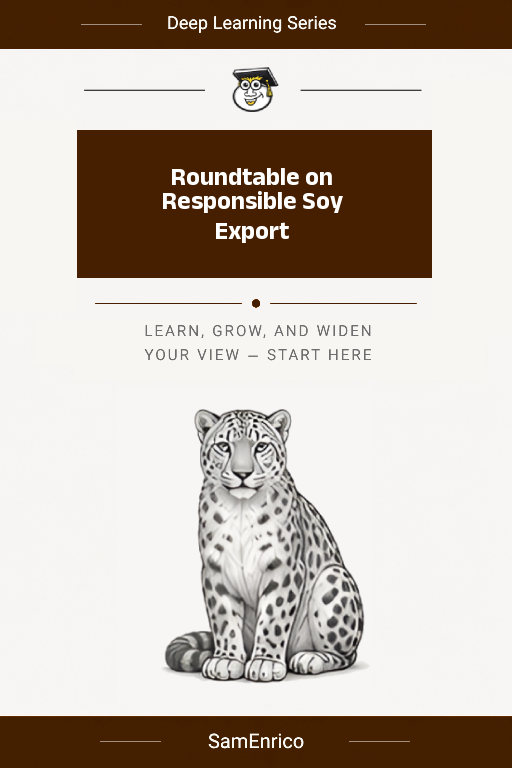
Roundtable on Responsible Soy Export eBook
Certify soy exports under RTRS, meeting deforestat
Certify soy exports under RTRS, meeting deforestation-free criteria for European feed and food ingredient buyers needing verified sustainable protein.
Formats
Free sample
Chapter 1: The Rotterdam Threshold...–- The first shipment arrived at Rotterdam on a Tuesday morning, like thousands before it. The bulk carrier Soyana had sailed 6,800 nautical miles from Santos, Brazil, carrying 55,000 metric tons of soybean meal destined for Dutch feed mills. The captain filed the standard customs declaration. The agents processed the paperwork. And then, for the first time in European history, a customs officer pressed "hold."Not because of pests.
Not because of contaminants. Not because of any traditional trade barrier. The reason was simpler and more terrifying to global agribusiness: the ship's owner could not prove, with geographic coordinates and satellite imagery, that every single bean onboard had been grown on land that was forest-free after December 31, 2020.The year was 2026. The European Union Deforestation Regulation (EUDR) had just become fully enforceable. And the global soy trade—a $60 billion annual market spanning five continents—would never be the same.The Warning That No One Heeded For the better part of a decade, the soy industry had known this day was coming.
The EUDR was adopted in 2023 after years of legislative debate, public consultation, and fierce lobbying from producer countries. The regulation's core premise was deceptively simple: any operator placing soy (along with cattle, palm oil, coffee, cocoa, rubber, and wood) on the EU market must prove that their products were not grown on land deforested after December 31, 2020.But simplicity vanished the moment anyone tried to implement it.The EUDR represented a fundamental shift in international trade law. Previous sustainability regulations had been voluntary—nice-to-have badges for environmentally conscious consumers. The EUDR made deforestation-free verification mandatory, with penalties including fines of up to 4% of a company's EU turnover, confiscation of products, and temporary bans from EU markets.The Soyana was not a real ship. But the scenario it represents is not fiction.
By the time you read this chapter, some variation of the Rotterdam Threshold will have occurred—perhaps not with a full cargo hold, perhaps not with public fanfare, but somewhere in the labyrinth of global soy logistics, a shipment will have been stopped because traceability failed.The question for exporters, traders, and compliance officers is not whether such holds will happen. They will. The question is whether your shipment will be the one stopped.The Anatomy of a Compliance Nightmare To understand why the EUDR has provoked panic across the soy supply chain, we must first understand what it actually requires. The regulation, which runs to 117 pages in its official consolidated version, contains three operational pillars that every soy exporter must master.Pillar One: Information Gathering (Article 9)Before placing any soy product on the EU market, operators must collect and maintain evidence for five years. This evidence must include:Geolocation data – For every plot of land where the soy was produced, the operator must have latitude and longitude coordinates (plot polygons, not just points).
These coordinates must be precise enough to identify the exact boundaries of production, allowing verification against deforestation databases.Production date – The date of production must be documented, establishing whether the soy was grown after the December 31, 2020 cut-off. (All soy placed on the EU market after the regulation's effective date must comply, regardless of when it was produced—meaning that old inventory sitting in silos since 2019 is fine, but any soy harvested after the cut-off must be verified.)Proof of legality – The production must comply with all relevant laws of the country of origin, including land use rights, environmental regulations, tax laws, anti-corruption statutes, and human rights protections (including Free, Prior and Informed Consent for Indigenous lands).Due Diligence Statement – A formal declaration, submitted through the EU's centralized information system, attesting that the operator has conducted adequate due diligence and found negligible or no risk of deforestation.For a vertically integrated producer who owns their farms and controls their logistics, this is burdensome but possible. For a trader sourcing from thousands of smallholders across the Brazilian Cerrado or the Argentine Chaco, this is a logistical nightmare.Pillar Two: Risk Assessment (Article 10)Collecting information is meaningless without a framework for evaluating it. Article 10 requires operators to assess the risk that their soy is non-compliant, based on:Country-level risk – The European Commission classifies countries (or regions within countries) as low-risk, standard-risk, or high-risk based on factors including forest cover trends, corruption indices, governance quality, and enforcement capacity.Supply chain complexity – Simple, traceable supply chains from known producers receive lower risk scores. Complex chains involving indirect suppliers, aggregated volumes, and multiple intermediaries receive higher scores.Presence of Indigenous peoples – Production on or near lands with Indigenous or traditional communities carries additional risk, requiring verification of FPIC and community relations.Historical deforestation – Production in regions with recent deforestation activity receives elevated risk scores, regardless of individual producer compliance.Operators cannot simply declare their risk assessment complete.
They must document the methodology, maintain the underlying data, and make it available for inspection by competent authorities.Pillar Three: Risk Mitigation (Article 11)For risks identified as non-negligible, operators must implement mitigation measures. These can include:Independent audits and certifications – Third-party verification of production practices, including recognized certification schemes like RTRS.Supply chain restructuring – Eliminating indirect suppliers, consolidating sourcing from verified producers, or exiting high-risk regions entirely.Enhanced traceability systems – Implementing blockchain, satellite monitoring, or other technologies to track soy from farm to port.Stakeholder engagement – Working with producer communities, governments, and civil society to address root causes of deforestation.The key word throughout the EUDR is "negligible." Operators can place soy on the EU market if they have concluded that the risk of deforestation is negligible—not zero, not absent, but sufficiently low that no further action is reasonably required. This creates a judgment call, and judgment calls create liability.The Cut-Off Date That Changed Everything December 31, 2020 seems like an arbitrary date. Why not 2015, when the Paris Agreement was signed? Why not 2010, when the EU first committed to halting biodiversity loss?
Why not a rolling baseline that adjusts over time?The answer is political and practical. The 2020 cut-off represents a compromise between environmental ambition and commercial reality. Earlier dates would have excluded vast quantities of soy from established, productive farms. Later dates would have allowed continued deforestation for years to come. 2020 was the last year before the regulation was formally proposed—a line drawn in the sand.But for producers in South America, the 2020 cut-off carries specific weight.
Consider the Brazilian Cerrado, a savanna biome covering 2 million square kilometers. The Cerrado has been the frontier of soy expansion for two decades, with deforestation rates that have fluctuated but never ceased. A farm that cleared native vegetation in 2018—just three years before the regulation was proposed—would be permanently barred from the EU market unless the land was legally converted (e.g., under an approved land use plan) or the deforestation was below a negligible threshold.The regulation does not distinguish between "good" deforestation and "bad" deforestation. There is no credit for replanting trees elsewhere. There is no exemption for farms that have since adopted regenerative practices.
The land was either forest on December 31, 2020, or it was not. This binary simplicity is the EUDR's greatest strength and its greatest source of controversy.The European Market: Too Big to Ignore, Too Strict to…
This is the end of the free sample. Get the eBook to keep going. Buy now
About this book
Details
- Author
- Martz Maryland
- Publisher
- SamEnrico
- Language
- English
- Genre
- Non-Fiction, Business Brief
- Released
- 2026-05-29
- Pages (approx.)
- 156
- Available as
- eBook, Audiobook

Read better in the ZLOADR app
Your eBooks on your phone or tablet. Sign in with your SamEnrico account and start reading.
More by Martz Maryland
 Distressed M&A Multiples HandbookMartz Maryland$11.99
 Ayurvedic Cooking ClassMartz Maryland$11.99
 Alcohol Harm Reduction GuideMartz Maryland$11.99
 OSHA Standards GuideMartz Maryland$11.99
 Food Addiction Recovery Workbook for TeensMartz Maryland$11.99
 The Juvenile Detention VictimMartz Maryland$11.99
 Croatia Digital Nomad VisaMartz Maryland$11.99
 SAD Light Box TimingMartz Maryland$11.99
 The Last Stagecoach Robbery: The Trial of the Great Northern HeistMartz Maryland$11.99
 The Labors of Heracles: A Hero’s Burden Beyond MortalityMartz Maryland$11.99
 How to Produce Textile ProcessingMartz Maryland$11.99
 How to Produce Horse Tack AccessoriesMartz Maryland$11.99
You may also like
 Hong Kong Handover 1997Dunn Johnnie$11.99
 Zumba For Postnatal Recovery CourseNeal Christian$11.99
 Zumba for BeginnersLadner Nikia$11.99
 YouTube Comment Mining GuideHumes Pandora$12.99
 Worry Box MeditationCarlin Rudy$11.99
 Workplace Stress MeditationNguyen Lynn$11.99
 Workplace Stress and Sleep RepairHawley Ivory$11.99
 Workplace Perfectionism CureDelaney Jeffry$11.99
 Workplace Injustice Anger GuideWallen Isabelle$11.99
 Work Addiction and Burnout LinkGreenwood Ester$11.99
 Women in Yoga and WellnessBeattie Galina$11.99
 Women in Stand Up ComedyChun Evangeline$11.99