
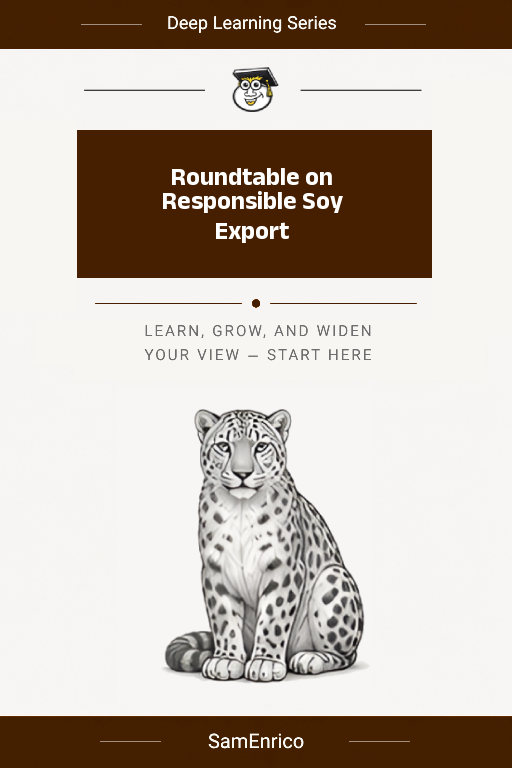
Roundtable on Responsible Soy Export
Certify soy exports under RTRS, meeting deforestat
Certify soy exports under RTRS, meeting deforestation-free criteria for European feed and food ingredient buyers needing verified sustainable protein.
Formats
About this book
Free sample
Chapter 1: The Rotterdam Threshold...–- The first shipment arrived at Rotterdam on a Tuesday morning, like thousands before it. The bulk carrier Soyana had sailed 6,800 nautical miles from Santos, Brazil, carrying 55,000 metric tons of soybean meal destined for Dutch feed mills. The captain filed the standard customs declaration. The agents processed the paperwork. And then, for the first time in European history, a customs officer pressed "hold."Not because of pests.
Not because of contaminants. Not because of any traditional trade barrier. The reason was simpler and more terrifying to global agribusiness: the ship's owner could not prove, with geographic coordinates and satellite imagery, that every single bean onboard had been grown on land that was forest-free after December 31, 2020.The year was 2026. The European Union Deforestation Regulation (EUDR) had just become fully enforceable. And the global soy trade—a $60 billion annual market spanning five continents—would never be the same.The Warning That No One Heeded For the better part of a decade, the soy industry had known this day was coming.
The EUDR was adopted in 2023 after years of legislative debate, public consultation, and fierce lobbying from producer countries. The regulation's core premise was deceptively simple: any operator placing soy (along with cattle, palm oil, coffee, cocoa, rubber, and wood) on the EU market must prove that their products were not grown on land deforested after December 31, 2020.But simplicity vanished the moment anyone tried to implement it.The EUDR represented a fundamental shift in international trade law. Previous sustainability regulations had been voluntary—nice-to-have badges for environmentally conscious consumers. The EUDR made deforestation-free verification mandatory, with penalties including fines of up to 4% of a company's EU turnover, confiscation of products, and temporary bans from EU markets.The Soyana was not a real ship. But the scenario it represents is not fiction.
By the time you read this chapter, some variation of the Rotterdam Threshold will have occurred—perhaps not with a full cargo hold, perhaps not with public fanfare, but somewhere in the labyrinth of global soy logistics, a shipment will have been stopped because traceability failed.The question for exporters…
This is the end of the free sample. Get the eBook to keep going. Buy now
Contents
- Chapter 1
- Chapter 2
- Chapter 3
- Chapter 4
- Chapter 5
- Chapter 6
- Chapter 7
- Chapter 8
- Chapter 9
- Chapter 10
- Chapter 11
- Chapter 12
Details
- Author
- Martz Maryland
- Publisher
- SamEnrico
- Language
- English
- Genre
- Non-Fiction, Business Brief
- Released
- 2026-05-29
- Pages (approx.)
- 156
- Available as
- eBook, Audiobook

Read better in the ZLOADR app
Your eBooks on your phone or tablet. Sign in with your SamEnrico account and start reading.
More by Martz Maryland
 Distressed M&A Multiples HandbookMartz Maryland$11.99
 Ayurvedic Cooking ClassMartz Maryland$11.99
 Alcohol Harm Reduction GuideMartz Maryland$11.99
 OSHA Standards GuideMartz Maryland$11.99
 Food Addiction Recovery Workbook for TeensMartz Maryland$11.99
 The Juvenile Detention VictimMartz Maryland$11.99
 Croatia Digital Nomad VisaMartz Maryland$11.99
 SAD Light Box TimingMartz Maryland$11.99
 The Last Stagecoach Robbery: The Trial of the Great Northern HeistMartz Maryland$11.99
 The Labors of Heracles: A Hero’s Burden Beyond MortalityMartz Maryland$11.99
 How to Produce Textile ProcessingMartz Maryland$11.99
 How to Produce Horse Tack AccessoriesMartz Maryland$11.99
You may also like
 Franchising Your Local Brand Across Borders Child Labor LawsWilson Ida$11.99
 Franchising Your Local Brand Across Borders Beneficial OwnershipGordon Debbie$11.99
 Franchising Your Local Brand Across Borders Trade SecretsKeener Tatum$11.99
 Franchising Your Local Brand Across Borders Performance DashboardsCota Lisette$11.99
 Franchising Your Local Brand Across Borders Parallel ImportsBailey Wallace$11.99
 Franchising Your Local Brand Across Borders Packaging RegulationsRandle Adaline$11.99
 Franchising Your Local Brand Across Borders Know Your CustomerMyers Adam$11.99
 Franchising Your Local Brand Across Borders Human TraffickingFranklin Lee$11.99
 Franchising Your Local Brand Across Borders Government IncentivesLogsdon Beckie$11.99
 Franchising Your Local Brand Across Borders Carbon FootprintMcfarlane Margot$11.99
 Franchising Your Local Brand Across Borders Bribery LawsStarr Cortney$11.99
 Franchising Your Local Brand Across Borders Best Practice SharingBryson Vernia$11.99