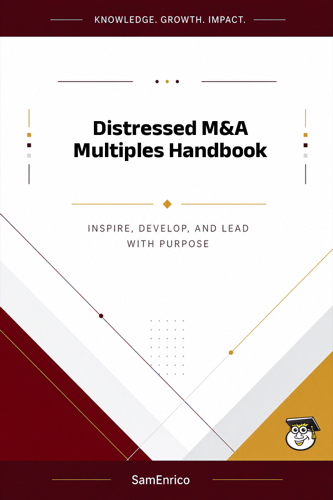
Distressed M&A Multiples Handbook
Examines asset sales, 363 deals, and bankruptcy tr
Examines asset sales, 363 deals, and bankruptcy transaction comps.
Formats
About this book
Free sample
Chapter 1: The Valuation Trap--–- Most investment bankers and private equity professionals never forget their first distressed deal. Mine came in the form of a mid-sized manufacturing company called Apex Metalworks. The numbers looked compelling on paper: a stalking horse bid at 4.2x normalized EBITDA, well below the industry average of 7x. My team had run the comparables, built the DCF model, and secured internal approval. We were confident.
We were also wrong. What we failed to understand was that Apex Metalworks was not a healthy company trading at a discount. It was a broken company trading at a broken price – and those two things are not the same. The auction attracted eleven bidders, drove the final price to 6.8x EBITDA, and we walked away with nothing but six months of wasted time and seven figures of legal fees. The lesson was brutal but essential: distressed multiples are not simply lower versions of healthy multiples.
They are a different species altogether.This chapter establishes the foundation for everything that follows. It explains why traditional valuation frameworks fail systematically when applied to financially distressed companies, introduces the concept of the zone of insolvency and its profound implications for multiples, maps the distressed capital structure that every buyer must understand, and delivers the core insight that distinguishes this handbook from every other valuation resource: distressed multiples reflect fundamentally different buyer motivations, risk profiles, and liability assumptions than their healthy counterparts. By the end of this chapter, you will never look at a low EBITDA multiple and assume it represents a bargain again.Why Traditional M&A Comparables Fail in Distressed Scenarios In healthy M&A, valuation rests on three pillars: comparable company analysis, precedent transactions, and discounted cash flow analysis. Each pillar assumes a going concern – a company that will continue operating, generating cash flows, and serving customers for the foreseeable future. Distressed scenarios shatter each pillar.The Going Concern Assumption When a company files for bankruptcy or approaches insolvency, the going concern assumption becomes questionable at best.
Customers flee, fearing they will not receive warranties or replacement parts. Suppliers demand cash on delivery or refuse to ship…
This is the end of the free sample. Get the eBook to keep going. Buy now
Contents
- Chapter 1
- Chapter 2
- Chapter 3
- Chapter 4
- Chapter 5
- Chapter 6
- Chapter 7
- Chapter 8
- Chapter 9
- Chapter 10
- Chapter 11
- Chapter 12
Details
- Author
- Martz Maryland
- Publisher
- SamEnrico
- Language
- English
- Genre
- Non-Fiction, Capital & Valuation Register, Distressed
- Released
- 2026-06-12
- Pages (approx.)
- 142
- Available as
- eBook, Audiobook

Read better in the ZLOADR app
Your eBooks on your phone or tablet. Sign in with your SamEnrico account and start reading.
More by Martz Maryland
 Ayurvedic Cooking ClassMartz Maryland$11.99
 Alcohol Harm Reduction GuideMartz Maryland$11.99
 OSHA Standards GuideMartz Maryland$11.99
 Food Addiction Recovery Workbook for TeensMartz Maryland$11.99
 The Juvenile Detention VictimMartz Maryland$11.99
 Croatia Digital Nomad VisaMartz Maryland$11.99
 SAD Light Box TimingMartz Maryland$11.99
 The Last Stagecoach Robbery: The Trial of the Great Northern HeistMartz Maryland$11.99
 The Labors of Heracles: A Hero’s Burden Beyond MortalityMartz Maryland$11.99
 How to Produce Textile ProcessingMartz Maryland$11.99
 How to Produce Horse Tack AccessoriesMartz Maryland$11.99
 Reddit Remote Internship GuideMartz Maryland$12.99