
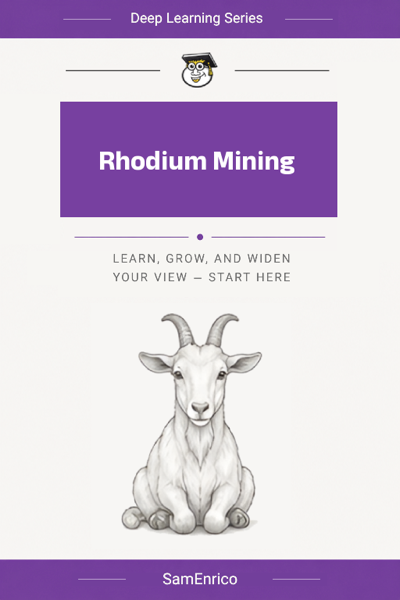
Non-FictionInformativeEducational
Rhodium Mining eBook
A Coursebook on Rhodium Mining
by Desantis Peg
A Coursebook on Rhodium Mining
Formats
Free sample
Chapter 1: The Ghost Metal...-- On a rainy Tuesday morning in March 2020, a scrap dealer in Akron, Ohio named Frank Sorrentino did what he had done every day for seventeen years. He sorted through piles of used catalytic converters, crushed them with a hydraulic press, and shipped the powdered ceramic residue to a smelter in Pennsylvania. Each converter paid him between fifty and eighty dollars, depending on size and condition. It was honest, unglamorous work. Frank drove a five-year-old Ford F-150 and lived in a modest ranch house.
He was not a wealthy man.That Tuesday, Frank processed two hundred converters. His profit was approximately $12,000. He felt satisfied.What Frank did not know was that among those two hundred converters was a batch of high-density diesel catalysts from a fleet of heavy trucks. Inside those particular converters, the concentration of a metal called rhodium was nearly three times higher than average. When the smelter later assayed the lot, they found 487 grams of rhodium—approximately 15.6 troy ounces.
At the market price on that day—which was depressed due to COVID panic—those 15.6 ounces were worth 187,000.Buthereisthedetailthat Frankstillcannotbringhimselftodiscuss:threemonthslater,thepriceofrhodiumdoubled.Thenittripled.By March2021,thosesame15.6ounceswouldhavebeenworth187,000. But here is the detail that Frank still cannot bring himself to discuss: three months later, the price of rhodium doubled. Then it tripled. By March 2021, those same 15.6 ounces would have been worth 187,000.Buthereisthedetailthat Frankstillcannotbringhimselftodiscuss:threemonthslater,thepriceofrhodiumdoubled.Thenittripled.By March2021,thosesame15.6ounceswouldhavebeenworth452,000. Frank had sold them for less than one-tenth of that.He had thrown away $400,000.
He did not know what rhodium was.This book is written so that you never make Frank's mistake.The Most Valuable Metal You Have Never Heard Of Rhodium occupies a strange place in the hierarchy of precious metals. Gold has been treasured for six thousand years. Silver has funded empires. Platinum has adorned royalty. Even palladium—the least known of the major precious metals—has received attention from investors since the 1990s.
But rhodium? Rhodium has remained almost invisible, known only to a small fraternity of metallurgists, geologists, and hyper-specialized traders.Yet the numbers tell a different story. In March 2021, rhodium reached $29,000 per troy ounce. At that moment, one ounce of rhodium was worth more than fourteen ounces of gold, more than two hundred ounces of silver, and nearly four times the value of its cousin platinum. For a brief, feverish window, rhodium became the most valuable non-artificial commodity on Earth by weight—more expensive than any drug, any gemstone, any rare earth element, and any other metal.The crash that followed was equally spectacular.
By September 2023, rhodium had fallen to 4,500perounce—an844,500 per ounce—an 84% decline. Investors who had piled into rhodium at the peak lost fortunes. Miners who had renegotiated labor contracts based on 4,500perounce—an8429,000 prices faced bankruptcy. Recyclers who had built new processing plants found themselves operating at a loss. The whiplash was brutal, but it was not unusual.
Rhodium had done this before: 10,000in2008,10,000 in 2008, 10,000in2008,1,000 in 2009, 3,000in2014,3,000 in 2014, 3,000in2014,25,000 in 2020, 29,000in2021,29,000 in 2021, 29,000in2021,4,500 in 2023. In the world of commodities, only one other asset class shows this level of volatility: cryptocurrencies. But unlike Bitcoin, rhodium is not a speculative abstraction. It is a physical metal with irreplaceable industrial applications. Every gasoline-powered car on Earth contains a small amount of rhodium.
Without it, those cars would emit toxic nitrogen oxides (NOx) into the atmosphere at levels that would violate every clean air regulation on the planet. Rhodium is not a luxury. It is a necessity.This is the first paradox of rhodium: it is invisible, unknown, and yet absolutely essential to modern industrial civilization.The Six Sisters: Introducing the Platinum Group Elements Before we can understand rhodium, we must understand its family. The Platinum Group Elements (PGEs) are six metals that sit together in the periodic table's transition metals block: platinum (Pt), palladium (Pd), rhodium (Rh), ruthenium (Ru), iridium (Ir), and osmium (Os). They are sometimes called the "noble metals" because they resist oxidation and corrosion even at high temperatures—a property that makes them invaluable in harsh industrial environments.Each of the six has its own personality.
Platinum, the most famous, is soft, ductile, and highly resistant to chemical attack. It is used in jewelry, laboratory crucibles, and catalytic converters (where it primarily oxidizes carbon monoxide and unburned hydrocarbons). Palladium is cheaper than platinum (usually), lighter, and even more reactive. It is the workhorse of catalytic converters, responsible for oxidizing hydrocarbons and, in three-way catalysts, reducing nitrogen oxides. Rhodium is the assassin—aggressive, rare, and devastatingly effective at breaking nitrogen-oxygen bonds.
Ruthenium is the industrialist: hard, brittle, and used in electronics resistors, hard-disk drives, and as a hardening agent for platinum and palladium alloys. Iridium is the survivor: the most corrosion-resistant metal known, with a melting point of 2,446°C, used in spark plugs, deep-sea electrodes, and crucibles for growing high-temperature crystals. Osmium is the toxic loner: dense, brittle, and volatile when heated, with a pungent odor of osmium tetroxide that can blind and kill at low concentrations. Osmium is rarely used commercially, and never in consumer products.Together, these six metals are almost always found together in nature. Geologists call them the "PGE suite" because they co-occur in specific types of magmatic ore deposits.
You cannot find rhodium without also finding platinum, palladium, and the others. But the ratios vary dramatically. The Bushveld Complex of South Africa—which we will explore in Chapter 3—produces ore with a rhodium-to-platinum ratio of approximately 1:5 in the Merensky Reef and 1:2 in the UG2 Reef. The Stillwater Complex in Montana produces a palladium-to-platinum ratio of 3:1, with rhodium as a minor byproduct. These ratios are not arbitrary.
They are controlled by the deep earth processes that concentrated these metals billions of years ago.What Makes Rhodium Different?To understand rhodium's value, we must understand its physical and chemical personality. Rhodium is a hard, silvery-white metal with a face-centered cubic crystal structure. It has a density of 12.41 grams per cubic centimeter—significantly less than gold (19.3) and platinum (21.4), but still nearly twice as dense as iron. Its melting point is 1,964°C, high enough to withstand the extreme temperatures inside a gasoline engine. Its reflectivity is extraordinary: rhodium reflects approximately 80% of visible light, making it the most reflective of the PGEs.
This property has made rhodium the preferred coating for high-quality searchlight mirrors, telescope reflectors, and optical instruments.But reflectivity is not what makes rhodium valuable. Its value comes from one specific chemical property: its ability to catalyze the reduction of nitrogen oxides to molecular nitrogen and oxygen.Here is what that means in practical terms. When gasoline burns inside an internal combustion engine, the high temperatures cause nitrogen and oxygen from the air to react with each other, forming nitrogen monoxide (NO) and nitrogen dioxide (NO₂). These compounds—collectively called NOx—are toxic, reactive, and the primary cause of photochemical smog. Inhaling NOx causes respiratory inflammation, reduces lung function, and worsens asthma.
Before catalytic converters, cities like Los Angeles, Mexico City, and Beijing experienced brown clouds of NOx so thick that schools closed and hospitals filled with respiratory patients.The catalytic converter solved this problem by passing exhaust gases through a ceramic honeycomb coated with rhodium (along with platinum and palladium). On the surface of…
This is the end of the free sample. Get the eBook to keep going. Buy now
About this book
Details
- Author
- Desantis Peg
- Publisher
- SamEnrico
- Language
- English
- Genre
- Non-Fiction, Informative, Educational
- Released
- 2026-06-02
- Pages (approx.)
- 150
- Available as
- eBook, Audiobook

Read better in the ZLOADR app
Your eBooks on your phone or tablet. Sign in with your SamEnrico account and start reading.
More by Desantis Peg
 Upwork Project Catalog GuideDesantis Peg$11.99
 Church Child Star ExperienceDesantis Peg$11.99
 Job Loss Journal Therapy GuideDesantis Peg$11.99
 MDD Neurobiology ExplainedDesantis Peg$11.99
 Meaningful Work FinderDesantis Peg$11.99
 Citation Rules for Annotated BibliographiesDesantis Peg$11.99
 Cavalry of the Clouds: Fighter DevelopmentDesantis Peg$11.99
 Rockefeller EstateDesantis Peg$11.99
 Messerschmitt Pilot MemoirDesantis Peg$11.99
 The Last Explorer: The Untold Story of Ranulph Fiennes and His Impossible Antarctic QuestDesantis Peg$11.99
 The Billionaire's Secret: The Monica Lewinsky Tapes RevealedDesantis Peg$11.99
 The Complete Guide to the Prostate DietDesantis Peg$11.99
You may also like
 Hong Kong Handover 1997Dunn Johnnie$11.99
 Zumba For Postnatal Recovery CourseNeal Christian$11.99
 Zumba for BeginnersLadner Nikia$11.99
 YouTube Comment Mining GuideHumes Pandora$12.99
 Worry Box MeditationCarlin Rudy$11.99
 Workplace Stress MeditationNguyen Lynn$11.99
 Workplace Stress and Sleep RepairHawley Ivory$11.99
 Workplace Perfectionism CureDelaney Jeffry$11.99
 Workplace Injustice Anger GuideWallen Isabelle$11.99
 Work Addiction and Burnout LinkGreenwood Ester$11.99
 Women in Yoga and WellnessBeattie Galina$11.99
 Women in Stand Up ComedyChun Evangeline$11.99