
Non-FictionStudent's ShortcutAnnotated Bibliography
Citation Rules for Annotated Bibliographies
undefined
by Desantis Peg
undefined
Formats
About this book
Free sample
Chapter 1: The Invisible Struggle–- Every semester, millions of students sit down to write an annotated bibliography, convinced they understand the assignment. They have their sources. They have their citation style guide. They have a word processor. And then, within minutes, they hit a wall that no one warned them about.The wall looks like this: the citation ends.
The annotation begins. And absolutely nowhere—not in the APA Publication Manual, not in the MLA Handbook, not in the Chicago Manual of Style—does it say what to do next. Should the annotation start on the same line as the citation or the line below? Should it be indented? Should there be a blank line in between?
What happens when the annotation runs longer than one paragraph? These are not trivial formatting questions. They are the difference between a professional-looking document that communicates authority and a sloppy one that signals carelessness.The dirty secret of academic writing is that the major style guides were never designed for annotated bibliographies. They tell you how to cite a journal article, a book, a website, a tweet, a courtroom transcript, and a handwritten letter from 1847. They tell you what to italicize, what to capitalize, and when to use a comma instead of a period.
But when it comes to the annotated bibliography—an assignment required in countless undergraduate and graduate courses across every discipline—the official guides fall silent. They assume you are creating a simple list of sources. They do not account for the fact that you also need to write substantive paragraphs beneath those sources, and that those paragraphs need to connect visually and logically to the citations above them.This silence is not an accident. It is a gap in the publishing industry's understanding of how real people use style guides. The people who write the official manuals are experts in bibliographic metadata.
They know the difference between a DOI and an ISBN, between a volume number and an issue number, between a publisher's location and a distributor's address. They are less expert in the day-to-day struggles of a graduate…
This is the end of the free sample. Get the eBook to keep going. Buy now
Contents
- Chapter 1
- Chapter 2
- Chapter 3
- Chapter 4
- Chapter 5
- Chapter 6
- Chapter 7
- Chapter 8
- Chapter 9
- Chapter 10
- Chapter 11
- Chapter 12
Details
- Author
- Desantis Peg
- Publisher
- SamEnrico
- Language
- English
- Genre
- Non-Fiction, Student's Shortcut, Annotated Bibliography
- Released
- 2026-06-07
- Pages (approx.)
- 153
- Available as
- eBook, Audiobook

Read better in the ZLOADR app
Your eBooks on your phone or tablet. Sign in with your SamEnrico account and start reading.
More by Desantis Peg
 Upwork Project Catalog GuideDesantis Peg$11.99
 Church Child Star ExperienceDesantis Peg$11.99
 Job Loss Journal Therapy GuideDesantis Peg$11.99
 MDD Neurobiology ExplainedDesantis Peg$11.99
 Meaningful Work FinderDesantis Peg$11.99
 Cavalry of the Clouds: Fighter DevelopmentDesantis Peg$11.99
 Rockefeller EstateDesantis Peg$11.99
 Messerschmitt Pilot MemoirDesantis Peg$11.99
 The Last Explorer: The Untold Story of Ranulph Fiennes and His Impossible Antarctic QuestDesantis Peg$11.99
 The Billionaire's Secret: The Monica Lewinsky Tapes RevealedDesantis Peg$11.99
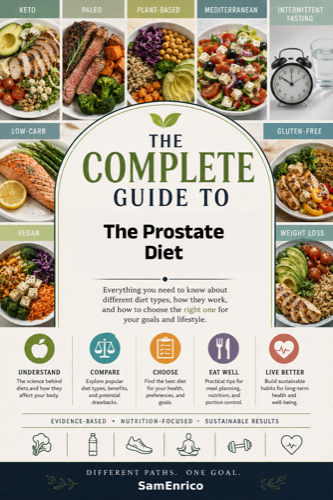 The Complete Guide to the Prostate DietDesantis Peg$11.99
 Rhodium MiningDesantis Peg$11.99
You may also like
 Hong Kong Handover 1997Dunn Johnnie$11.99
 Zumba For Postnatal Recovery CourseNeal Christian$11.99
 Zumba for BeginnersLadner Nikia$11.99
 YouTube Comment Mining GuideHumes Pandora$12.99
 Worry Box MeditationCarlin Rudy$11.99
 Workplace Stress MeditationNguyen Lynn$11.99
 Workplace Stress and Sleep RepairHawley Ivory$11.99
 Workplace Perfectionism CureDelaney Jeffry$11.99
 Workplace Injustice Anger GuideWallen Isabelle$11.99
 Work Addiction and Burnout LinkGreenwood Ester$11.99
 Women in Yoga and WellnessBeattie Galina$11.99
 Women in Stand Up ComedyChun Evangeline$11.99