
Non-FictionHealth & WellnessNeuroscience
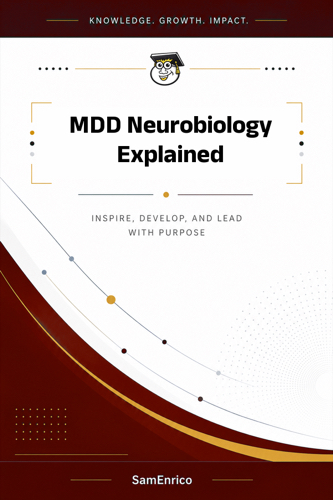
MDD Neurobiology Explained
Explore serotonin, dopamine and brain circuit chan
by Desantis Peg
Explore serotonin, dopamine and brain circuit changes in depression.
Formats
About this book
Free sample
Chapter 1: Beyond the Myth--The first thing you need to know is that almost everything you have been told about depression and your brain is wrong.Not slightly mistaken. Not oversimplified for public consumption. Wrong in a way that has sent millions of people down treatment paths that were never designed to work for them, left countless others feeling like personal failures when perfectly good medications failed to help, and allowed an entire industry to profit from a theory that was always more marketing than science.The "chemical imbalance" theory of depression—the idea that depression is caused by low serotonin, and that raising serotonin with an SSRI will fix it—is not a proven fact. It never was. It was a hypothesis, proposed in the 1960s, that gained traction for three reasons: it was simple, it was sellable, and for a small subset of patients, it seemed to work well enough to keep the idea alive.
But decades of research have shown that the reality of depression is far more complex, far more interesting, and—this is the crucial part—far more treatable than the chemical imbalance myth ever suggested.This chapter will dismantle that myth. Not because the author enjoys destroying things, but because you cannot build a working map of depression on a foundation of sand. Before we can understand what actually happens in the depressed brain—the real roles of serotonin, dopamine, glutamate, and the elaborate circuitry that connects them—we must first clear away the misconceptions that have blocked our view for half a century.The Birth of a Myth In the 1960s, psychiatrists noticed something interesting. Patients with depression who were given a drug called iproniazid—originally developed for tuberculosis—seemed to experience mood improvement. Iproniazid worked by inhibiting an enzyme called monoamine oxidase, which breaks down neurotransmitters including serotonin, norepinephrine, and dopamine.
Around the same time, another drug called imipramine was found to have antidepressant effects, and it worked by blocking the reuptake of the same monoamine neurotransmitters.These observations led to what became known as the "monoamine hypothesis" of depression: that depression was caused…
This is the end of the free sample. Get the eBook to keep going. Buy now
Contents
- Chapter 1
- Chapter 2
- Chapter 3
- Chapter 4
- Chapter 5
- Chapter 6
- Chapter 7
- Chapter 8
- Chapter 9
- Chapter 10
- Chapter 11
- Chapter 12
Details
- Author
- Desantis Peg
- Publisher
- SamEnrico
- Language
- English
- Genre
- Non-Fiction, Health & Wellness, Neuroscience
- Released
- 2026-06-07
- Pages (approx.)
- 144
- Available as
- eBook, Audiobook

Read better in the ZLOADR app
Your eBooks on your phone or tablet. Sign in with your SamEnrico account and start reading.
More by Desantis Peg
 Upwork Project Catalog GuideDesantis Peg$11.99
 Church Child Star ExperienceDesantis Peg$11.99
 Job Loss Journal Therapy GuideDesantis Peg$11.99
 Meaningful Work FinderDesantis Peg$11.99
 Citation Rules for Annotated BibliographiesDesantis Peg$11.99
 Cavalry of the Clouds: Fighter DevelopmentDesantis Peg$11.99
 Rockefeller EstateDesantis Peg$11.99
 Messerschmitt Pilot MemoirDesantis Peg$11.99
 The Last Explorer: The Untold Story of Ranulph Fiennes and His Impossible Antarctic QuestDesantis Peg$11.99
 The Billionaire's Secret: The Monica Lewinsky Tapes RevealedDesantis Peg$11.99
 The Complete Guide to the Prostate DietDesantis Peg$11.99
 Rhodium MiningDesantis Peg$11.99
You may also like
 Hong Kong Handover 1997Dunn Johnnie$11.99
 Zumba For Postnatal Recovery CourseNeal Christian$11.99
 Zumba for BeginnersLadner Nikia$11.99
 YouTube Comment Mining GuideHumes Pandora$12.99
 Worry Box MeditationCarlin Rudy$11.99
 Workplace Stress MeditationNguyen Lynn$11.99
 Workplace Stress and Sleep RepairHawley Ivory$11.99
 Workplace Perfectionism CureDelaney Jeffry$11.99
 Workplace Injustice Anger GuideWallen Isabelle$11.99
 Work Addiction and Burnout LinkGreenwood Ester$11.99
 Women in Yoga and WellnessBeattie Galina$11.99
 Women in Stand Up ComedyChun Evangeline$11.99