
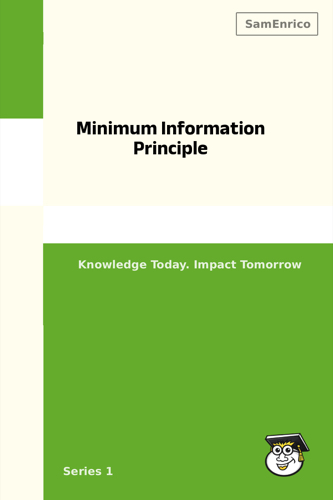
Minimum Information Principle eBook
Teaches breaking complex topics into atomic cards
Teaches breaking complex topics into atomic cards for easier memorization.
Formats
Free sample
Chapter 1: The Familiarity Trap--–- Every student knows the feeling. You close the textbook after an hour of intense reading. The diagrams make sense. The arguments flow logically. You nod along, convinced that you have finally grasped the material.
Then comes the test. Or worse, a colleague asks a simple question. Your mind goes blank. The concepts you just read dissolve like morning fog. You remember fragments, vague impressions, the shape of an argument without its substance.
This is not a failure of effort or intelligence. This is the natural consequence of mistaking recognition for recall, and it is the single greatest barrier to lasting knowledge.For decades, educators and self-taught learners alike have operated under a dangerous assumption: that understanding and memorization are separate processes, and that the former somehow precedes the latter. We tell ourselves that if we just read something enough times, highlight enough passages, or listen to enough lectures, the material will eventually stick. This approach feels productive because it generates immediate feedback. When you re-read a paragraph, it feels familiar.
When you review your highlights, you recognize the key points. That feeling of familiarity is comforting, but it is also profoundly deceptive. Neuroscience has shown that recognition and recall are handled by entirely different neural pathways. Recognition is passive. It requires only that a stimulus triggers a vague sense of having encountered it before.
Recall is active. It demands that your brain reconstruct information from scratch, without cues, in the empty space of your own mind. The difference between these two processes is the difference between recognizing a song on the radio and being able to hum it from memory. It is the difference between spotting a familiar face in a crowd and describing that face to a police sketch artist. And it is the difference between feeling like you know something and actually knowing it.This book exists because that difference matters more than most people realize.
In the pages that follow, you will be introduced to a principle that has been validated by decades of cognitive science research, refined by the developers of spaced repetition systems, and practiced by the world's most effective self-learners. It is called the Minimum Information Principle, and it is deceptively simple: any piece of information you wish to remember permanently must be broken down into the smallest possible atomic units, each tested individually through active recall. This principle flies in the face of conventional studying. Conventional studying asks you to absorb large, interconnected systems of knowledge all at once. The Minimum Information Principle asks you to dismantle those systems into indivisible building blocks, master each block separately, and then reassemble them inside your mind.
The process feels slow at first. It feels unnatural. It requires a discipline that most learners have never been taught. But it is also the only method that reliably defeats the forgetting curve, transforms passive recognition into active recall, and builds knowledge that survives for years rather than hours.This chapter exists to convince you that your current approach to learning is probably wrong, not because you are lazy or incapable, but because your brain was never designed to absorb complex information the way textbooks present it. We will begin by examining the brutal limits of working memory.
Then we will dissect the recognition-recall gap, showing exactly why re-reading and highlighting are among the least efficient study methods ever devised. Finally, we will trace the history of the Minimum Information Principle from its origins in Piotr Wozniak's doctoral research to its modern incarnations in Anki, Super Memo, and the Zettelkasten method. By the end of this chapter, you will understand why the "big picture" approach to learning is a myth, why atomic knowledge is the only knowledge that sticks, and why every subsequent chapter in this book will ask you to abandon almost everything you think you know about effective studying.The Brutal Limits of Working Memory The human brain did not evolve to memorize textbooks. It evolved to navigate savannas, track social relationships, and avoid predators. This evolutionary history left us with a cognitive architecture that is remarkably powerful in some domains and surprisingly weak in others.
One of its most significant limitations is the capacity of working memory: the mental space where conscious thought happens, where information is temporarily held and manipulated. For decades, cognitive psychologists believed that working memory could hold approximately seven items, plus or minus two. That estimate came from George Miller's famous 1956 paper, "The Magical Number Seven, Plus or Minus Two," and it shaped generations of educational theory. But more recent research has revised that number sharply downward. The consensus today is that working memory can hold no more than three to four items at once.
Four. That is it. You can hold four discrete pieces of information in your conscious mind before things start to slip.Consider what this means for the way most people study. You open a chapter on cellular respiration. The chapter introduces glycolysis, the Krebs cycle, the electron transport chain, ATP synthase, NADH, FADH2, oxygen as the final electron acceptor, and the proton gradient.
That is eight or nine major concepts, plus countless sub-concepts. Your working memory can hold four of them at once, at absolute best. The moment you try to hold a fifth, one of the first four falls out. You are not aware of this happening. Your brain is remarkably good at covering its own gaps, at creating the illusion of continuity.
But the information is gone, lost to the same neural oblivion that claims most of what we experience each day. The result is that you can read the same chapter ten times and still fail to retain it, not because you are a poor reader, but because your brain physically cannot hold all that information at once. Each pass through the text is like pouring water into a sieve. Some droplets cling, but most flow through.This is the first and most devastating reason that conventional studying fails. It asks your working memory to do something it was never designed to do: hold and integrate large sets of novel information simultaneously.
The Minimum Information Principle responds to this limitation by reducing every piece of knowledge to a size that fits comfortably within working memory. One fact per card. One question per review. One atomic unit of information, tested in isolation. This may sound reductive.
It may sound like it destroys the richness and interconnectedness of real understanding. But the opposite is true. By respecting the limits of working memory, atomic learning allows you to build complex knowledge structures without ever overwhelming the cognitive architecture that must construct them. You cannot build a cathedral by throwing all the stones at the wall at once. You lay them one by one, in sequence, with patience and precision.Recognition vs.
Recall: The Deceptive Comfort of Familiarity If working memory limits explain why large amounts of information cannot be absorbed at once, the recognition-recall gap explains why re-reading and reviewing feel so productive while accomplishing so little. The distinction is straightforward but profound. Recognition occurs when a stimulus triggers a sense of familiarity. You see a face and know you have seen…
This is the end of the free sample. Get the eBook to keep going. Buy now
About this book
Details
- Author
- Boudreau Corrine
- Publisher
- SamEnrico
- Language
- English
- Genre
- Non-Fiction, Self-Help, Learning Theory
- Released
- 2026-06-05
- Pages (approx.)
- 153
- Available as
- eBook, Audiobook

Read better in the ZLOADR app
Your eBooks on your phone or tablet. Sign in with your SamEnrico account and start reading.
More by Boudreau Corrine
 Forensic Hair Microscopy GuideBoudreau Corrine$11.99
 Rowboat Racer Hypnosis GuideBoudreau Corrine$11.99
 Control Release Recovery GuideBoudreau Corrine$11.99
 Scientist Imposter GuideBoudreau Corrine$11.99
 The Potassium HandbookBoudreau Corrine$11.99
 Entrepreneur WorkaholismBoudreau Corrine$11.99
 Persuasion For ChefsBoudreau Corrine$11.99
 From Ashes to Apollo: The Miraculous Return of the Saturn V RocketBoudreau Corrine$11.99
 The Ballad of William Wavell Wakefield: Rugby's Forgotten MaestroBoudreau Corrine$11.99
 How to Produce a Flame BroilerBoudreau Corrine$11.99
 How to Produce Saxophone Pad SaversBoudreau Corrine$11.99
 A Collector's Handbook to the Austin 4 (1939-40)Boudreau Corrine$11.99