
Non-FictionTrue CrimeForensic Science
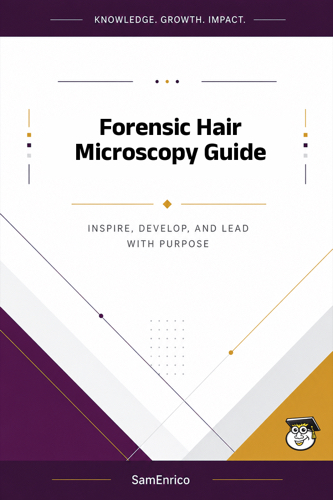
Forensic Hair Microscopy Guide
Examines hair morphology, medullary patterns, and
Examines hair morphology, medullary patterns, and cuticle scales for crime scene matching.
Formats
About this book
Free sample
Chapter 1: The Silent Witness–- Every crime scene tells a story, but not all its witnesses have voices. The broken window points toward forced entry. The blood spatter maps a violent struggle. The latent fingerprint whispers of a specific touch. Yet, amid these familiar exhibits, another form of evidence lingers—invisible to the untrained eye, easily transferred, and stubbornly persistent.
A single strand of hair, no wider than a thread of silk, carries within its microscopic architecture a biography of its origin: the species it came from, the body region it occupied, whether it was cut, broken, or fell naturally, and even traces of the environment it has traveled through. For more than a century, forensic hair microscopy has served as the gatekeeper of this silent testimony, transforming the mundane shed hair into a potential link between suspect, victim, and scene.The forensic hair examiner operates at the frontier where biology meets detective work. Unlike DNA analysis, which requires the destruction of the sample and yields probabilistic genetic profiles, microscopic hair comparison preserves the evidence intact while extracting a different class of information—morphological, contextual, and immediately observable. In the hands of a trained microscopist, a single mounted hair becomes a map of medullary highways, a gallery of cuticle scale patterns, and a palette of pigment distributions. This chapter establishes the foundational philosophy of this guide: that hair microscopy is not a relic of a pre-DNA era but a complementary discipline with unique strengths, well-documented limitations, and an evolving role in modern forensic science.The Locard Principle and the Persistence of Hair Transfer Edmond Locard, the French criminologist often called the "Sherlock Holmes of France," articulated a deceptively simple truth early in the twentieth century: "Every contact leaves a trace." Hair exemplifies this principle with almost inconvenient fidelity.
When two people embrace, when a hand runs through hair, when a garment brushes against a car seat, fibers and hairs transfer from one surface to another. Unlike fingerprints, which require deliberate deposition on a receptive surface, hairs transfer spontaneously and often unconsciously. They embed themselves into carpet fibers, cling to upholstery…
This is the end of the free sample. Get the eBook to keep going. Buy now
Contents
- Chapter 1
- Chapter 2
- Chapter 3
- Chapter 4
- Chapter 5
- Chapter 6
- Chapter 7
- Chapter 8
- Chapter 9
- Chapter 10
- Chapter 11
- Chapter 12
Details
- Author
- Boudreau Corrine
- Publisher
- SamEnrico
- Language
- English
- Genre
- Non-Fiction, True Crime, Forensic Science
- Released
- 2026-06-11
- Pages (approx.)
- 160
- Available as
- eBook, Audiobook

Read better in the ZLOADR app
Your eBooks on your phone or tablet. Sign in with your SamEnrico account and start reading.
More by Boudreau Corrine
 Rowboat Racer Hypnosis GuideBoudreau Corrine$11.99
 Control Release Recovery GuideBoudreau Corrine$11.99
 Scientist Imposter GuideBoudreau Corrine$11.99
 The Potassium HandbookBoudreau Corrine$11.99
 Entrepreneur WorkaholismBoudreau Corrine$11.99
 Persuasion For ChefsBoudreau Corrine$11.99
 Minimum Information PrincipleBoudreau Corrine$11.99
 From Ashes to Apollo: The Miraculous Return of the Saturn V RocketBoudreau Corrine$11.99
 The Ballad of William Wavell Wakefield: Rugby's Forgotten MaestroBoudreau Corrine$11.99
 How to Produce a Flame BroilerBoudreau Corrine$11.99
 How to Produce Saxophone Pad SaversBoudreau Corrine$11.99
 A Collector's Handbook to the Austin 4 (1939-40)Boudreau Corrine$11.99
You may also like
 Hong Kong Handover 1997Dunn Johnnie$11.99
 Zumba For Postnatal Recovery CourseNeal Christian$11.99
 Zumba for BeginnersLadner Nikia$11.99
 YouTube Comment Mining GuideHumes Pandora$12.99
 Worry Box MeditationCarlin Rudy$11.99
 Workplace Stress MeditationNguyen Lynn$11.99
 Workplace Stress and Sleep RepairHawley Ivory$11.99
 Workplace Perfectionism CureDelaney Jeffry$11.99
 Workplace Injustice Anger GuideWallen Isabelle$11.99
 Work Addiction and Burnout LinkGreenwood Ester$11.99
 Women in Yoga and WellnessBeattie Galina$11.99
 Women in Stand Up ComedyChun Evangeline$11.99