
Non-FictionBusiness BriefGlobal TeamsTime Zones
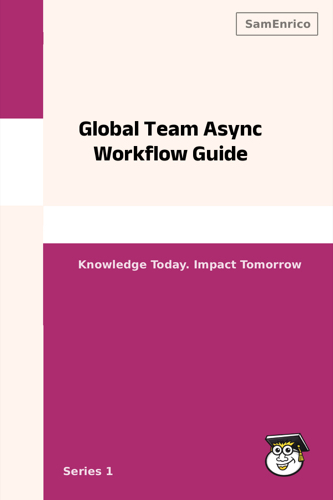
Global Team Async Workflow Guide eBook
Coordinate across time zones using follow the sun
Coordinate across time zones using follow the sun handoffs, recorded updates, and 24 hour response windows.
Formats
Free sample
Chapter 1: The Midnight Meeting--It was 2:14 AM in Bangalore. Priya’s phone buzzed against her nightstand—not once, but three times in rapid succession. Slack, then a calendar reminder, then a direct message from her manager in New York: “Are you joining the sync?”She had been asleep for exactly ninety minutes. Her two-year-old had woken at midnight with a fever, and Priya had just settled her back down. Now she faced a choice: ignore the meeting and risk being seen as “not committed,” or join a video call at 2 AM with her face half-hidden, hoping no one noticed the thermometer on the desk behind her.She joined.The meeting had fourteen people.
Three were in New York (7 PM their time, annoyed they had to stay late). Two were in London (midnight, one of them yawning openly). Four were in Singapore (8 AM, just starting their day). And five were in Bangalore—all of whom, like Priya, had been woken up.The agenda? A status update that could have been an email.
The meeting ran forty-seven minutes. No decisions were made. One blocker was identified, but the person who could solve it was in San Francisco, where it was 2 PM—but he hadn’t been invited.When the call ended, Priya lay in the dark, wide awake. She calculated: she would get four hours of sleep before her daughter woke again. Then she would work a full day, attend another meeting at 11 PM to accommodate New York, and do it all over again.Two weeks later, Priya resigned.
In her exit interview, she didn’t mention salary, career growth, or office politics. She said: “I just need to sleep.”This story is not an outlier. It is the rule.The Global Team Paradox We built global teams to follow the sun—to pass work from region to region so that progress never stops. The theory is elegant: when a developer in Sydney finishes her day, a developer in Bangalore picks up where she left off. When Bangalore ends, London begins.
When London ends, New York starts. Then the loop repeats. Twenty-four hours of continuous work, zero individuals working overtime.In theory.In practice, the “follow the sun” model has become something far darker: the never-ending workday. A US manager schedules a meeting at 7 PM her time so that Asia can attend at 9 AM their time. But that means Europe stays late.
Or the same meeting is scheduled at 8 AM US time to accommodate Europe, which means Asia joins at 9 PM. Someone always sacrifices. And over time, everyone sacrifices.The result is not 24/7 productivity. It is 24/7 burnout.This book is not a gentle suggestion to “try being more asynchronous.” It is a declaration of war on the meeting-industrial complex that has hijacked global teamwork. It is a practical, chapter-by-chapter dismantling of the belief that real-time communication equals progress.
And it is a complete blueprint for building a system where work advances while you sleep—not because you worked through the night, but because you designed a workflow that doesn’t need you to.But before we build that system, we have to understand what we’re fighting against.The Sync Tax: Your Team’s Hidden Cost Let’s name the enemy.The Sync Tax is the total cost—in hours, money, and human energy—of every live, real-time interaction that could have been asynchronous. It includes meetings, but it also includes the Slack thread that expects an immediate reply, the “quick call” that lasts forty minutes, and the DM that says “got a sec?” without context.Most teams have no idea how much they are paying the Sync Tax. Let’s calculate it.The Meeting Cost Formula Take a one-hour meeting with eight people across three time zones. Here is the true cost:Direct cost: 8 people × 1 hour = 8 person-hours Context switching cost: Research consistently shows that it takes an average of 23 minutes to fully refocus after an interruption. A one-hour meeting is an interruption.
So add 23 minutes per person: 8 × 23 minutes = 184 minutes (3.07 person-hours)Total cost: 11.07 person-hours At an average loaded cost of $100 per hour (salary + benefits + overhead), that one meeting costs your organization **$1,107**.Now multiply that by the number of meetings your team has each week. If your team of eight has ten meetings per week (which is conservative for most global teams), you are spending $11,070 per week on meetings. That is over half a million dollars per year.And that’s just the direct cost. It doesn’t include:The work that didn’t get done because people were in meetings The delayed decisions because the right person wasn’t in the room (or was in the wrong time zone)The burnout-driven turnover, like Priya’s resignation The quiet quitting of people who have stopped joining the 2 AM calls but also stopped caring The Sync Tax is the single largest inefficiency in global teams today. And it is almost entirely invisible.The Three Myths That Keep the Sync Tax Alive Before we can eliminate the Sync Tax, we have to dismantle the myths that sustain it.Myth #1: “Real-time communication is more efficient”This is the most seductive lie in modern work.
A live conversation feels efficient. You ask a question, someone answers immediately. No waiting. No back-and-forth. Done.But efficiency is not the same as effectiveness.A five-minute live conversation is efficient for the two people in it.
But what about the three people who weren’t invited but needed the information? What about the person who joins late and has to ask for a recap? What about the decision that wasn’t documented and gets reversed two weeks later because no one remembers the rationale?A synchronous conversation serves the people in the room at that exact moment. An asynchronous artifact (a document, a recorded video, a well-written ticket) serves everyone, forever, on their own time.The truth: Live conversations are efficient for the speaker. Asynchronous artifacts are effective for the system.Myth #2: “We need meetings to build relationships”This myth contains a kernel of truth—and that kernel has been weaponized to justify endless meetings.
Yes, relationships matter. Yes, trust is harder to build across screens and time zones. But the solution is not to add more meetings. The solution is to make the meetings you do have count.Consider this: a one-hour “team sync” with fourteen people (like Priya’s 2 AM call) builds zero relationships. People are exhausted, distracted, and resentful.
They are not bonding over shared goals; they are counting the minutes until they can go back to sleep.Conversely, a fifteen-minute recorded video where you share something personal about your weekend, a thirty-minute virtual coffee chat once per month, or a thoughtful written update that acknowledges a teammate’s contribution—these build far more trust than any status meeting ever will.The truth: Meetings do not build relationships. Shared vulnerability, recognition, and respect do. And none of those require a live video call.Myth #3: “Asynchronous means slow”This is the most damaging myth of all. Managers fear that if they stop forcing real-time replies, work will grind to a halt. They imagine a world where they ask a question on Monday and get an answer on Friday.But that is not asynchronous work.…
This is the end of the free sample. Get the eBook to keep going. Buy now
About this book
Details
- Author
- Brownlee Cori
- Publisher
- SamEnrico
- Language
- English
- Genre
- Non-Fiction, Business Brief, Global Teams, Time Zones
- Released
- 2026-06-07
- Pages (approx.)
- 138
- Available as
- eBook, Audiobook

Read better in the ZLOADR app
Your eBooks on your phone or tablet. Sign in with your SamEnrico account and start reading.
More by Brownlee Cori
 The Bedtime Body ScanBrownlee Cori$11.99
 Hypnotic Nerve Pain GuideBrownlee Cori$11.99
 Executive Kidnap Crisis Logistics ManualBrownlee Cori$11.99
 Trade Preference Program GuideBrownlee Cori$11.99
 The 21st Century's Silent Revolution: How the Right to Repair Movement Became LawBrownlee Cori$11.99
 Echoes of the Forgotten: The Lost Tapes of the 1969 Apollo 11 Backup CrewBrownlee Cori$11.99
 Part Time Work Dubai StudentsBrownlee Cori$12.99
 Blockchain Supply Chain TrackBrownlee Cori$12.99
 Rv Cleaning (Waste Tank Handling)Brownlee Cori$11.99
 Understanding Congenital Mitral MalformationBrownlee Cori$17.99
You may also like
 Hong Kong Handover 1997Dunn Johnnie$11.99
 Zumba For Postnatal Recovery CourseNeal Christian$11.99
 Zumba for BeginnersLadner Nikia$11.99
 YouTube Comment Mining GuideHumes Pandora$12.99
 Worry Box MeditationCarlin Rudy$11.99
 Workplace Stress MeditationNguyen Lynn$11.99
 Workplace Stress and Sleep RepairHawley Ivory$11.99
 Workplace Perfectionism CureDelaney Jeffry$11.99
 Workplace Injustice Anger GuideWallen Isabelle$11.99
 Work Addiction and Burnout LinkGreenwood Ester$11.99
 Women in Yoga and WellnessBeattie Galina$11.99
 Women in Stand Up ComedyChun Evangeline$11.99