
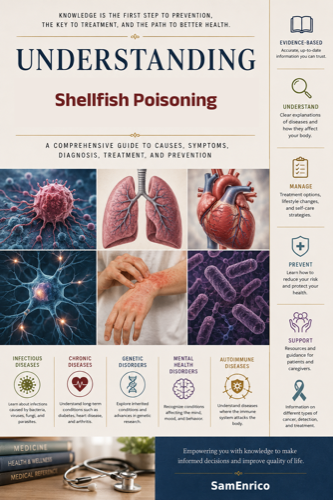
Understanding Shellfish Poisoning
This disease publication, published by SamEnrico,
This disease publication, published by SamEnrico, covers Understanding Shellfish Poisoning
Formats
About this book
Free sample
Chapter 1: The Silent Harvest--–- On a calm August morning in 2016, a family of six sat down for a breakfast of freshly harvested blue mussels from a beach near Kodiak, Alaska. Within forty-five minutes, the mother’s lips began to tingle. By the time she mentioned this to her husband, her fingers had gone numb. Two hours later, all six family members were in the emergency department. Three would require mechanical ventilation to breathe.
Two would spend a week in the intensive care unit. The mussels they had gathered were beautiful, plump, and entirely indistinguishable from safe shellfish. There was no red tide, no discolored water, no warning sign on the beach. The only evidence of danger was invisible, odorless, and tasteless. This is the defining characteristic of shellfish poisoning: it offers no warning.The Alaska PSP outbreak of 2016 was not an anomaly.
It was one of dozens of similar incidents that occur every year around the world. In 2017, a shipment of clams imported from a region with unreported algal blooms caused an outbreak of diarrhetic shellfish poisoning across three Italian cities, sickening over two hundred people who had dined at separate restaurants supplied by the same distributor. In 2019, a single meal of recreationally harvested scallops in Nova Scotia sent five people to the hospital with amnesic shellfish poisoning, leaving one survivor with permanent memory loss so severe he could no longer recognize his own children. These are not isolated tragedies. They are the visible peaks of a much larger public health challenge—one that has grown substantially in the past three decades and shows every sign of worsening.The global burden of shellfish poisoning is significantly underestimated.
Official surveillance systems record approximately two thousand confirmed cases annually worldwide. However, epidemiological modeling based on hospitalization rates, export recalls, and retrospective surveys suggests the true number is five to ten times higher. The gap between reported and actual cases exists for several reasons: mild cases never seek medical attention, physicians in non-coastal regions fail to recognize the syndrome, and many countries lack any reporting requirement for non-fatal seafood poisonings. Even in…
This is the end of the free sample. Get the eBook to keep going. Buy now
Contents
- Chapter 1
- Chapter 2
- Chapter 3
- Chapter 4
- Chapter 5
- Chapter 6
- Chapter 7
- Chapter 8
- Chapter 9
- Chapter 10
- Chapter 11
- Chapter 12
Details
- Author
- Stegall Obdulia
- Publisher
- SamEnrico
- Language
- English
- Genre
- Non-Fiction, Informative, Educational
- Released
- 2026-05-06
- Pages (approx.)
- 157
- Available as
- eBook, Audiobook

Read better in the ZLOADR app
Your eBooks on your phone or tablet. Sign in with your SamEnrico account and start reading.
More by Stegall Obdulia
 Reddit Upvote Validation HandbookStegall Obdulia$11.99
 Nauru Phosphate BrokerStegall Obdulia$11.99
 Marty Robbins Gunfighter BalladsStegall Obdulia$11.99
 Burnout Recovery Emotional ReleaseStegall Obdulia$11.99
 The Physical Exercise Memory GuideStegall Obdulia$11.99
 Soul Rebels: The Birth of Nigerian Afrobeat and the Cult Film That Ignited a RevolutionStegall Obdulia$11.99
 Japanese Scholarship EligibilityStegall Obdulia$12.99
 Coffee Value Addition GuideStegall Obdulia$12.99
 SculleryStegall Obdulia$11.99