
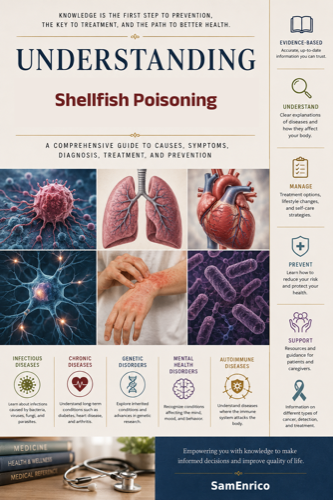
Non-FictionInformativeEducational
Understanding Shellfish Poisoning eBook
This disease publication, published by SamEnrico,
This disease publication, published by SamEnrico, covers Understanding Shellfish Poisoning
Formats
Free sample
Chapter 1: The Silent Harvest--–- On a calm August morning in 2016, a family of six sat down for a breakfast of freshly harvested blue mussels from a beach near Kodiak, Alaska. Within forty-five minutes, the mother’s lips began to tingle. By the time she mentioned this to her husband, her fingers had gone numb. Two hours later, all six family members were in the emergency department. Three would require mechanical ventilation to breathe.
Two would spend a week in the intensive care unit. The mussels they had gathered were beautiful, plump, and entirely indistinguishable from safe shellfish. There was no red tide, no discolored water, no warning sign on the beach. The only evidence of danger was invisible, odorless, and tasteless. This is the defining characteristic of shellfish poisoning: it offers no warning.The Alaska PSP outbreak of 2016 was not an anomaly.
It was one of dozens of similar incidents that occur every year around the world. In 2017, a shipment of clams imported from a region with unreported algal blooms caused an outbreak of diarrhetic shellfish poisoning across three Italian cities, sickening over two hundred people who had dined at separate restaurants supplied by the same distributor. In 2019, a single meal of recreationally harvested scallops in Nova Scotia sent five people to the hospital with amnesic shellfish poisoning, leaving one survivor with permanent memory loss so severe he could no longer recognize his own children. These are not isolated tragedies. They are the visible peaks of a much larger public health challenge—one that has grown substantially in the past three decades and shows every sign of worsening.The global burden of shellfish poisoning is significantly underestimated.
Official surveillance systems record approximately two thousand confirmed cases annually worldwide. However, epidemiological modeling based on hospitalization rates, export recalls, and retrospective surveys suggests the true number is five to ten times higher. The gap between reported and actual cases exists for several reasons: mild cases never seek medical attention, physicians in non-coastal regions fail to recognize the syndrome, and many countries lack any reporting requirement for non-fatal seafood poisonings. Even in the United States, which has one of the most robust shellfish safety monitoring systems globally, the Centers for Disease Control and Prevention estimates that for every reported case of shellfish poisoning, at least four go undocumented.The economic impact is equally substantial. A single harmful algal bloom event can force the closure of commercial shellfish harvesting beds for weeks or months.
The 2015 West Coast domoic acid event—the largest in recorded history—closed fisheries from central California to Washington state for nearly nine months, resulting in an estimated economic loss of over 100million.The2018closureof Prince Edward Islandmusselbedsduetoa PSPeventcost Canadianfishermenapproximately100 million. The 2018 closure of Prince Edward Island mussel beds due to a PSP event cost Canadian fishermen approximately 100million.The2018closureof Prince Edward Islandmusselbedsduetoa PSPeventcost Canadianfishermenapproximately25 million in lost revenue. Small coastal communities that depend on shellfish tourism and recreational harvesting face additional uncounted losses when seasonal closures coincide with peak tourist months.Perhaps most troubling, the problem is expanding. Harmful algal blooms—the source of all shellfish toxins—are increasing in frequency, duration, and geographic range. As detailed in Chapter 2, warming ocean temperatures, nutrient pollution from agriculture and urban runoff, and changing ocean currents are creating conditions favorable for toxic algae in regions that were historically safe.
Paralytic shellfish poisoning, once confined to temperate waters between 30 and 60 degrees latitude, is now appearing in Arctic Alaska and northern Norway. Amnesic shellfish poisoning, first recognized in Canada in 1987, has now been documented in every ocean basin. The globalization of the seafood trade means that shellfish harvested from a bloom in Chile can be frozen, shipped, and consumed in Tokyo or London within seventy-two hours—well within the window for human illness.Against this backdrop, this chapter, and the chapters that follow, serve a critical purpose. The vast majority of shellfish poisonings are preventable. Prevention requires three things: knowledge of the risk, access to monitoring information, and adherence to basic safety rules.
These are not complicated. They do not require expensive equipment or specialized training. They require what this book delivers—a clear, evidence-based, practical understanding of how shellfish become toxic, how to recognize the poisoning syndromes, what to do when they occur, and how to avoid them entirely.The Hidden Burden of Shellfish Poisoning To understand why shellfish poisoning remains underappreciated as a public health concern, we must first understand the nature of the illnesses themselves. The five major syndromes—paralytic, amnesic, diarrhetic, neurotoxic, and azaspiracid shellfish poisoning—vary dramatically in severity and presentation. Paralytic shellfish poisoning (PSP) is the most lethal, with an untreated fatality rate approaching 10 percent.
Amnesic shellfish poisoning (ASP) produces permanent brain injury in survivors. The other three syndromes are non-fatal but cause substantial morbidity, including severe diarrhea requiring hospitalization for fluid resuscitation and neurological symptoms that can persist for weeks.However, the very nature of these illnesses contributes to underrecognition. A person who develops nausea, vomiting, and diarrhea after eating shellfish may assume they have a simple case of food poisoning from bacteria. A physician who sees a patient with perioral tingling and mild ataxia may consider a transient ischemic attack or multiple sclerosis before considering shellfish poisoning, particularly if the patient does not mention the meal. The diagnosis requires a specific question: what did you eat in the past forty-eight hours, and where did it come from?Case Study: The 2016 Alaska PSP Outbreak The Alaska outbreak warrants detailed examination because it illustrates nearly every critical feature of shellfish poisoning epidemiology, clinical presentation, and prevention.
On August 12, 2016, a family of six—two parents and four children aged eight to seventeen—harvested approximately forty blue mussels from a beach near Kodiak Island. The beach was not posted with any warning signs. The water showed no discoloration. The family had harvested from the same beach multiple times in previous years without incident. They cooked the mussels in a pot of boiling water until the shells opened, a method they believed rendered any potential contaminants safe.The first symptoms appeared thirty-five minutes after the meal began.
The mother noted a tingling sensation around her lips. Her husband reported a similar sensation within forty-five minutes. By sixty minutes, the seventeen-year-old daughter complained of numbness in her fingertips and described feeling as though she were walking on sponges. The family called 911 at the seventy-minute mark, after the father attempted to stand from the dinner table and fell, unable to maintain his balance.Emergency medical services arrived twenty minutes later. By that time, the mother had developed slurred speech.
The father was able to walk with assistance but demonstrated a wide-based, unsteady gait. The children showed variable symptoms: the eldest had mild perioral tingling only; the eight-year-old had progressed rapidly to diffuse numbness and required assistance to sit upright. All six patients were transported to the Providence Kodiak Island Medical Center, a small rural hospital with limited intensive care capacity.Over the next four hours, three patients deteriorated. The mother, father, and eight-year-old developed descending paralysis characteristic of severe PSP. The father lost the ability to cough or swallow.
The mother developed respiratory distress with oxygen saturation falling to 84 percent on room air. The eight-year-old became apneic. All…
This is the end of the free sample. Get the eBook to keep going. Buy now
About this book
Details
- Author
- Stegall Obdulia
- Publisher
- SamEnrico
- Language
- English
- Genre
- Non-Fiction, Informative, Educational
- Released
- 2026-05-06
- Pages (approx.)
- 157
- Available as
- eBook, Audiobook

Read better in the ZLOADR app
Your eBooks on your phone or tablet. Sign in with your SamEnrico account and start reading.
More by Stegall Obdulia
 Reddit Upvote Validation HandbookStegall Obdulia$11.99
 Nauru Phosphate BrokerStegall Obdulia$11.99
 Marty Robbins Gunfighter BalladsStegall Obdulia$11.99
 Burnout Recovery Emotional ReleaseStegall Obdulia$11.99
 The Physical Exercise Memory GuideStegall Obdulia$11.99
 Soul Rebels: The Birth of Nigerian Afrobeat and the Cult Film That Ignited a RevolutionStegall Obdulia$11.99
 Japanese Scholarship EligibilityStegall Obdulia$12.99
 Coffee Value Addition GuideStegall Obdulia$12.99
 SculleryStegall Obdulia$11.99
You may also like
 Hong Kong Handover 1997Dunn Johnnie$11.99
 Zumba For Postnatal Recovery CourseNeal Christian$11.99
 Zumba for BeginnersLadner Nikia$11.99
 YouTube Comment Mining GuideHumes Pandora$12.99
 Worry Box MeditationCarlin Rudy$11.99
 Workplace Stress MeditationNguyen Lynn$11.99
 Workplace Stress and Sleep RepairHawley Ivory$11.99
 Workplace Perfectionism CureDelaney Jeffry$11.99
 Workplace Injustice Anger GuideWallen Isabelle$11.99
 Work Addiction and Burnout LinkGreenwood Ester$11.99
 Women in Yoga and WellnessBeattie Galina$11.99
 Women in Stand Up ComedyChun Evangeline$11.99