
Non-FictionInformativeEducational
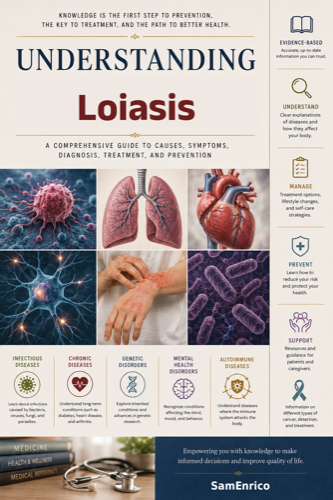
Understanding Loiasis eBook
This disease publication, published by SamEnrico,
by Wills Micah
This disease publication, published by SamEnrico, covers Understanding Loiasis
Formats
Free sample
Chapter 1: The Invisible Stowaway...--It begins, almost always, with nothing at all.You wake up one morning in a village outside Yaoundé, Cameroon, or perhaps in a logging camp deep in the rainforest of the Republic of Congo. You are an aid worker, a teacher, a rubber plantation laborer, or a traveler who took the wrong road three weeks ago. Your skin feels ordinary. Your eyes see clearly. You drink coffee, swat a few flies, and walk into the day.
Nothing hurts. Nothing itches. Nothing crawls.And yet, inside you, something is already there.Somewhere beneath the fascia of your forearm or the loose tissue of your eyelid, a larval worm no larger than a human hair has just completed its final molt. It is now a young adult Loa loa —a nematode, a roundworm, and one of the most exquisitely adapted parasites on Earth. It will live inside you for the next twelve to seventeen years.
It will grow to the size of a long, thin matchstick—fifty to seventy millimeters in length, barely a millimeter wide. It will mate with another worm, perhaps in your axilla or your groin, and the female will begin releasing hundreds of thousands of microscopic offspring called microfilariae into your bloodstream. Those offspring will circulate through your heart, your lungs, your brain’s capillaries, and the fine vessels of your retina. And unless a Chrysops fly—the deer fly, the mango fly—bites you and sucks them up, they will die in about a year, replaced by new waves of microfilariae from the same adult female.You will not feel any of this. Not for months.
Sometimes not for years.That is the first and most important truth about loiasis: it is a master of invisibility. And that invisibility is why this book exists.The Problem of a Forgotten Disease Loiasis is not rare. In the rainforests of West and Central Africa, it is astonishingly common. Epidemiologists have spent decades walking from village to village, pricking fingers, and looking at blood under microscopes. What they have found should shock anyone who cares about global health.
In some communities in Cameroon’s Lekié Division, more than forty percent of adults carry microfilariae in their blood. In parts of Equatorial Guinea, the prevalence exceeds fifty percent in older age groups. Even in cities like Douala or Kinshasa, where the Chrysops fly is less common, serological surveys—tests that measure antibodies to Loa loa antigens—suggest that one in three residents has been exposed at some point in their lives.And yet, ask the average doctor in Paris, London, or New York about loiasis, and you will likely get a blank stare. Ask a physician in Lagos or Nairobi, and the answer may not be much better. Loiasis is what public health experts call a neglected tropical disease—NTD for short.
But within that category, it occupies a peculiar and dangerous position. It is neglected not because it is rare, not because it is trivial, and certainly not because it is easy to treat. It is neglected because it has the misfortune of inhabiting the same geographic space as two of the most devastating parasitic diseases on earth: onchocerciasis (river blindness) and lymphatic filariasis (elephantiasis). For decades, global health programs poured billions of dollars into controlling those two illnesses. They distributed ivermectin and albendazole by the millions of doses.
They mapped rivers and identified breeding sites. They built elaborate delivery systems that reached the most remote villages in Africa.And then, in the late 1990s, those programs ran into a wall. That wall was Loa loa.The story of that collision will unfold in later chapters. For now, it is enough to understand that loiasis is not a curiosity, not a medical oddity, and not a disease that only affects a handful of unfortunate travelers. It is a major public health problem that has frustrated and derailed some of the most ambitious disease-control campaigns in history.
It kills people—not often, but when it does, it kills them in ways that are sudden, terrifying, and entirely preventable. And it is only now, after decades of neglect, that scientists are beginning to understand its true scope.This chapter is about the worm itself. Before we can understand why loiasis is so difficult to diagnose, why it can turn a routine public health intervention into a catastrophe, and why your chances of encountering it are higher than you might think, we have to meet the creature at the center of the story. We have to understand its anatomy, its lifecycle, its evolutionary genius, and its strange, intimate relationship with the humans and flies that keep it alive.A Worm Like No Other Loa loa belongs to the phylum Nematoda—the roundworms. This is a vast and ancient group.
There are more than twenty-five thousand described species of nematodes, and some biologists believe the true number is ten times that. They live everywhere: in soil, in fresh water, in the guts of termites, in the roots of fig trees, in the muscles of whales. A handful of them have evolved to live inside humans. Among these, Loa loa is something of a celebrity, though not for reasons anyone would wish for.Unlike the hookworm, which attaches to the intestinal wall and drinks blood, Loa loa is a wanderer. It does not settle in one organ or tissue.
It moves. Adult worms glide through the subcutaneous connective tissue—the loose, fibrous layer just beneath the skin—at a rate of about one centimeter per minute. They travel along fascial planes, slide between muscle groups, and occasionally breach the surface in ways that are impossible to ignore. When a worm reaches the conjunctiva of the eye—the transparent membrane that covers the white of the eye—it causes a dramatic and unforgettable spectacle: a thin, white, undulating line moving slowly across the sclera, visible to the naked eye. This is the “eye worm” that gives loiasis its common name.
It is painless, usually, but it is also deeply unsettling. Patients who experience it describe a sensation of “something crawling” or “a hair in my eye.” Some have captured it on their phones.But here is the crucial detail: most infected people never see a worm. The vast majority of adult Loa loa remain hidden. They travel through the back, the chest, the abdominal wall, the scalp. They are too deep to be seen and too thin to be felt.
Their presence is revealed only indirectly—through the allergic reactions they provoke, through the microfilariae they release, or through the rare complication of a brain scan showing a worm that has wandered into forbidden territory.The adult worms are sexually dimorphic, meaning males and females look different. Females are larger: sixty to seventy millimeters long, zero point five to zero point six millimeters wide. Males are smaller: thirty to thirty-four millimeters long, zero point three to zero point four millimeters wide. Both are translucent and off-white. Under a dissecting microscope, you can see the female’s reproductive tract—two long tubes filled with developing microfilariae, like a coiled garden hose packed with seeds.
A single female can produce between ten thousand and thirty thousand microfibrille per day. Over a lifetime of ten to…
This is the end of the free sample. Get the eBook to keep going. Buy now
About this book
Details
- Author
- Wills Micah
- Publisher
- SamEnrico
- Language
- English
- Genre
- Non-Fiction, Informative, Educational
- Released
- 2026-06-02
- Pages (approx.)
- 154
- Available as
- eBook, Audiobook

Read better in the ZLOADR app
Your eBooks on your phone or tablet. Sign in with your SamEnrico account and start reading.
More by Wills Micah
 Child Stars Who Killed ThemselvesWills Micah$11.99
 Posture And Breath ConnectionWills Micah$11.99
 Stress and Relationship Apology RepairWills Micah$11.99
 Active Listening for Anger ManagementWills Micah$11.99
 The Still Breath PointWills Micah$11.99
 Barley & Blood: The Viking Brewer Who Conquered RomeWills Micah$11.99
 How to Start a Technical Schools BusinessWills Micah$11.99
 Feature LeadWills Micah$11.99
 Media Consumption PatternsWills Micah$12.99
 Real Estate LLC For Foreign InvestorsWills Micah$12.99
You may also like
 Hong Kong Handover 1997Dunn Johnnie$11.99
 Zumba For Postnatal Recovery CourseNeal Christian$11.99
 Zumba for BeginnersLadner Nikia$11.99
 YouTube Comment Mining GuideHumes Pandora$12.99
 Worry Box MeditationCarlin Rudy$11.99
 Workplace Stress MeditationNguyen Lynn$11.99
 Workplace Stress and Sleep RepairHawley Ivory$11.99
 Workplace Perfectionism CureDelaney Jeffry$11.99
 Workplace Injustice Anger GuideWallen Isabelle$11.99
 Work Addiction and Burnout LinkGreenwood Ester$11.99
 Women in Yoga and WellnessBeattie Galina$11.99
 Women in Stand Up ComedyChun Evangeline$11.99