
Non-FictionInformativeEducational
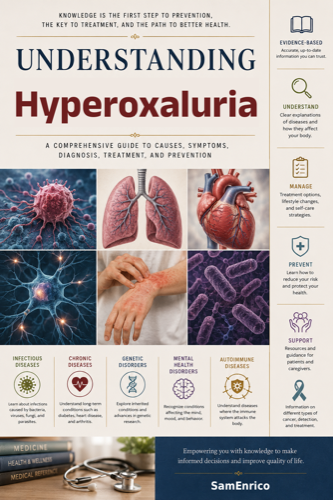
Understanding Hyperoxaluria eBook
This disease publication, published by SamEnrico,
by Galvez Dian
This disease publication, published by SamEnrico, covers Understanding Hyperoxaluria
Formats
Free sample
Chapter 1: The Crystal Thief--Imagine waking up one morning with a sharp pain in your lower back. You assume you slept wrong, or maybe you lifted something heavy the day before. You take an over-the-counter pain reliever and go about your day. But by evening, the pain has migrated downward, wrapping around your flank and into your groin. You cannot find a comfortable position.
You pace. You sweat. You vomit from the intensity. By midnight, you are in an emergency department, curled on a gurney, begging for relief.This is the first moment most people learn they have a kidney stone. For the average person, it is a single, terrible event—a week of misery, a trip to the urologist, a prescription for hydration, and then never again.
But for someone with hyperoxaluria, that first stone is not an ending. It is a warning shot. And unlike the common stone former who may go years or decades between episodes, the person with hyperoxaluria lives under a continuous sentence of crystal formation, tissue damage, and, in the most severe cases, the slow destruction of their kidneys and every major organ system in their body.This book is for that person. It is also for the parent who watches their child pass stones before they can tie their own shoes. It is for the spouse who sits in the transplant center waiting room.
It is for the gastroenterologist who sees unexplained kidney failure in a patient with Crohn's disease. And it is for the patient who has been told, for the tenth time, that they just need to drink more water—without ever being told why their body makes stones in the first place.The crystal thief does not steal your life all at once. It steals it in grains so small you cannot see them, over years so long you do not notice the accumulation. This chapter begins where every journey must: with the fundamental question of what oxalate is, where it comes from, how your kidneys handle it, and why too much of it turns a harmless waste product into a weapon.What Is Oxalate, Anyway?Oxalate is a naturally occurring organic acid. Its chemical structure is simple: two carbon atoms, four oxygen atoms, and two negative charges that make it eager to bind with positively charged ions like calcium.
In the periodic table of human metabolism, oxalate is not a celebrity. It does not get the attention of glucose or cholesterol. It does not have the glamour of serotonin or dopamine. But it has a singular, dangerous property: when oxalate meets calcium in the wrong environment, they form a crystal that is almost impossible to dissolve.Think of it this way. If you spill table salt on a counter, a wet sponge will wipe it away instantly.
Salt is highly soluble. If you spill sugar, the same sponge works almost as well. But if you spill cement powder and add water, you get a solid mass that requires a chisel to remove. Calcium oxalate is the cement of the human body. Once it crystallizes, it does not go back into solution except under extreme conditions that do not exist inside a living kidney.You encounter oxalate every day.
It is present in spinach, rhubarb, beets, almonds, cashews, peanuts, chocolate, black tea, wheat bran, and star fruit. It is in the French fries you ate last week (potatoes are moderate in oxalate, but frying concentrates it). It is in the berry smoothie you drank after a workout (raspberries and blackberries are surprisingly high). For most people, this dietary oxalate passes through the gut, binds to calcium from food, and exits in the stool, never causing harm. But oxalate also comes from another source: your own liver.The liver is a chemical factory.
Every moment of every day, it performs thousands of reactions to break down proteins, synthesize new molecules, and dispose of waste. One of those reactions involves a small molecule called glyoxylate. Under normal circumstances, the liver converts glyoxylate into glycine, an amino acid used to build proteins and other essential compounds. But when one of the liver's enzymes is missing, defective, or overwhelmed, glyoxylate takes a different path. It converts to oxalate instead.
This endogenous production accounts for roughly half of the oxalate in your urine if you have normal kidney function. If you have a genetic defect in one of the liver enzymes, endogenous production can increase tenfold or more.So oxalate enters your body from two directions: from the food you eat, and from the chemical reactions inside your own liver. Neither source is dangerous on its own. The danger begins when oxalate accumulates in the blood faster than the kidneys can remove it.The Kidneys: Your Oxalate Garbage Disposal The kidneys are often described as filters, but that undersells them. A coffee filter is passive—it catches grounds and lets water through.
The kidneys are active, dynamic, electrochemical marvels that adjust their behavior second by second based on your blood pressure, hydration status, hormone levels, and the concentration of dozens of solutes. Each kidney contains approximately one million nephrons, each a microscopic processing unit that pulls blood plasma through a semipermeable membrane (the glomerulus), reabsorbs what the body needs to keep, and excretes the rest as urine.Oxalate is one of the solutes the kidneys are responsible for excreting. Under normal conditions, a healthy kidney filters oxalate from the blood and sends it into the urine, where it remains dissolved because the urine volume is high enough and the concentration of oxalate is low enough. The kidney also has the ability to secrete additional oxalate beyond what is filtered—an active transport system that moves oxalate from the blood into the tubular fluid. This secretion pathway is a backup system, and it works well as long as oxalate loads are within normal limits.But the kidney has limits.
The maximum concentration of oxalate that can remain dissolved in urine is about 0.5 millimoles per liter. Above that threshold, oxalate begins to precipitate out of solution, forming microscopic crystals. These crystals are initially so small that they pass harmlessly in the urine. You have probably passed thousands of them without ever knowing. But under the right—or rather, wrong—conditions, those microscopic crystals stick together, attach to the lining of the renal tubules, and grow into macroscopic stones.The tipping point is a concept called supersaturation.
Imagine adding teaspoon after teaspoon of table salt to a glass of water. The first few teaspoons dissolve instantly. After a while, the water becomes saturated—it cannot hold any more salt in solution. The next teaspoon falls to the bottom of the glass and stays there, undissolved. That is supersaturation.
In the kidney, supersaturation occurs when urine volume is too low, oxalate concentration is too high, calcium concentration is too high, or any combination of these factors. Once supersaturation crosses a critical threshold, crystallization is inevitable.This is why the first and most important treatment for hyperoxaluria is not a drug, not a surgery, not a genetic therapy—it is water. Dilution is the only reliable way to lower oxalate concentration in urine. But water alone is rarely enough for patients with significant…
This is the end of the free sample. Get the eBook to keep going. Buy now
About this book
Details
- Author
- Galvez Dian
- Publisher
- SamEnrico
- Language
- English
- Genre
- Non-Fiction, Informative, Educational
- Released
- 2026-05-08
- Pages (approx.)
- 147
- Available as
- eBook, Audiobook

Read better in the ZLOADR app
Your eBooks on your phone or tablet. Sign in with your SamEnrico account and start reading.
More by Galvez Dian
 Anger And Child's Social Media UseGalvez Dian$11.99
 Brand Ranking Emerging Market PulseGalvez Dian$11.99
 PNE for First RespondersGalvez Dian$11.99
 Self Care Time Blocking GuideGalvez Dian$11.99
 The Last Pharaoh's Gambit: Cleopatra’s Unseen Gambit in the Roman SenateGalvez Dian$11.99
 Water SkiGalvez Dian$11.99
 Banking as a Service API GuideGalvez Dian$12.99
 Benefits Gap Portfolio ManualGalvez Dian$12.99
 How to Become a Chemical-etching ProcessorGalvez Dian$11.99
You may also like
 Hong Kong Handover 1997Dunn Johnnie$11.99
 Zumba For Postnatal Recovery CourseNeal Christian$11.99
 Zumba for BeginnersLadner Nikia$11.99
 YouTube Comment Mining GuideHumes Pandora$12.99
 Worry Box MeditationCarlin Rudy$11.99
 Workplace Stress MeditationNguyen Lynn$11.99
 Workplace Stress and Sleep RepairHawley Ivory$11.99
 Workplace Perfectionism CureDelaney Jeffry$11.99
 Workplace Injustice Anger GuideWallen Isabelle$11.99
 Work Addiction and Burnout LinkGreenwood Ester$11.99
 Women in Yoga and WellnessBeattie Galina$11.99
 Women in Stand Up ComedyChun Evangeline$11.99