
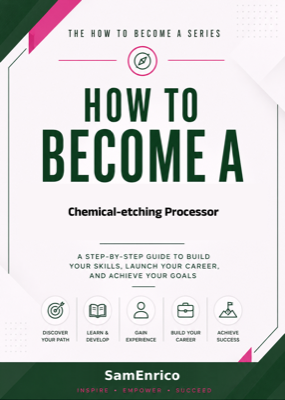
Non-FictionInformativeEducational
How to Become a Chemical-etching Processor
How to Become a Chemical-etching Processor
by Galvez Dian
How to Become a Chemical-etching Processor
Formats
About this book
Free sample
Chapter 1: The Invisible Etch...--–- The smartphone in your pocket has forty-eight layers of copper circuitry so fine that a human hair would cover twelve separate wires. The car you drive contains over three thousand etched components, from the sensors that deploy your airbags to the controller that manages your brakes. The pacemaker keeping someone’s heart beating relies on chemical etching to create circuits smaller than a grain of sand. None of this exists without a person standing over a bath of acid, watching, waiting, and knowing exactly when to stop. That person could be you.This chapter is not a sales pitch.
It is not a motivational poster. It is an honest, unflinching look at one of manufacturing’s best-kept secrets: the world of the chemical-etching processor. By the time you finish these pages, you will understand what this job actually is, why it pays what it pays, where you fit in the hierarchy, and whether you have the stomach for what comes next.The Hidden Industry That Touches Everything Walk through any modern building, and you are surrounded by the work of chemical-etching processors. The backlight on your laptop screen? Etched.
The radio-frequency filters in your Wi-Fi router? Etched. The metal shields inside your microwave that keep radiation from leaking out? Etched. The surgical scalpel blades that are disposable and sterile?
Etched into shape from flat stainless steel, then sharpened chemically rather than ground.Chemical etching, also known as photochemical machining or photochemical milling, is a subtractive manufacturing process. Unlike 3D printing, which adds material layer by layer, or stamping, which pounds metal into shape, etching dissolves away everything that should not be there. The result is precision that mechanical methods cannot match. A stamping press creates burrs—tiny ridges of displaced metal that require secondary finishing. A laser cutter leaves a heat-affected zone where the metal’s properties change.
But a chemically etched part has no burrs, no heat damage, and no mechanical stress. It comes out of the bath exactly as the pattern intended, with edges so clean you could examine them under an…
This is the end of the free sample. Get the eBook to keep going. Buy now
Contents
- Chapter 1
- Chapter 2
- Chapter 3
- Chapter 4
- Chapter 5
- Chapter 6
- Chapter 7
- Chapter 8
- Chapter 9
- Chapter 10
- Chapter 11
- Chapter 12
Details
- Author
- Galvez Dian
- Publisher
- SamEnrico
- Language
- English
- ISBN
- 9781505795516
- Genre
- Non-Fiction, Informative, Educational
- Released
- 2026-05-18
- Pages (approx.)
- 141
- Available as
- eBook, Paperback, Audiobook

Read better in the ZLOADR app
Your eBooks on your phone or tablet. Sign in with your SamEnrico account and start reading.
More by Galvez Dian
 Anger And Child's Social Media UseGalvez Dian$11.99
 Brand Ranking Emerging Market PulseGalvez Dian$11.99
 PNE for First RespondersGalvez Dian$11.99
 Self Care Time Blocking GuideGalvez Dian$11.99
 The Last Pharaoh's Gambit: Cleopatra’s Unseen Gambit in the Roman SenateGalvez Dian$11.99
 Water SkiGalvez Dian$11.99
 Banking as a Service API GuideGalvez Dian$12.99
 Benefits Gap Portfolio ManualGalvez Dian$12.99
 Understanding HyperoxaluriaGalvez Dian$17.99
You may also like
 Hong Kong Handover 1997Dunn Johnnie$11.99
 Zumba For Postnatal Recovery CourseNeal Christian$11.99
 Zumba for BeginnersLadner Nikia$11.99
 YouTube Comment Mining GuideHumes Pandora$12.99
 Worry Box MeditationCarlin Rudy$11.99
 Workplace Stress MeditationNguyen Lynn$11.99
 Workplace Stress and Sleep RepairHawley Ivory$11.99
 Workplace Perfectionism CureDelaney Jeffry$11.99
 Workplace Injustice Anger GuideWallen Isabelle$11.99
 Work Addiction and Burnout LinkGreenwood Ester$11.99
 Women in Yoga and WellnessBeattie Galina$11.99
 Women in Stand Up ComedyChun Evangeline$11.99