
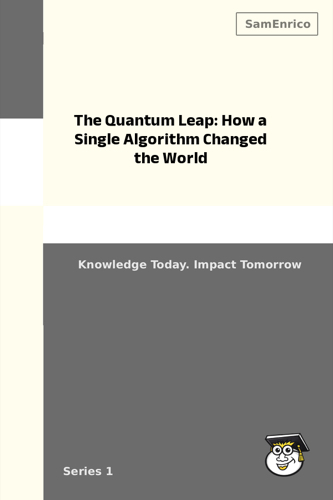
The Quantum Leap: How a Single Algorithm Changed the World
Explore how Shor's algorithm, developed in 1994, b
Explore how Shor's algorithm, developed in 1994, became the cornerstone of quantum computing, revolutionizing cryptography and sparking a global tech arms race.
Formats
About this book
Free sample
Chapter 1: The Classical Cage...--–- In 1977, three mathematicians at MIT published a challenge. They had invented a new kind of lock—one that didn't use metal tumblers or electronic codes, but pure number theory. To prove how strong their lock was, they printed a 129-digit number in Scientific American and offered a $100 reward to anyone who could figure out the two prime numbers that, when multiplied together, produced it. They estimated that a classical computer—even one that had the luxury of thousands of years—would never crack it. The lock, they believed, was eternal.It took seventeen years and six hundred volunteers using sixteen hundred computers to prove them wrong.When the factors were finally revealed in 1994—the same year Peter Shor unveiled his quantum algorithm—the mathematical world gasped.
Not because the lock had been broken, but because of how long it took. Thirty quadrillion calculations. Thousands of computers humming in basements and university labs across forty countries. The effort was heroic, but it proved a deeper truth: the asymmetry between multiplying two primes and factoring their product was not just large—it was cosmological. Multiply a 300-digit prime by another 300-digit prime.
A child could do it with a spreadsheet in a millisecond. Now try to reverse the process. You would need to test every prime number up to the square root of that 600-digit product. There are more such primes than atoms in the observable universe.This asymmetry became the silent foundation of the digital age. Every time you typed your password into a website, every time your phone connected to a Wi-Fi network, every time a bank transferred money between accounts, you were trusting that asymmetry.
You were trusting that what was easy to build (the lock) was impossibly hard to break (the key). You were trusting that the classical computer—that obedient, sequential, one-thing-at-a-time machine—had met its match in pure mathematics.But trust, even mathematical trust, is a fragile thing.The Librarian Who Could Only Read One Book To understand why that trust existed—and why it is now crumbling—we must first understand the machine that built…
This is the end of the free sample. Get the eBook to keep going. Buy now
Contents
- Chapter 1
- Chapter 2
- Chapter 3
- Chapter 4
- Chapter 5
- Chapter 6
- Chapter 7
- Chapter 8
- Chapter 9
- Chapter 10
- Chapter 11
- Chapter 12
Details
- Author
- Darling Frieda
- Publisher
- SamEnrico
- Language
- English
- Genre
- Non-Fiction, Quantum Computing
- Released
- 2026-06-03
- Pages (approx.)
- 127
- Available as
- eBook, Audiobook

Read better in the ZLOADR app
Your eBooks on your phone or tablet. Sign in with your SamEnrico account and start reading.
More by Darling Frieda
 Franklin RNA Research Legacy CourseDarling Frieda$11.99
 Gut Microbiome Brain Axis GuideDarling Frieda$11.99
 Firefighter Failure FearDarling Frieda$11.99
 Carson Post Silent Spring Depression GuideDarling Frieda$11.99
 The Caregiver Veteran Care GuideDarling Frieda$11.99
 Tangaroa and Hina: The Tide That Bound the SkyDarling Frieda$11.99
 Understanding Foreign Accent SyndromeDarling Frieda$17.99
 AI Fraud Detection GuideDarling Frieda$12.99
 Non Technical CTO Interview WorkbookDarling Frieda$12.99
 Ultimate Handbook Guide to Wendeng : (China) Travel GuideDarling Frieda$11.99
 Value Stream CoachDarling Frieda$11.99
You may also like
 Hong Kong Handover 1997Dunn Johnnie$11.99
 Zumba For Postnatal Recovery CourseNeal Christian$11.99
 Zumba for BeginnersLadner Nikia$11.99
 YouTube Comment Mining GuideHumes Pandora$12.99
 Worry Box MeditationCarlin Rudy$11.99
 Workplace Stress MeditationNguyen Lynn$11.99
 Workplace Stress and Sleep RepairHawley Ivory$11.99
 Workplace Perfectionism CureDelaney Jeffry$11.99
 Workplace Injustice Anger GuideWallen Isabelle$11.99
 Work Addiction and Burnout LinkGreenwood Ester$11.99
 Women in Yoga and WellnessBeattie Galina$11.99
 Women in Stand Up ComedyChun Evangeline$11.99