
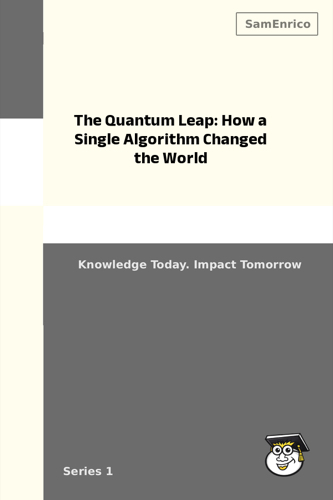
The Quantum Leap: How a Single Algorithm Changed the World eBook
Explore how Shor's algorithm, developed in 1994, b
Explore how Shor's algorithm, developed in 1994, became the cornerstone of quantum computing, revolutionizing cryptography and sparking a global tech arms race.
Formats
Free sample
Chapter 1: The Classical Cage...--–- In 1977, three mathematicians at MIT published a challenge. They had invented a new kind of lock—one that didn't use metal tumblers or electronic codes, but pure number theory. To prove how strong their lock was, they printed a 129-digit number in Scientific American and offered a $100 reward to anyone who could figure out the two prime numbers that, when multiplied together, produced it. They estimated that a classical computer—even one that had the luxury of thousands of years—would never crack it. The lock, they believed, was eternal.It took seventeen years and six hundred volunteers using sixteen hundred computers to prove them wrong.When the factors were finally revealed in 1994—the same year Peter Shor unveiled his quantum algorithm—the mathematical world gasped.
Not because the lock had been broken, but because of how long it took. Thirty quadrillion calculations. Thousands of computers humming in basements and university labs across forty countries. The effort was heroic, but it proved a deeper truth: the asymmetry between multiplying two primes and factoring their product was not just large—it was cosmological. Multiply a 300-digit prime by another 300-digit prime.
A child could do it with a spreadsheet in a millisecond. Now try to reverse the process. You would need to test every prime number up to the square root of that 600-digit product. There are more such primes than atoms in the observable universe.This asymmetry became the silent foundation of the digital age. Every time you typed your password into a website, every time your phone connected to a Wi-Fi network, every time a bank transferred money between accounts, you were trusting that asymmetry.
You were trusting that what was easy to build (the lock) was impossibly hard to break (the key). You were trusting that the classical computer—that obedient, sequential, one-thing-at-a-time machine—had met its match in pure mathematics.But trust, even mathematical trust, is a fragile thing.The Librarian Who Could Only Read One Book To understand why that trust existed—and why it is now crumbling—we must first understand the machine that built the digital world. The classical computer, from the room-sized ENIAC of 1945 to the i Phone in your pocket, operates on a single, unbreakable rule: it processes information one step at a time. This is not a design flaw. It is the definition of classical computation.Imagine a vast library.
In this library, there are billions of books, but only one librarian. The librarian is incredibly fast—she can read a book in a microsecond, run to the next aisle, pick another book, and read that one too. But she can only read one book at a time. If you asked her to find a specific sentence somewhere in the library, she would have to check each book sequentially. If you asked her to factor a number by testing every possible prime, she would start with 2, then 3, then 5, and so on, until she either found the factors or ran out of time.This librarian is the classical computer.
Its power comes from speed and efficiency, not parallelism. For most of human history, this was enough. The problems we wanted to solve—balancing a checkbook, rendering a 3D animation, simulating weather patterns—could be broken into sequential steps that the librarian could handle in reasonable time. But some problems resist sequential attack. They are not hard because they require complex operations.
They are hard because they require many operations, and the number of operations grows so fast that even a million librarians working for a billion years would not finish.These are the problems that live in a class computer scientists call NP—nondeterministic polynomial time. Without diving into the mathematical weeds, NP problems share a peculiar property: if someone gives you a solution, you can verify it quickly, but finding that solution in the first place is astronomically hard. Factoring falls into this class. Given the two primes that multiply to 129 digits, a computer can verify they are correct in microseconds. But finding them from scratch?
That took the world seventeen years.Moore's Law and the Coming Wall For decades, the computing industry had a secret weapon against hard problems: Moore's Law. In 1965, Gordon Moore, co-founder of Intel, observed that the number of transistors on a microchip doubled roughly every two years. This wasn't a law of physics; it was an observation of engineering progress. But it held for fifty years. Transistors shrank from the width of a human hair to the size of a few atoms.
Clock speeds climbed from kilohertz to gigahertz. The librarian got faster and faster, and problems that once seemed impossible became routine.But by the early 2000s, the limits of classical physics began to assert themselves. Transistors cannot shrink below the size of a few silicon atoms without quantum effects—tunneling, leakage, interference—disrupting their behavior. Heat dissipation becomes impossible. The energy required to flip a bit approaches fundamental thermodynamic limits.
Moore's Law did not die; it slowed, then plateaued, then became a zombie—a prediction kept alive by marketing slides and architectural tricks (multiple cores, specialized circuits) rather than raw transistor density.The industry responded with parallel processing: instead of one librarian, why not put a thousand librarians in the same building? This is what multi-core processors do. But parallel classical computing has its own limits. Some problems, like factoring, are "embarrassingly parallel"—you can assign each librarian a different range of numbers to test. But the number of librarians you can afford is tiny compared to the number of tests required.
If you have a thousand cores, each testing a million numbers per second, you can check a billion numbers per second. That sounds fast until you realize that the number of primes you need to test for a 600-digit number is roughly 10^300—a one with three hundred zeros after it. At a billion tests per second, you would need 10^283 years. The universe is 13.8 billion years old, or about 1.38 x 10^10 years. The difference between 10^10 and 10^283 is not a gap; it is an abyss.The Asymmetric Lock That Built the Internet This abyss is precisely what made RSA encryption—named after its inventors Rivest, Shamir, and Adleman—so seductive.
Here was a lock that anyone could build in seconds but that, without the private key, would take longer than the age of the universe to pick.How does RSA work? At its core, it exploits the factoring asymmetry. Choose two large prime numbers, p and q. Multiply them to get N = p * q. This N is your public key—you can share it with the world.
To encrypt a message, the sender uses N and another number (derived from p and q) to scramble the message into ciphertext. To decrypt it, you need to know p and q—the original primes. Without them, the only way to decrypt is to factor N. And factoring N, as we have seen, is astronomically hard for a classical computer.For decades, this was enough. Governments, banks, militaries, and tech companies built their entire security infrastructure on the assumption that factoring was, for all practical purposes, impossible.
The Transport Layer Security (TLS) protocol that protects your web browsing? RSA. The digital signatures that verify software updates? RSA…
This is the end of the free sample. Get the eBook to keep going. Buy now
About this book
Details
- Author
- Darling Frieda
- Publisher
- SamEnrico
- Language
- English
- Genre
- Non-Fiction, Quantum Computing
- Released
- 2026-06-03
- Pages (approx.)
- 127
- Available as
- eBook, Audiobook

Read better in the ZLOADR app
Your eBooks on your phone or tablet. Sign in with your SamEnrico account and start reading.
More by Darling Frieda
 Franklin RNA Research Legacy CourseDarling Frieda$11.99
 Gut Microbiome Brain Axis GuideDarling Frieda$11.99
 Firefighter Failure FearDarling Frieda$11.99
 Carson Post Silent Spring Depression GuideDarling Frieda$11.99
 The Caregiver Veteran Care GuideDarling Frieda$11.99
 Tangaroa and Hina: The Tide That Bound the SkyDarling Frieda$11.99
 Understanding Foreign Accent SyndromeDarling Frieda$17.99
 AI Fraud Detection GuideDarling Frieda$12.99
 Non Technical CTO Interview WorkbookDarling Frieda$12.99
 Ultimate Handbook Guide to Wendeng : (China) Travel GuideDarling Frieda$11.99
 Value Stream CoachDarling Frieda$11.99
You may also like
 Hong Kong Handover 1997Dunn Johnnie$11.99
 Zumba For Postnatal Recovery CourseNeal Christian$11.99
 Zumba for BeginnersLadner Nikia$11.99
 YouTube Comment Mining GuideHumes Pandora$12.99
 Worry Box MeditationCarlin Rudy$11.99
 Workplace Stress MeditationNguyen Lynn$11.99
 Workplace Stress and Sleep RepairHawley Ivory$11.99
 Workplace Perfectionism CureDelaney Jeffry$11.99
 Workplace Injustice Anger GuideWallen Isabelle$11.99
 Work Addiction and Burnout LinkGreenwood Ester$11.99
 Women in Yoga and WellnessBeattie Galina$11.99
 Women in Stand Up ComedyChun Evangeline$11.99