
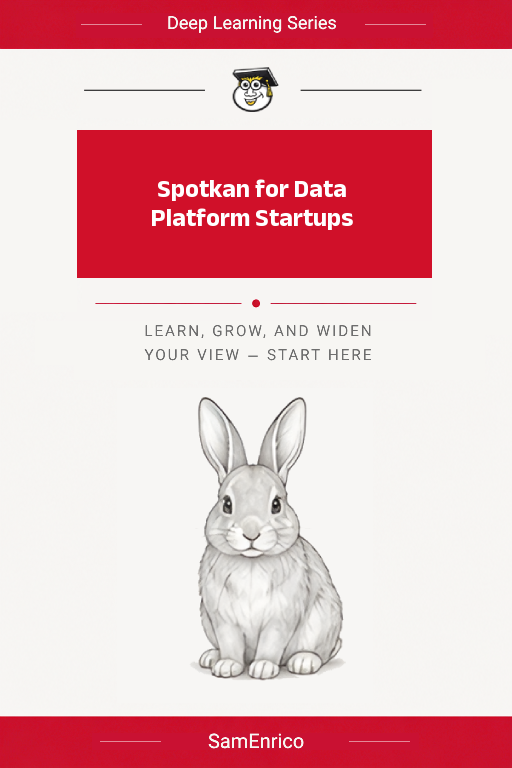
Spotkan for Data Platform Startups eBook
Handle petabytes using Spotify's data kanban syste
Handle petabytes using Spotify's data kanban system, managing ETL pipelines and dashboards as work items with service level agreements for startup analytics.
Formats
Free sample
Chapter 1: The 2 AM Fire...--It was 2:17 AM when Alexandra Chen’s phone buzzed for the seventh time in two hours. The screen glowed with a Slack notification from the CEO: “Revenue dashboard is showing $0 for the last six hours. Board deck is due at 9 AM. Please fix.”Alex, the sole data engineer at Streamlytics—a fast-growing music analytics startup—stared at her laptop from her kitchen table, still wearing yesterday’s hoodie. She had already restarted the Airflow DAG three times.
She had manually backfilled the missing partitions. She had even rewritten the SQL window function that kept timing out on the events table. Nothing worked because the problem wasn’t the code. The problem was that Streamlytics had quietly crossed 500 terabytes of event data six weeks ago, and their batch ETL—proudly built by Alex herself just eight months earlier—now took 14 hours to run. The morning dashboards were stale by lunch.
The “nightly” job finished at 3 PM. And the CEO was asking why the numbers didn’t match Salesforce.Alex was good at her job. She had a master’s degree in computer science, five years of experience at a Fortune 500 company, and deep expertise in Python, SQL, and Airflow. But none of that prepared her for what happened when a startup’s data volume doubles every four months. She was drowning not because she lacked skill, but because she was trying to solve a workflow problem with technical tools.The Petabyte Wall Is Not a Storage Limit Here is the first thing you need to understand about scaling a data platform: the Petabyte Wall is not about storage.
You can buy storage. S3 costs pennies. GCS is cheaper than your coffee budget. The Petabyte Wall is a velocity ceiling—the point at which your existing processes for moving, transforming, and serving data can no longer keep up with the speed of business.Streamlytics had not hit a storage limit. They had hit a freshness crisis.
The CEO needed revenue numbers by 9 AM. The pipeline delivered them at 3 PM. The gap between “when data is needed” and “when data is ready” was growing every week.Most data engineers mistake this for a performance problem. They think: “If only I could rewrite this in Py Spark,” or “If only we could afford Snowflake,” or “If only the CEO would accept yesterday’s numbers.” But performance optimizations only delay the wall. They do not move it.
What moves the wall is changing how you see, manage, and prioritize data work.This book introduces a different approach. It is called Spotkan—a portmanteau of Spotify (the company that processes 1.4 trillion events per day) and Kanban (the visual workflow system from Toyota manufacturing). Spotkan treats every pipeline, dashboard, and data product as a visible work item moving through a small set of standardized stages. It replaces heroics with flow, firefighting with foresight, and the 2 AM panic with a board you can look at before you go to sleep.But before we build that board, we need to understand exactly why traditional ETL fails at startup velocity.The Three Failure Modes of Batch-Only Thinking Streamlytics did not make a single mistake. They made a cascading series of decisions that seemed reasonable at each stage of their growth but collapsed under compounding complexity.
These failure modes are so common that they have names.Failure Mode One: The Batch Desperation Cycle Every startup data platform begins innocently. You have 10 gigabytes of event data. A simple Python script that runs once a night works perfectly. You deploy it, forget about it, and move on to building features.Then you hit 100 gigabytes. The nightly script now takes 45 minutes, but it still finishes before anyone arrives.
No problem.Then you hit 1 terabyte. The script takes 4 hours. The marketing team starts complaining that their morning campaign report is late. You add indexing. You optimize joins.
You get back to 2 hours. Crisis averted.Then you hit 10 terabytes. The script takes 9 hours. The CEO wants real-time metrics. You panic and start researching Kafka, Flink, and Spark Streaming.
You attend a webinar about “lambda architectures.” You realize you don’t have a team to manage any of this. You settle for running the batch job twice a day. It works—barely.Then you hit 100 terabytes. The batch job now takes 16 hours. There is no window to run it twice.
You are now in batch desperation: the irrational belief that if you just throw enough compute at the problem, or rewrite it in just the right framework, the batch job will suddenly become fast enough. It will not. You are hitting the Petabyte Wall.Streamlytics reached this stage in month nine. Alex had already rewritten the pipeline three times: first in pure Python, then in SQL on Postgres, then in dbt on Redshift. Each rewrite bought her a few weeks.
Each rewrite was harder than the last. And each rewrite moved her further away from what actually matters: treating data as a service, not a script.Failure Mode Two: The Dashboard Proliferation Problem While Alex was fighting batch jobs, the rest of Streamlytics was multiplying dashboards. The marketing team built five dashboards for campaign performance. The product team built twelve dashboards for user engagement. The finance team built three dashboards for revenue—none of which agreed with each other because they queried different tables at different times.By month twelve, Streamlytics had 47 dashboards.
Of those, 31 had been viewed in the last week. Nineteen had been viewed in the last month. Eight had not been viewed in over three months but still ran every night, consuming compute and confusing anyone who accidentally clicked them.Alex called these “zombie dashboards.” They were dead but still walking, consuming resources, and occasionally biting someone who trusted their stale numbers. Every zombie dashboard was a pipeline that Alex had to maintain, a test she had to update when schemas changed, and a distraction when someone asked, “Why does this number look wrong?”The tragedy is that Alex knew which dashboards were valuable. The revenue dashboard—the one that broke at 2 AM—was viewed 400 times per week.
The “daily active users” dashboard was viewed 200 times per week. But the other 45 dashboards were noise. Yet in the batch-only mindset, every pipeline was equal. Every job ran at midnight. Every failure was a crisis.
There was no way to say, “This dashboard can be updated every hour because it informs pricing decisions, while that dashboard can be updated daily because it’s just exploratory.”Spotkan solves this by attaching service level agreements to every data asset. A revenue dashboard gets a 15-minute freshness SLA and a dedicated on-call rotation. An exploratory dashboard gets a 24-hour SLA and an automated “delete after 30 days of zero views” policy. The workflow prioritizes the valuable ones and kills the zombies.Failure Mode Three: The Invisible Dependency Graph The most insidious failure mode is the one you cannot see. By month fifteen, Streamlytics had 73 pipelines, each feeding into others in ways that no one fully understood.
The “daily active users” dashboard depended on a table that was built from three source tables, each of which depended on two API ingestion pipelines. When the Spotify API rate-limited…
This is the end of the free sample. Get the eBook to keep going. Buy now
About this book
Details
- Author
- Boudreau Corrine
- Publisher
- SamEnrico
- Language
- English
- Genre
- Non-Fiction, Startup Guide
- Released
- 2026-06-01
- Pages (approx.)
- 139
- Available as
- eBook, Audiobook

Read better in the ZLOADR app
Your eBooks on your phone or tablet. Sign in with your SamEnrico account and start reading.
More by Boudreau Corrine
 Forensic Hair Microscopy GuideBoudreau Corrine$11.99
 Rowboat Racer Hypnosis GuideBoudreau Corrine$11.99
 Control Release Recovery GuideBoudreau Corrine$11.99
 Scientist Imposter GuideBoudreau Corrine$11.99
 The Potassium HandbookBoudreau Corrine$11.99
 Entrepreneur WorkaholismBoudreau Corrine$11.99
 Persuasion For ChefsBoudreau Corrine$11.99
 Minimum Information PrincipleBoudreau Corrine$11.99
 From Ashes to Apollo: The Miraculous Return of the Saturn V RocketBoudreau Corrine$11.99
 The Ballad of William Wavell Wakefield: Rugby's Forgotten MaestroBoudreau Corrine$11.99
 How to Produce a Flame BroilerBoudreau Corrine$11.99
 How to Produce Saxophone Pad SaversBoudreau Corrine$11.99
You may also like
 Hong Kong Handover 1997Dunn Johnnie$11.99
 Zumba For Postnatal Recovery CourseNeal Christian$11.99
 Zumba for BeginnersLadner Nikia$11.99
 YouTube Comment Mining GuideHumes Pandora$12.99
 Worry Box MeditationCarlin Rudy$11.99
 Workplace Stress MeditationNguyen Lynn$11.99
 Workplace Stress and Sleep RepairHawley Ivory$11.99
 Workplace Perfectionism CureDelaney Jeffry$11.99
 Workplace Injustice Anger GuideWallen Isabelle$11.99
 Work Addiction and Burnout LinkGreenwood Ester$11.99
 Women in Yoga and WellnessBeattie Galina$11.99
 Women in Stand Up ComedyChun Evangeline$11.99