
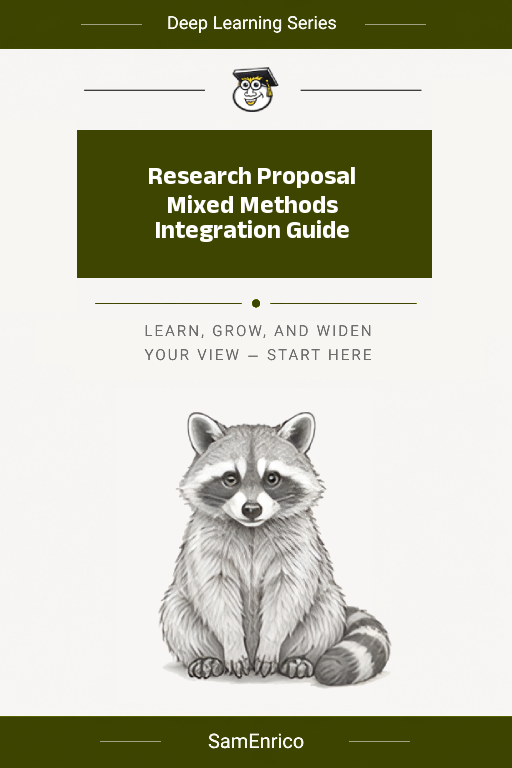
researchStudent's ShortcutMixed Methods
Research Proposal Mixed Methods Integration Guide eBook
Combine qualitative and quantitative components wi
Combine qualitative and quantitative components with clear integration points and meta inference strategies.
Formats
Free sample
Chapter 1: The Integration Imperative--The most expensive mistake in academic research is not a failed hypothesis or a null finding. It is the quiet, unacknowledged waste that occurs when a researcher collects qualitative interviews and quantitative surveys, analyzes them separately, writes them up in adjacent chapters, and calls the result “mixed methods.” This book exists because that mistake has become standard practice. Doctoral committees approve it. Grant reviewers overlook it. Journals publish it.
And yet, from a methodological standpoint, collecting two kinds of data without a deliberate, transparent mechanism for making them speak to one another is not mixed methods at all. It is multimethod research dressed in borrowed clothing. The difference is not semantic. It is the difference between a sum and a synthesis, between description and discovery, between a proposal that merely ticks a box and one that transforms how we understand a problem.If you are reading this book, you have likely already committed to using mixed methods in your dissertation or grant proposal. You may have taken a course, read a textbook, or heard a advisor say that mixed methods is “powerful” or “cutting‑edge.” But somewhere between that initial enthusiasm and the blank page of your proposal, you may have encountered a troubling question: How exactly do I make these two things work together?
The textbooks tell you what mixed methods is. They give you typologies and diagrams and philosophical justifications. What they rarely give you is a builder’s blueprint for integration—the specific, actionable steps for designing a study where the qualitative and quantitative strands are not merely concurrent but conversational, not merely sequential but synergistic.This chapter is the foundation upon which the entire book rests. It does three things. First, it draws a clear and consequential line between multimethod research (doing two things separately) and truly mixed methods research (creating a whole greater than the sum of its parts).
Second, it introduces the concept of yield—the unique insights that emerge only from the interface between qualitative and quantitative data—and its unhappy opposite, research waste. Third, it provides a practical framework for rewriting the most common section of any proposal, the “deficiency statement” in the literature review, so that it justifies integration rather than merely acknowledging a gap in existing studies. By the end of this chapter, you will never again confuse collecting two types of data with integrating them. And you will have the vocabulary and the tools to convince reviewers that your proposal does something genuinely new.The Multimethod Mistake: Why Two Studies Do Not Equal One Mixed Study Let us begin with a thought experiment. Imagine a researcher studying the relationship between workplace flexibility and employee burnout.
She designs a survey with validated measures of flexibility (the ability to set one’s own hours, work from home, etc.) and burnout (emotional exhaustion, depersonalization, reduced accomplishment). She distributes this survey to five hundred employees across three organizations. She runs regression analyses and finds that higher flexibility predicts lower burnout, with an effect size that is modest but statistically significant. Separately, she conducts semi‑structured interviews with twenty employees, asking about their experiences of workload, control, and recovery. She analyzes these interviews using thematic analysis and identifies four major themes: boundary blurring, guilt about non‑work hours, supervisor expectations, and the psychological safety to disconnect.Now, has she conducted mixed methods research?
Most novice researchers would say yes. She has quantitative data and qualitative data. She has numbers and stories. She has breadth and depth. But here is the methodological truth: unless she has a deliberate plan to bring these two datasets into conversation, she has done two independent studies and stapled them together.
She has not integrated them. The quantitative analysis could stand alone as a perfectly adequate paper on flexibility and burnout. The qualitative analysis could stand alone as a perfectly adequate paper on the phenomenology of remote work. Their coexistence in the same dissertation does not automatically create a third, more powerful form of understanding.This is the multimethod mistake. It is extraordinarily common.
In fact, a systematic review of mixed methods dissertations in the social sciences found that nearly forty percent failed to demonstrate any meaningful integration between strands (Bryman, 2007; Fetters et al., 2024). These dissertations passed their defenses. Their authors became doctors. But their work did not realize the promise of mixed methods. And their proposals, critically, did not convince reviewers that integration was necessary in the first place.What distinguishes multimethod from truly mixed methods is not the presence of two types of data.
It is the presence of a design that specifies how and where the strands will interact. In a truly mixed methods study, the qualitative questions are derived from the quantitative findings, or the quantitative instrument is built from qualitative themes, or the two strands are collected simultaneously with a joint display planned from the outset. The integration point is not an afterthought. It is the organizing principle of the entire study.Consider what our hypothetical researcher could have done differently. Instead of separate analyses, she could have designed the study as an explanatory sequential design: first collect the survey data, then use the results to purposefully sample interview participants—not randomly, but based on their scores.
She could have interviewed employees who scored high on flexibility but also high on burnout (the “disconfirming” cases) and employees who scored low on flexibility but low on burnout (the “unexpected successes”). She could have used the interview data to explain why the statistical relationship was only modest. She could have built a joint display where each quantitative finding is paired with qualitative evidence that confirms, complicates, or contradicts it. That is integration. And that is what this book teaches.Yield: The Unique Insight That Only Integration Can Produce If the multimethod mistake is what we want to avoid, the concept of yield is what we want to maximize.
Yield, in the mixed methods literature, refers to the insights that become visible only when qualitative and quantitative data are brought into dialogue (Venkatesh et al., 2023). These insights are not available to either strand alone. They are emergent properties of the interface between them.To understand yield, consider a simple example from health research. A randomized controlled trial of a school‑based mental health intervention finds no statistically significant effect on depression scores. A qualitative study of the same intervention, conducted separately, finds that students and teachers unanimously report positive changes in emotional regulation and classroom climate.
Are these findings contradictory? From a multimethod perspective, yes—and the researcher might conclude that the intervention failed. But from an integrative perspective, the discord is itself a finding. The quantitative measure (a standardized depression inventory) may be insensitive to the specific ways this intervention worked. The qualitative data reveal that students felt noticed by adults for the first time, which did not immediately reduce depression scores but may be a precursor to longer‑term change.
The yield is a new understanding: the intervention produced proximal relational outcomes that were not captured by the distal clinical measure. That insight could not have emerged from the quantitative data alone (which showed nothing) or the qualitative data alone (which showed only…
This is the end of the free sample. Get the eBook to keep going. Buy now
About this book
Details
- Author
- Granger Daysi
- Publisher
- SamEnrico
- Language
- English
- Genre
- research, Student's Shortcut, Mixed Methods
- Released
- 2026-05-30
- Pages (approx.)
- 160
- Available as
- eBook, Audiobook

Read better in the ZLOADR app
Your eBooks on your phone or tablet. Sign in with your SamEnrico account and start reading.
More by Granger Daysi
 The Real Killer Still FreeGranger Daysi$11.99
 Reconstruction of Cult HomicidesGranger Daysi$11.99
 Bedwetting and Dream ConnectionGranger Daysi$11.99
 Primary Insurance Amount GuideGranger Daysi$11.99
 Peg System For PharmacologyGranger Daysi$11.99
 Partition Of India 1947Granger Daysi$11.99
 Dream Journaling for CreativityGranger Daysi$11.99
 Pomodoro for Police OfficersGranger Daysi$11.99
 The Vanishing of the Last Viking KingGranger Daysi$11.99
 The Magic Realism Revolution: Gabriel García Márquez and Europe's Literary Awakening (1980-2000)Granger Daysi$11.99
 Currants: Red, Black & WhiteGranger Daysi$11.99
 How to Produce a Potato PlanterGranger Daysi$11.99
You may also like
 Scientific Research On TM GuideMartens Nathanial$11.99
 Research Proposal Methodology Section MasteryPauley Debroah$11.99
 Research Proposal Appendix CompilationRaines Tyisha$11.99
 Academic Researcher Distraction GuideFord Virgil$11.99
 TM Research and ScienceCovert Nicki$11.99
 Social Anxiety Research ReviewRoberge Cole$11.99
 Research Proposal Significance Section GuideBock Tory$12.99
 Research Proposal Reviewer PsychologyLugo Tawanda$11.99
 Research Proposal Research Questions DesignLara Robbi$11.99
 Research Proposal References and CitationsPatten Shanice$11.99
 Research Proposal Mixed Methods DesignCameron Omega$11.99
 Research Proposal Data Management PlanAnderson Roberto$12.99