
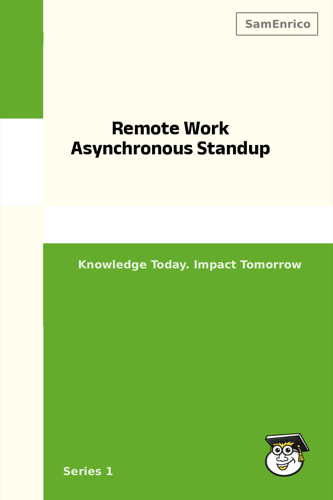
Remote Work Asynchronous Standup eBook
Replace live meetings with written status updates
by Fultz Amie
Replace live meetings with written status updates everyone reads on their own time.
Formats
Free sample
Chapter 1: The Hundred Million Dollar Habit--–- It was 10:02 AM on a Tuesday when Sarah, a senior product manager at a mid-sized Saa S company, realized she had spent fourteen hours that week listening to people talk about what they were going to do, rather than actually doing it. The daily standup had just ended—fifteen minutes of rapid-fire updates, interrupted by two dropped connections, one accidental cat filter, and a lengthy digression about a bug that only affected three users. As she closed her laptop, Sarah calculated something she had never calculated before. Her team of twelve people, each earning an average of $65 per hour including benefits, had just burned $195 in salary on that single meeting. Multiply that by five days a week, fifty weeks a year, and her team alone was spending nearly $49,000 annually on the morning standup.
Not on work. Not on problem-solving. On standing in a virtual circle and announcing, "Yesterday I worked on the login flow. Today I will continue working on the login flow. No blockers."Sarah's story is not unusual.
It is, in fact, the most ordinary business ritual of the twenty-first century. The daily standup—imported from agile software development and now practiced in marketing departments, law firms, hospitals, and even some manufacturing floors—has become the default answer to the question, "How do we keep remote teams aligned?" But like many defaults, it was never designed for the context in which it now operates. The standup was invented in the 1990s by a small team of software developers sitting in the same room, standing in front of a physical whiteboard, for no more than five minutes. Today, it is a thirty-minute video call (fifteen if the team is disciplined) involving people scattered across six time zones, staring at their own faces, waiting for their turn to speak. The ritual has outlived its utility.
And it is costing you far more than you think.This book is built on a simple, provocative claim: the daily live standup meeting should be replaced entirely by a written, asynchronous status update that everyone reads on their own time. Not supplemented. Not shortened. Not moved to every other day. Replaced.
The evidence for this claim comes from three converging sources. First, a growing body of management research demonstrating that synchronous meetings are the single biggest destroyer of deep work in the modern organization. Second, the lived experience of high-performing remote teams at companies like Git Lab, Zapier, and Automattic, who abandoned daily standups years ago and never looked back. And third, a simple economic calculation that any CFO would recognize as common sense: if a meeting does not produce a permanent, searchable record of decisions, it is not a meeting—it is a recurring tax on attention.But before we can convince you to cancel that 10:00 AM recurring invite, we need to understand the true cost of the habit. Not just the obvious cost in salary dollars, but the hidden costs: the interruption of flow state, the extrovert bias that silences quieter voices, the documentation deficit that leaves no trace of what was actually discussed, and the psychological toll of performing "engagement" for a grid of faces.
This chapter is an autopsy of the live standup. We will examine its origins, its hidden economics, and the myths that keep it alive. By the end, you will see the daily standup not as a harmless ritual, but as an expensive addiction—one you are ready to quit.The Origin Story of a Ritual The daily standup was never meant to be a meeting. Not really. It was invented as part of Extreme Programming (XP) in the late 1990s by software developers who were tired of status reports.
The original format, as described by Kent Beck in Extreme Programming Explained, was brutally simple: the team stands in a circle, each person answers three questions—What did you do yesterday? What will you do today? What is in your way?—and the entire ceremony takes less than five minutes. The standing posture was intentional: it created mild physical discomfort, discouraging anyone from launching into a long monologue or a side conversation. The whiteboard was the source of truth; the verbal updates were just a quick sync.Notice what the original standup did not have.
It did not have a video screen. It did not have participants joining from home offices, coffee shops, or different continents. It did not have a chat sidebar generating parallel conversations. And crucially, it did not have a project management tool that already answered the first two questions. In 1999, if you wanted to know what a colleague worked on yesterday, you had to ask them.
Today, that information lives in Jira, Asana, Trello, Click Up, or any of the two dozen task trackers that have become standard equipment for knowledge work. The daily standup has become a meeting where everyone recites information that is already visible in a shared database. The team is not syncing. They are performing.How did this happen? The agile movement scaled.
As software development methodologies spread from engineering to the entire organization, the standup came with it. Marketing teams adopted agile. HR departments adopted agile. Law firms adopted "agile legal." In each case, the standup was imported as a package deal—if you want to be agile, you must stand in a circle every morning and answer the three questions. But the original context was lost.
The physical circle became a Zoom grid. The standing discomfort became the discomfort of staring at your own face for thirty minutes. And the five-minute sync became a thirty-minute ritual of turn-taking, interrupted by "sorry, you were breaking up" and "can you share your screen?"The result is a meeting that serves neither the purpose of coordination nor the purpose of documentation. It is too fast for deep problem-solving and too slow for efficient status updates. It is too public for sensitive conversations and too private for anyone who was not invited.
It is, in the words of one frustrated engineering director I interviewed, "the worst of both worlds—all the interruption of a meeting with none of the record of an email."The Economic Calculation You Have Been Avoiding Let us talk about money. Not because money is the only measure of value, but because money is the measure that managers cannot ignore. The cost of a live standup is not theoretical. It is a line item on your profit and loss statement, hiding in plain sight under "salaries and wages."Consider a conservative scenario. A team of ten people, each earning an average of $50 per hour including benefits and overhead.
They hold a daily standup that actually takes fifteen minutes—not the inflated thirty minutes of the worst cases, but a disciplined, on-time, no-digression fifteen minutes. That meeting costs $125 per day in salary. Over fifty working weeks, that is $31,250 per year for a single team. For a company with twenty such teams, the annual cost exceeds $600,000. For a large enterprise with five hundred teams, the cost exceeds $15 million per year.
And that is the disciplined version.Now consider the real world. According to a 2022 study of three million workers conducted by the…
This is the end of the free sample. Get the eBook to keep going. Buy now
About this book
Details
- Author
- Fultz Amie
- Publisher
- SamEnrico
- Language
- English
- Genre
- Non-Fiction, Self-Help, Async, Standup
- Released
- 2026-06-09
- Pages (approx.)
- 134
- Available as
- eBook, Audiobook

Read better in the ZLOADR app
Your eBooks on your phone or tablet. Sign in with your SamEnrico account and start reading.
More by Fultz Amie
 Demand Forecasting ModelsFultz Amie$11.99
 Flow State for SalespeopleFultz Amie$11.99
 Gambling Addiction Self Exclusion LawsFultz Amie$11.99
 The Lyre and the Laurel: The Ancient Greek Football Rivalry That Shaped CivilizationFultz Amie$11.99
 New Account RepresentativeFultz Amie$11.99
 How to Start a Boxed Stationery Business (Beginners Guide)Fultz Amie$11.99
 Press Release Distribution GuideFultz Amie$12.99
 Learn to Play the Rudra VinaFultz Amie$11.99