
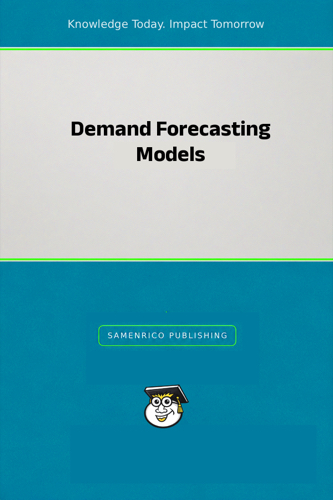
Demand Forecasting Models
Apply time series and causal methods to predict fu
by Fultz Amie
Apply time series and causal methods to predict future demand accurately.
Formats
About this book
Free sample
Chapter 1: The Million-Dollar Question--The warehouse manager’s voice was tight on the phone call. “We have forty thousand units of Christmas decorations arriving tomorrow. It’s January fifteenth.”The silence on the other end of the line was the silence of someone doing rapid mental math. Forty thousand units. Retail price: fifteen dollars each.
Six hundred thousand dollars of inventory arriving six weeks too late. The decorations would sit in a warehouse until November, accumulating carrying costs, then sell at fifty percent discount—if they sold at all.“How did this happen?” the regional director finally asked.“The forecast,” the warehouse manager said. “Someone forecasted a December surge. It didn’t come. So the system ordered for January.
The surge came in January instead. So now we have Christmas in January.”The director sighed. “Whose forecast was it?”“Everyone’s,” the manager said. “And no one’s. The statistical model predicted one thing.
Sales overrode it with another. Finance adjusted it down. By the time it hit procurement, nobody remembered where the number came from. But the system ordered the inventory anyway.”This story is not apocryphal. It happens every day in companies of every size, from family-owned distributors to Fortune 500 retailers.
The specific numbers change. The fundamental pattern does not. Someone makes a forecast. Someone else changes it. The supply chain executes against the changed number.
And months later, when the inventory arrives at the wrong time, in the wrong quantity, or for the wrong product, everyone points at everyone else.The problem is rarely bad math. The problem is a profound misunderstanding of what forecasting is, what it can do, and—most critically—what it cannot do.The Great Misunderstanding Ask ten business executives what forecasting is, and nine will give you the same answer: “Predicting the future.” The tenth might add “accurately.” This definition is simple, intuitive, and almost completely wrong.Forecasting is not predicting the future. Forecasting is quantifying uncertainty about the future to make better decisions today.This distinction is not semantic. It is the difference between success and failure, between six hundred thousand dollars of January Christmas decorations and a…
This is the end of the free sample. Get the eBook to keep going. Buy now
Contents
- Chapter 1
- Chapter 2
- Chapter 3
- Chapter 4
- Chapter 5
- Chapter 6
- Chapter 7
- Chapter 8
- Chapter 9
- Chapter 10
- Chapter 11
- Chapter 12
Details
- Author
- Fultz Amie
- Publisher
- SamEnrico
- Language
- English
- Genre
- Non-Fiction, Business Brief, Predictive Analytics
- Released
- 2026-06-08
- Pages (approx.)
- 135
- Available as
- eBook, Audiobook

Read better in the ZLOADR app
Your eBooks on your phone or tablet. Sign in with your SamEnrico account and start reading.
More by Fultz Amie
 Remote Work Asynchronous StandupFultz Amie$11.99
 Flow State for SalespeopleFultz Amie$11.99
 Gambling Addiction Self Exclusion LawsFultz Amie$11.99
 The Lyre and the Laurel: The Ancient Greek Football Rivalry That Shaped CivilizationFultz Amie$11.99
 New Account RepresentativeFultz Amie$11.99
 How to Start a Boxed Stationery Business (Beginners Guide)Fultz Amie$11.99
 Press Release Distribution GuideFultz Amie$12.99
 Learn to Play the Rudra VinaFultz Amie$11.99