
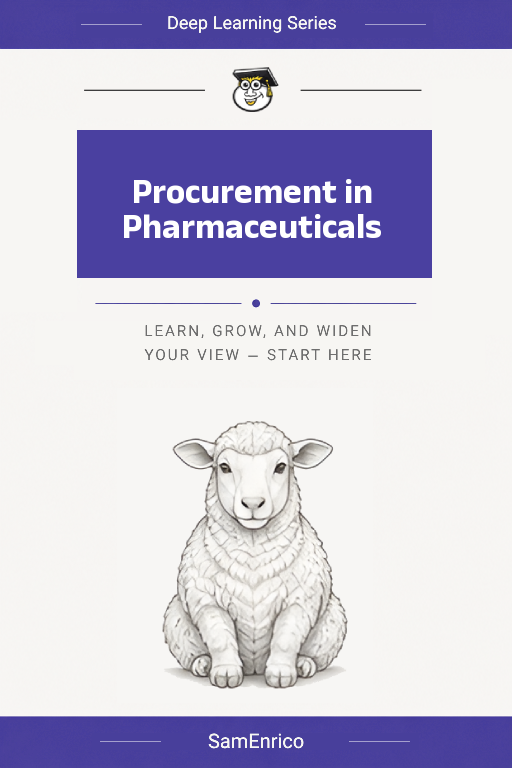
Non-FictionOperational Efficiency ManualPharma
Procurement in Pharmaceuticals
Navigate pharma procurement including raw material
by Bolt Rashad
Navigate pharma procurement including raw materials, lab equipment, and cold chain logistics.
Formats
About this book
Free sample
Chapter 1: The Pharma Paradox--Every procurement manager remembers the phone call that changes everything.For Maria Chen, it came at 11:47 PM on a Tuesday. The night shift supervisor at her company’s fill-finish facility had just completed a routine in-process check. The results: out-of-specification. The raw material—a seemingly innocuous excipient purchased for 18,000becauseitwas4018,000 because it was 40% cheaper than the incumbent supplier’s—had just failed. The batch, valued at 18,000becauseitwas404.2 million, was now on hold.
The production line was idle. And within seventy-two hours, Maria would discover that the “cheaper” raw material would cost her company over $11 million in direct losses, regulatory reporting fees, expedited freight for replacement material, and a customer penalty for delayed delivery.This is the Pharma Paradox: in pharmaceutical procurement, the cheapest option is almost always the most expensive.The Illusion of Savings The pharmaceutical industry operates under a fundamental misunderstanding that has persisted for decades. Procurement professionals, measured on cost reduction targets, chase lower unit prices. Finance departments celebrate supplier negotiations that shave 2% off raw material costs. And executives reward purchasing teams for delivering “savings” that appear on spreadsheets but never materialize in actual financial performance.The problem is that pharmaceutical manufacturing is not assembling furniture or packaging consumer goods.
When a tablet disintegrates too quickly or a biologic denatures, the root cause is rarely the active ingredient. More often, it is the excipient, the solvent, the packaging component, or the raw material that someone bought because it was cheaper.Consider the anatomy of a typical pharmaceutical deviation. A manufacturer receives a shipment of magnesium stearate—a common lubricant used in tablet compression. The Certificate of Analysis looks acceptable. The price was competitive.
But during production, tablets begin sticking to the punches. The line stops. Investigation reveals that the magnesium stearate’s particle size distribution falls outside the validated range, despite the Co A showing acceptable averages. The supplier used a different milling process, changed without notification. The result: three weeks of production lost, 2.1 million tablets rejected, and a regulatory filing for a manufacturing deviation.The “savings” on that purchase?
4,200.Theactualcost?4,200. The actual cost? 4,200.Theactualcost?1.7 million.This chapter dismantles the illusion that low purchase price equals low total cost. It introduces…
This is the end of the free sample. Get the eBook to keep going. Buy now
Contents
- Chapter 1
- Chapter 2
- Chapter 3
- Chapter 4
- Chapter 5
- Chapter 6
- Chapter 7
- Chapter 8
- Chapter 9
- Chapter 10
- Chapter 11
- Chapter 12
Details
- Author
- Bolt Rashad
- Publisher
- SamEnrico
- Language
- English
- Genre
- Non-Fiction, Operational Efficiency Manual, Pharma
- Released
- 2026-05-30
- Pages (approx.)
- 143
- Available as
- eBook, Audiobook

Read better in the ZLOADR app
Your eBooks on your phone or tablet. Sign in with your SamEnrico account and start reading.
More by Bolt Rashad
 Emotional Eating and Diet CultureBolt Rashad$11.99
 Herniated Disc MeditationBolt Rashad$11.99
 Hypnotic Competition SimulationBolt Rashad$11.99
 The Active ListenerBolt Rashad$11.99
 Airline Pilot Stress ManagementBolt Rashad$11.99
 The Miracle on Ice: The Untold OvertimeBolt Rashad$11.99
 The Bridge That Time Forgot: The Mysterious Collapse of the Roman Pont du GardBolt Rashad$11.99
 Understanding Factor Vii DeficiencyBolt Rashad$17.99
 Data Presentation Cheat Sheet for AnalystsBolt Rashad$12.99
 How to Start a Cyclic Hydrocarbons (saturated and Unsaturated) Business (Beginners Guide)Bolt Rashad$11.99
 Pet Grooming (Basic Certification)Bolt Rashad$11.99
You may also like
 Hong Kong Handover 1997Dunn Johnnie$11.99
 Zumba For Postnatal Recovery CourseNeal Christian$11.99
 Zumba for BeginnersLadner Nikia$11.99
 YouTube Comment Mining GuideHumes Pandora$12.99
 Worry Box MeditationCarlin Rudy$11.99
 Workplace Stress MeditationNguyen Lynn$11.99
 Workplace Stress and Sleep RepairHawley Ivory$11.99
 Workplace Perfectionism CureDelaney Jeffry$11.99
 Workplace Injustice Anger GuideWallen Isabelle$11.99
 Work Addiction and Burnout LinkGreenwood Ester$11.99
 Women in Yoga and WellnessBeattie Galina$11.99
 Women in Stand Up ComedyChun Evangeline$11.99